
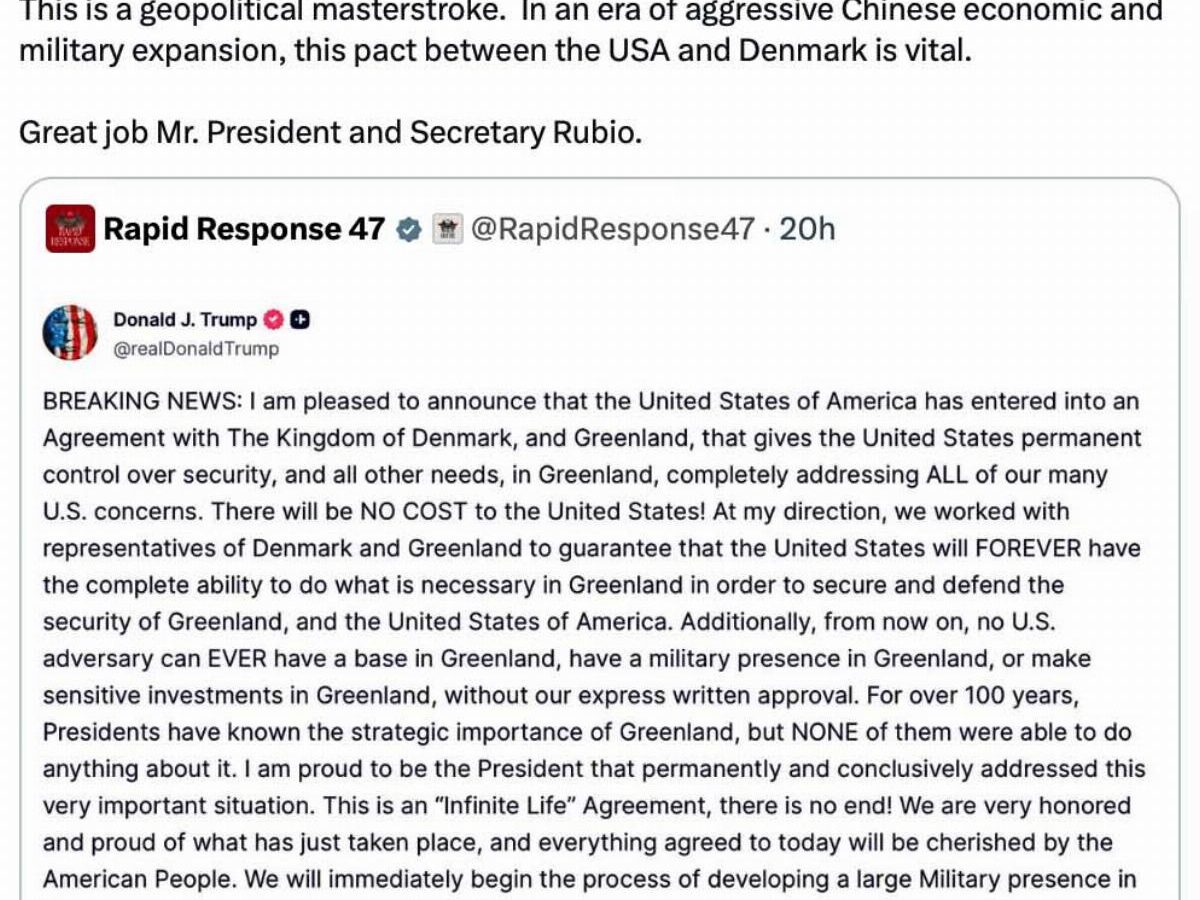
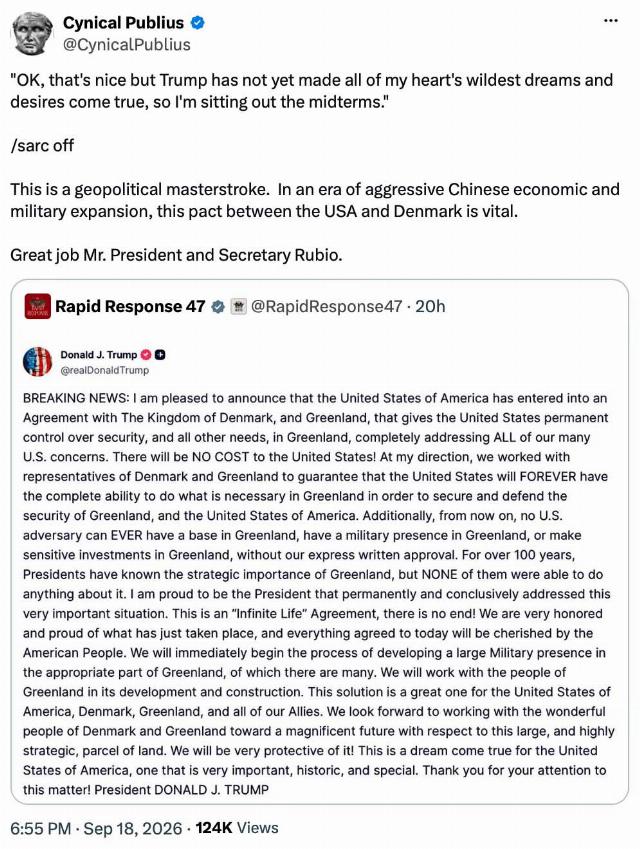
President Trump’s newly concluded agreement with Greenland and Denmark hands the United States a permanent military foothold on the island, veto power over certain foreign military and investment activity, and unrestricted movement for American troops and equipment across Greenland’s territory — a package that, according to a blogger at American Thinker, Democrats and their media allies have chosen to ignore rather than acknowledge.
Writing for American Thinker, Mike McDaniel frames the deal as the latest in a series of national security wins — the sealing of the southern border, the foiling of Iran’s nuclear and terrorist ambitions, and now Greenland — that he says are being suppressed or ridiculed by the political left. “Why do Democrats want America to be an insecure failure?” McDaniel asks at the top of his piece, a question that sets the combative tone for the rest of the argument.
What the agreement actually does
McDaniel relies on a summary published by John Hinderaker at Powerline to lay out the contours of the deal. According to that summary, the United States has secured a permanent military foothold that even an independent Greenland would inherit regardless of its own preferences. Washington also reportedly holds veto power over any non-NATO military presence in Greenland, as well as over who can invest in the island’s strategic infrastructure and resources outside of NATO and EU channels.
The participating Danish authorities, in this account, signed away their say over the principle of new US bases, retaining only the right to discuss implementation details. The same reading holds that Danish authorities no longer set the rules for US military movement across the island. And the whole arrangement, McDaniel notes, is now justified by the defense of “the American continent.”
McDaniel argues that Denmark understood it could not effectively defend Greenland on its own — let alone repel a US or other adversarial incursion — despite what he characterizes as Danish protestations and threats to place troops on the island to fend off an American invasion he says was never coming.
Broader access than the 1951 framework
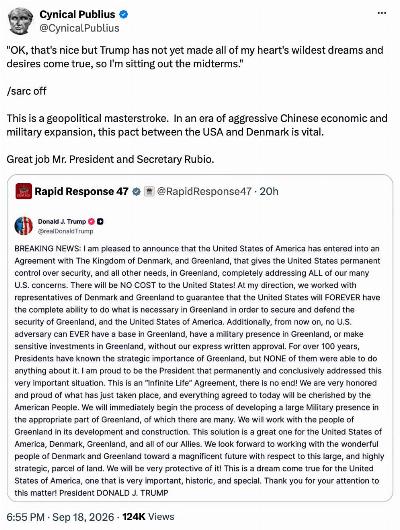
Compared with the 1951 defense agreement that previously governed US military activity in Greenland, McDaniel describes the new pact as a significant expansion. Under the terms he cites, the United States can build two additional bases, with more as necessary, and troops and equipment are already on the way.
The agreement also grants what McDaniel calls unlimited access, quoting language stating that “the United States of America shall enjoy… the right of free access to and movement between the Defense Areas through Greenland, including the Territorial Waters, by land, air and sea.” That formulation, he notes, covers movement by land, air, and sea — including on the water and by submarine — which the earlier agreement did not permit.
McDaniel further highlights that the old 1951 agreement existed solely “for the benefit of the North Atlantic Treaty Organization,” whereas the new one lists the defense of “the American continent” as an objective. As he describes it, the text celebrates “the irreplaceable role” of the US military and “the United States’ indispensable historical and ongoing contributions to the security and defense of Greenland,” and names the establishment of Trump’s “Golden Dome” missile defense system as a key goal of the arrangement.
Sovereignty in name, American interests in practice
McDaniel concedes that the preamble of the agreement affirms Danish sovereignty. But he argues the document is focused on American interests rather than NATO’s, working in concert with protecting Greenland and Danish interests — interests, he adds, that Denmark lacks the military might to enforce on its own. In his rendering, Denmark retains ostensible sovereignty while the United States can “go anywhere and do pretty much anything,” with Greenland and Denmark benefiting from American investment and the economic growth and prosperity that a US presence brings.
The writer’s central claim is that Trump and Secretary of State Marco Rubio obtained everything Washington wants and needs — objectives, he says, that every president for more than a century acknowledged and claimed to want, but did little or nothing to secure. He insists Greenland and Denmark stand to gain substantially as well.
‘Red-faced with rage’ and then silence
The political reaction is where McDaniel’s argument turns sharpest. He contends that Democrats and their “media propagandists” were initially “red-faced with rage” over the agreement and dealt with it by misrepresenting its contents — but then, upon the deal’s full publication, largely went quiet. Congressional Republicans, he adds with evident frustration, have mostly done the same, failing to tout what he considers a momentous accomplishment.
McDaniel’s framing positions the Greenland agreement within a broader critique of what he calls a “Bizarro World reality,” in which, as he sees it, every Trump effort to secure the country or protect Americans from crime is ignored, attacked, or underappreciated. He singles out the closed border — which he notes was supposed to be impossible without comprehensive immigration reform, yet happened virtually overnight — as a parallel case.
Looking ahead, McDaniel predicts that future Democratic administrations will “squander this historic accomplishment.” For now, he writes, it belongs on a growing list of achievements that, in his assessment, make America and the world safer.
A deal whose political afterlife is still unfolding
The essay is unmistakably an opinion piece, and it leans heavily on the Powerline summary for its factual scaffolding rather than presenting independent reporting. That said, the specifics it cites — permanent basing rights, veto authority over non-NATO military presence and strategic investment, unrestricted movement across Greenland by land, air, and sea, and the shift in stated purpose from NATO benefit to defense of the American continent — are the substance of the debate the agreement has touched off.
McDaniel’s piece is less a news account than a rallying argument: that the deal is real, that its terms exceed anything the 1951 framework provided, and that its opponents have run out of things to say about it. Whether the silence he describes reflects concession, exhaustion, or simple indifference, his column makes clear he believes the agreement deserves far more attention from supporters and critics alike than it has received so far.
Source: www.americanthinker.com — https://www.americanthinker.com/blog/2026/10/trump-s-greenland-deal-has-provoked-a-tds-pandemic/