
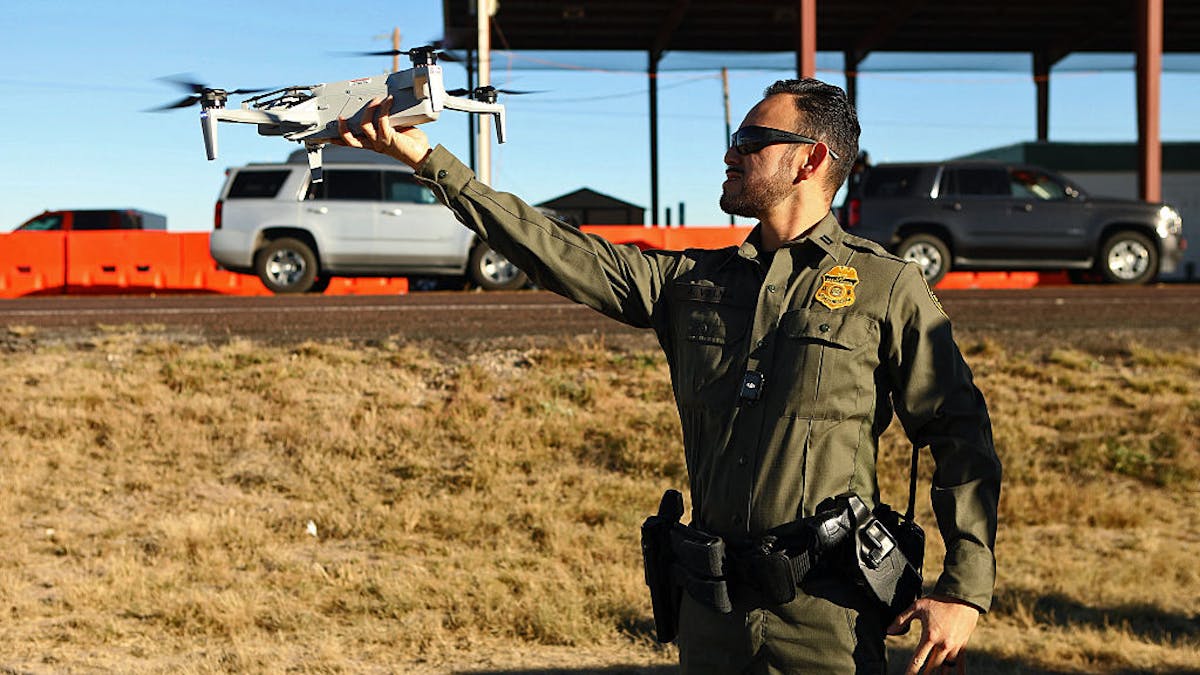
Drone activity along the U.S.-Mexico border in Texas’ Rio Grande Valley has plummeted roughly 75% since the U.S. military deployed a new laser weapons system, military officials told CBS News. The technology, mounted on military vehicles and operated with Xbox-style controllers, is giving troops a decisive edge against a growing cartel threat.
Army Col. Robert Felicio, commander of the 130th Maneuver Enhancement Brigade deployed to the border, said the laser has had a “significant” impact on drone activity. The system first went into action on August 25 and 26, when U.S. forces shot down three drones, according to CBS News.
Since January, American troops have intercepted 300 drones believed to be tied to Mexican cartels, with the laser taking out 11 of those over a 10-day stretch, the outlet reported. Officials caution that part of the drop in incursions may stem from cartels shifting to new smuggling routes, but they credit the laser with a major role.

From Jamming to Destroying
Before the laser arrived, the military relied on jamming drones and sending them back into Mexico — a tactic that offered only temporary relief. The new weapon changes the calculus, allowing troops to permanently disable hostile drones.
“When you just send it back and then it comes back up or is defeated temporarily, but the game changer is ensuring that that tool can’t be used again against you,” Felicio told CBS.
The laser systems are bolted onto military vehicles and operated by soldiers who watch camera footage on a tablet while using Xbox controllers to aim and fire, according to CBS. Army Lt. Owen Farquer, an operator, said troops who grew up playing video games find the controllers intuitive. When the laser fires, a brief flash of light appears before the drone drops out of the sky, CBS reported.

Cartels’ Drone Assassinations
The threat is not hypothetical. Inside Mexico, cartels have used drones for assassinations, with 221 such attacks recorded between 2021 and 2025, killing 77 people, according to a report from the National Counterterrorism Innovation, Technology, and Education Center (NCITE).
The new laser capability has strained cartel operations and hit their finances hard, said Army Lt. Col. Ray Richards, commander of the 211th Military Police Battalion from the Massachusetts National Guard, which is also deployed to the border.
“When you think of 75% reduction of that capability and how that spreads based on X amount of dollars are tied to that — I think when you talk about disruption to the cartels, that is a huge part of that story,” Richards told CBS.

Initial Mishaps and FAA Coordination
The rollout has not been without complications. During the laser’s first use, the military accidentally shot down a Customs and Border Protection (CBP) drone near El Paso, Texas, prompting the Federal Aviation Administration (FAA) to close the airspace, CBS reported. Two weeks earlier, all air traffic over El Paso had been shut down after federal authorities failed to coordinate with the FAA.
Since those incidents, the military has tightened coordination with the FAA on its use of the anti-drone technology, according to CBS.
Contract Awarded to AeroVironment
The laser system stems from a landmark $465 million contract awarded by the Army to AeroVironment for high-energy lasers — the first-of-its-kind deal, CBS reported. That investment appears to be paying off, as officials point to the laser as a game-changer in border security and the broader fight against cartel drone threats.
The dramatic reduction in drone activity in the Rio Grande Valley comes amid record-low illegal immigration, but cartels have found new ways to menace the United States through uncrewed aerial vehicles. With the laser now operational, U.S. troops have a new tool to ensure those drones cannot be used again — a capability that military leaders call critical to disrupting cartel operations.
Source: www.dailywire.com — https://www.dailywire.com/news/how-the-u-s-is-using-a-laser-weapon-to-take-out-the-latest-cartel-threat