
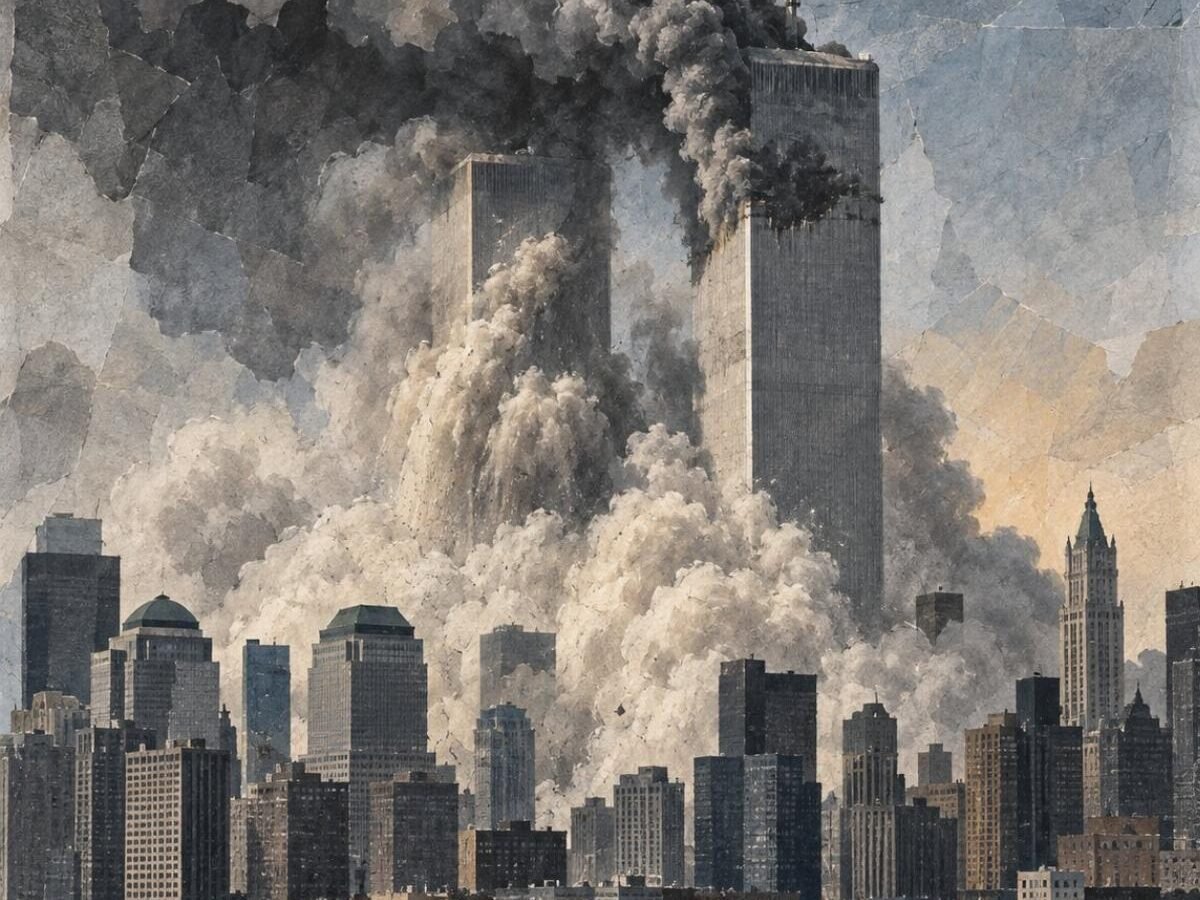
Twenty-five years on, the September 11 anniversary still arrives with a strange double weight for those who lived it up close: the public grief that belongs to the whole country, and the private grief that belongs to a single family. In a reflection published by American Thinker, writer Greg Maresca — a New York native — refuses to keep the two apart.
For Maresca, the World Trade Center was never the abstract name in the history books. It was the Twin Towers, and they belonged to his childhood. He recalls watching them climb skyward behind a burnt-orange iron inner façade, at a time when New York felt endless and everything seemed built to last.
The Skyline He Watched Grow Up
He sets the towers against the city’s earlier monument: the Empire State Building, finished in 1931, which ruled the skyline as the world’s tallest building for four decades. It took until 1973 for the Twin Towers to redefine Manhattan. A friend’s father worked on the construction, and Maresca remembers the man handing out hard hats stamped with the towers’ logo to the neighborhood boys.
The Empire State Building, in his telling, stood for the city’s early ambition. The towers were something else — a contemporary stretch. They weren’t only modern architecture; they were identity. They were permanence.
And then, on a single morning, they were gone.
Two and a half decades later, the Fire Department of New York still carries the towers in its culture and iconography, Maresca writes. They appear on FDNY EMS patches and station-house logos across all five boroughs — a mark of how tightly the department’s identity remains bound to that day.
A Column He Nearly Didn’t Write
Maresca admits he hesitated. He decided at the last minute to write the piece “for posterity’s sake” — because the day he was trying to memorialize collided with something else in his own life. As he sat down to reflect on 9/11, his mother was dying of cancer. She passed shortly afterward.
He doubts the anniversary registered with her in her illness, though he notes one connection he holds onto: the closest his mother ever came to an airplane was lunch with her girlfriends at Windows on the World, the restaurant atop the North Tower. She was, he writes, one Brooklyn gal who never once asked for a window seat.
That is the thread Maresca pulls hardest. There are moments, he says, when history doesn’t merely happen around us — it enters the house and parks itself at the head of the table. September 11, 2001, was for him not only the month America lost its sense of invulnerability, but also the moment he lost the most influential woman in his life.
The Hospice Room and the Whole Country
It’s a parallel he sees repeating right now. His wife is living through the same collision of timelines: her mother died last month.
Terminal illness, he observes, reduces life to hospice care, whispered updates, and the endless tick of time — and then September 11, 2001 arrived and pulled the entire country into that same hospice room. Separating the national wound from the personal one, he suggests, is nearly impossible. Everyone mourned the 2,977 victims. He was also mourning his mother, watching a disease teach him the same lesson the attacks did: life can change without permission and without warning.
His conclusion resists the easy closure that anniversary writing often reaches for. We learn to live around our losses, he writes, but we never outgrow them. The towers and his mother together marked the end of one world and the beginning of another — the place where innocence was lost, memory became sacred, and nothing built by human hands or held by the human heart could ever again be mistaken for indestructible.
The essay closes with a turn to the present, tying the act of remembrance to the act of speech: the ability to speak one’s mind, Maresca argues, matters more than ever to the republic.
Why This Kind of Memory Still Matters
Anniversary pieces tend to fall into a few familiar shapes — the policy retrospective, the security audit, the pledge of vigilance. Maresca’s is none of those. It is the kind of writing that argues the 9/11 memory is best kept not in a museum case but in a body: in a childhood spent watching steel rise, in a hard hat with a logo on the front, in a restaurant at the top of the North Tower where a Brooklyn woman took her girlfriends for lunch.
That approach has its vulnerabilities. Personal grief can blur into sentiment, and a single writer’s loss is not the country’s loss. Maresca doesn’t claim otherwise — he holds them side by side, insisting that the overlap is the point. For a generation of New Yorkers and Americans who lost someone in the same season as the attacks, or who simply grew up in the towers’ shadow, the refusal to separate the two may ring truer than any of the more polished commemorations.
What remains is a modest claim, offered 25 years later by a man who watched the skyline go up as a boy and then watched it come down as a columnist: the structures are gone, the 2,977 are gone, and the people who loved them are not done mourning. We live around them. We don’t outgrow them.
Published in American Thinker’s foreign policy and 9/11 section, the piece is dated September 11, 2026.
Source: www.americanthinker.com — https://www.americanthinker.com/blog/2026/09/shadows-from-9-11/