
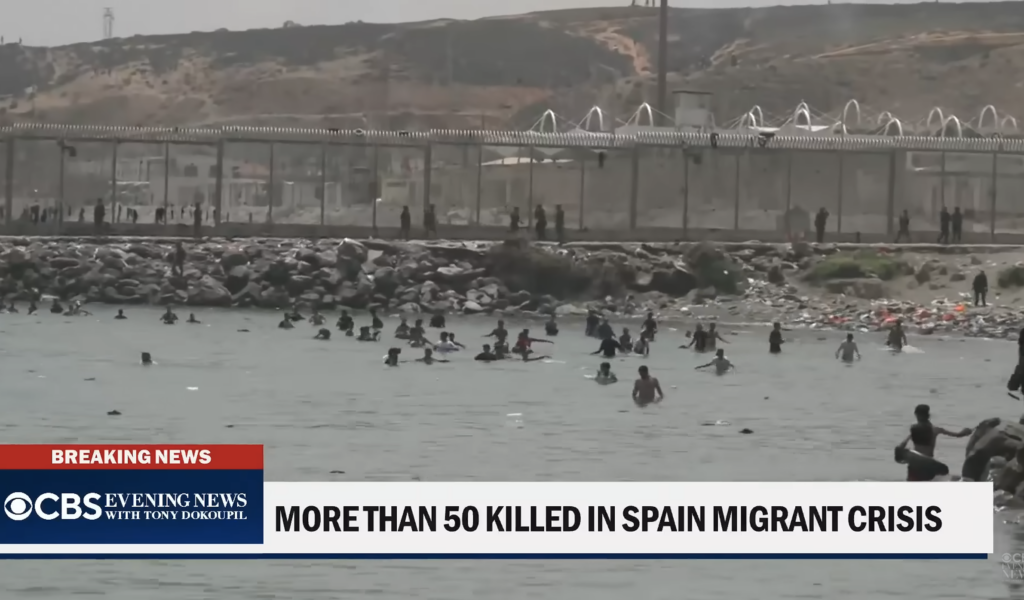
Approximately 60,000 young men from Morocco have arrived in the Spanish autonomous city of Ceuta, a small territory in North Africa, in what officials are describing as an overwhelming migration surge triggered in part by a recent court ruling.
The arrivals followed a decision by Spain’s Supreme Court, the Tribunal Supremo, that migrants captured at sea cannot be immediately returned to their native country through what is known as a “pushback” policy. Spanish Territorial Policy Minister Ángel Víctor Torres acknowledged the ruling as a contributing factor to the surge, though he said legal experts believe eventual deportation remains possible after time-consuming legal processes are completed for each individual.
The Geography and Challenge
Ceuta is located on the African side of the Strait of Gibraltar, where the Atlantic Ocean meets the Mediterranean Sea. As a Spanish territory surrounded by Morocco, residents typically receive food and supplies via a 30- to 60-minute ferry ride from mainland Spain. The city, along with its sister territory Melilla located 250 miles eastward on the Mediterranean coast, represents Spanish-speaking enclaves in a region where Arabic is the predominant language.

The most common water route used by migrants involves a three-mile crossing through treacherous waters, either by swimming or clinging to inner tubes while paddling. According to reports from the scene, more than 50 people have died attempting the crossing, with bodies observed floating in the water. Many arrivals carried cell phones in plastic bags to protect them from water damage during their journey.
Overwhelming Local Infrastructure
The sudden influx has severely strained Ceuta’s capacity to respond. Migrants are sleeping on beaches with limited access to food or drinking water. Under the court ruling, each arrival must be admitted for processing in compliance with Spanish immigration rules, a procedure that requires considerable time.
The number of arrivals exceeds the population of 95 percent of American cities and towns, creating logistical challenges for the small territory. Social media has been identified as a factor in spreading information that migrants who reached Ceuta or Melilla by sea would have a right to stay, though officials have criticized this as a misinterpretation of the ruling. The court decision did, however, grant specific procedural rights to those arriving by sea rather than by land.

Local Impact and Concerns
Thousands of migrants now roam the streets of Ceuta, prompting safety concerns among residents. Shops have closed and residents have sheltered inside amid fears of vandalism and looting as the arrivals seek food, clothing, shelter, and other necessities with no jobs awaiting them.
Rocío Gil, a Ceuta resident, told Spanish television: “As a woman, you have to live this to understand what it’s like. It’s an invasion … and there is no law.”
CBS News interviewed migrants after their arrival, who explained they spontaneously jumped into the water and swam the three miles to reach Spanish territory.

Processing and Legal Status
The Spanish court ruling requires that migrants intercepted at sea receive due process before deportation, rather than immediate return to their country of origin. If released during this processing period, migrants may not appear for subsequent court hearings or appointments with immigration authorities, similar to patterns observed in other countries.
Once lawfully present in Spain through this process, migrants gain rights to travel to other European Union countries, expanding the potential scope of their movement beyond the initial point of entry.
Broader Implications
The situation in Ceuta has drawn comparisons to border security challenges in other nations, where judicial decisions have been cited as factors influencing migration patterns. Minister Torres noted that while deportation may ultimately be possible, the required legal procedures for each individual create significant delays in enforcement.
The event highlights tensions between judicial rulings on immigration procedures and government efforts to maintain border security and manage migration flows. The Arabic-speaking arrivals face additional challenges communicating with Spanish-speaking local officials, complicating the processing and integration challenges already facing the small territory.
Source: thefederalist.com — https://thefederalist.com/2026/08/06/migrants-invaded-ceuta-because-a-court-encouraged-them-scotus-just-did-the-same-here/