
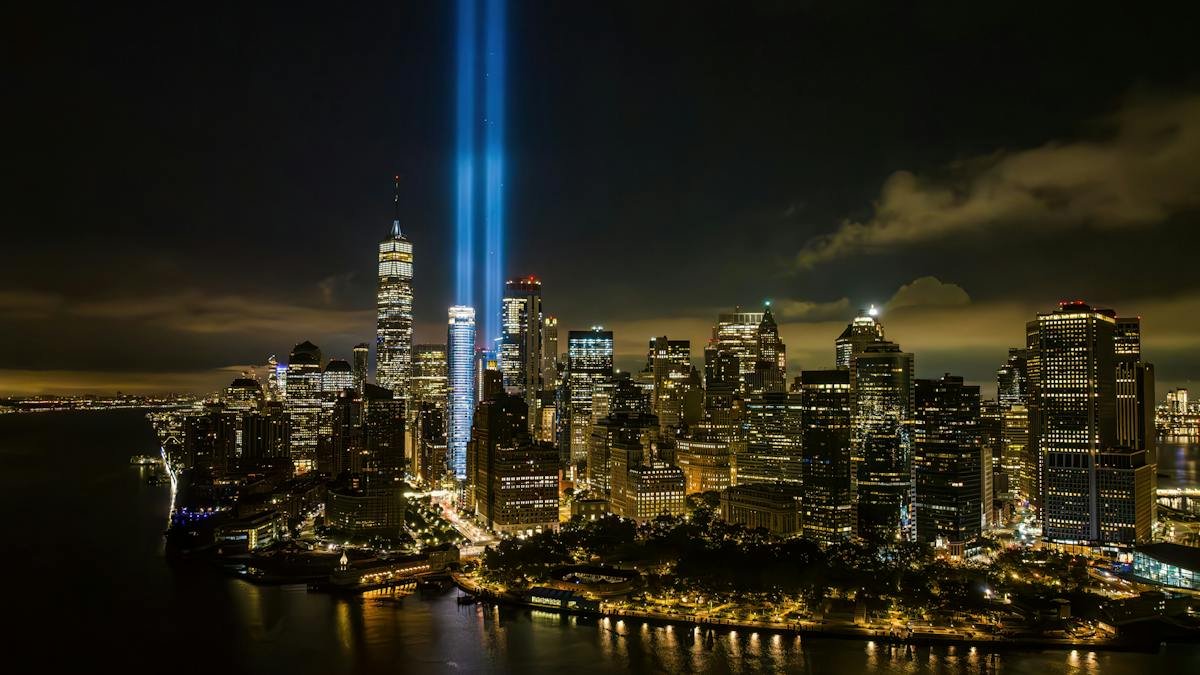
Twenty-five years after hijacked jets brought down the World Trade Center, a survivor who made it out of the North Tower is warning that the country is already losing its grip on what the day actually meant.
Human rights activist Sujo John, who was working on the 81st floor of the North Tower when American Airlines Flight 11 struck, told The Daily Wire that he fears a kind of national amnesia is setting in about the worst terror attack on American soil.
“Everyone’s got a story,” John said. He credits his survival to his faith.
Nearly 3,000 Died — and the Toll Kept Climbing
Almost 3,000 people were killed on September 11, 2001, excluding the hijackers. But the deaths did not stop when the towers fell. According to numbers cited by The Daily Wire, more than 7,000 U.S. military personnel were killed in the wars that followed in Afghanistan and Iraq, along with nearly 8,000 U.S. contractors. Those figures do not include the hundreds of thousands of allied troops and police killed, or the millions of veterans now living with severe disabilities and post-traumatic stress disorder.
The toxic cloud that hung over the 14.6-acre Ground Zero site in Lower Manhattan created a second, slower catastrophe. Decades later, survivors and first responders are still dying. John pointed to reporting indicating that some 57,000 people have reported cancer diagnoses tied to the attacks. Reported diagnoses include recent spikes in cancers of the thymus gland in the chest, stomach and bowel endocrine cancers, and breast cancer in men. Cases among survivors now total 28,913 — surpassing the 28,131 cases among first responders.
“Victims of 9/11 who were exposed to all that stuff have died,” John said.
A Debate Over What to Call It
A quarter-century later, the attack remains a political flashpoint. John pointed to the Council on American-Islamic Relations’ recent direction for schools not to describe 9/11 as a terrorist attack, and said he was stunned to be asked by a reporter whether he would tell a group of children that it was one.
“You’re dealing with radical Islam,” John said. “It’s crazy that we were talking about something like that.”
An Email Sent 41 Minutes Before the First Plane Hit
John and his wife Mary had moved to the United States from Calcutta, India, in February 2001. They were young, launching their careers, and wanted to experience a new city. He took a job in the North Tower; she worked in the South Tower.
On the morning of the attacks, John wrote an email to a friend from church at 8:05 a.m. He read it aloud during his conversation with The Daily Wire. In it, he described his first six months in America, expressed gratitude for how good God had been to them, and confessed that he missed being involved in ministry the way he had been in India.
The night before, he had signed a life insurance policy and woke his wife to tell her whom to call and which paperwork to find.
Forty-one minutes after he hit send, Flight 11 crashed into the 93rd through 99th floors of the North Tower. His office became a scene of fire and twisted steel as walls began to collapse. Rumors spread that a wing of the plane had ripped through their floor.
“Ten thousand gallons of jet fuel, flying at 440 miles an hour. You can only imagine how loud that was,” John recalled. “But we all thought it was a small commuter plane. Nobody thought it was a large plane, let alone a terrorist attack.”
Mary, four months pregnant, was running late that morning. The E train stopped just short of the South Tower subway station where she was headed, and she stepped onto the street as people jumped to their deaths around her.

The Stairwell, the Second Plane, and the Firefighter Who Didn’t Make It
After helping rescue a woman trapped in a crumpled bathroom stall, John and his colleagues began the hour-and-20-minute descent down the stairs. He remembers passing firefighters and police officers, high-fiving them and telling them they were the real heroes.
“We had no idea that that would be the last time we would see their faces,” he said.
He also singled out two men he worked with, Michael Benfante and John Cerqueira, who carried a Port Authority employee in a wheelchair down 68 flights before the building collapsed. All three survived by ducking under a firetruck.
“Nineteen Al-Qaeda terrorists attacked America that day,” John said. “And the first response came through these men. They showed the world what this country is made of.”
John heard the second explosion from the stairwell as United Airlines Flight 175 struck the South Tower at 9:03 a.m. With cell phones jammed, he called his wife from a landline in an Asian bank on the evacuated 51st floor. A firefighter forced him back down the stairs moments later.
“I’m absolutely sure that man that came and alerted me didn’t make it out of the building,” John said.
At the concourse level, he described seeing bodies and body parts between the towers. Not knowing whether Mary was alive, he headed toward the South Tower — and then heard the roar of it coming down.

“Okay, this is it. I’m going to die here,” he remembers thinking.
He prayed with people nearby as thick soot filled the air. Then someone pulled him out of the debris, identifying himself as an FBI agent. The two followed a red flashing light from a crushed ambulance to safety. The agent told John he had to go back for more people, and ran into the North Tower. The ground shook again. The tower collapsed.
Special Agent Leonard W. Hatton was the only active FBI agent to die in the 9/11 attacks.
Hours later, John’s cell phone sprang back to life. Mary was on the other end. Both had survived.
From Public Speaking to Fighting Modern Slavery
John went on to found You Can Free Us, a global initiative aimed at fighting modern slavery. Its work focuses on freeing children from international sex trafficking and forced labor — work that involves confronting cartels, mafias and predators who set traps on Instagram and TikTok with fake summer jobs and modeling contracts.
He acknowledged experiencing survivor’s guilt in the first days and weeks after the attacks, when church bells and funeral processions were constant.
“As I look back … I look at different small ways God has used my life,” he said.
Asked what he would want people to take from the anniversary, John framed it in terms of faith and purpose rather than politics.
“Life on Earth is so short compared to life after this life,” he said. “What is important is living every day at peace within yourself, at peace with your loved ones, and at peace with God. That’s truly the secret to living a life that has purpose.”
Source: www.dailywire.com — https://www.dailywire.com/news/the-9-11-lesson-this-survivor-says-america-is-already-forgetting