
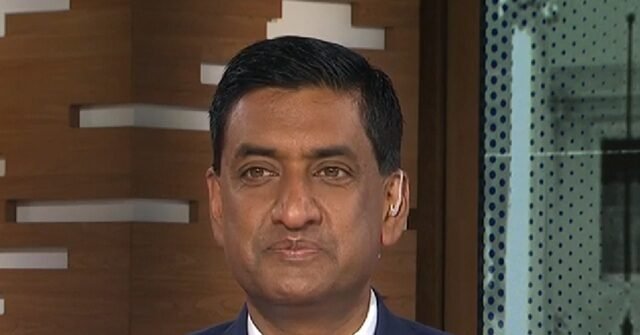
Rep. Ro Khanna (D-CA) escalated his criticism of the Trump administration’s Venezuela policy on Friday, calling the president’s deal to gain majority control over more than 65 billion barrels of Venezuelan oil reserves “morally wrong.”
Speaking on MSNBC’s “All In” with Chris Hayes, Khanna responded to the president’s announcement that the U.S. would essentially take over Venezuela’s oil reserves following the abduction of the country’s leader — a move the California Democrat framed as a throwback to a darker era of American foreign policy.
“Sad to see. It’s like we’ve rolled back the clock 100 years,” Khanna said. “Yeah, the era of gunboat diplomacy and, you know, the history. So what we did in Guatemala, what we did in El Salvador, what we did in Haiti, but it’s wrong. It’s wrong to have a colonial model of the world.”
Hayes had set the stage by asking whether there remains any “core of anti-imperial civic culture” in the U.S. that would recognize the problem with “abducting a country’s leader to take their oil.”
Khanna’s response went beyond a mere policy objection — he invoked his own family history as a moral counterweight to the president’s approach. “My grandfather was in jail twice fighting for British independence,” he noted. “And it was FDR who pushed Churchill to decolonize. And I thought America had stood for decolonization. Trump is rolling it all back because he simply believes in a world where might makes right, where you take what you can.”
The congressman stressed that his opposition was not merely about strategy or self-interest, but about the very identity of the nation. “We need to oppose it on moral grounds,” he said. “It’s not just that it’s strategically wrong. It’s morally wrong. It’s not what America should be, given our principles.”
A Broader Fight Over U.S. Power
Khanna’s remarks reflect a deepening divide in Washington over how far the U.S. should go in asserting control over foreign resources — especially in Latin America, where memories of U.S. interventionism run deep. His reference to Guatemala, El Salvador, and Haiti deliberately invoked twentieth-century episodes of U.S. meddling that many Democrats and human rights groups have long condemned.
The timing is notable: Trump’s announcement comes amid an ongoing crackdown on Venezuela’s leadership, and the administration has framed the oil deal as a strategic win for American energy security. Supporters argue that gaining control over Venezuela’s vast reserves reduces U.S. dependence on hostile nations and puts valuable resources under more responsible management.
But Khanna’s framing reframes the issue as a test of American values. By drawing a direct line between the president’s actions and historical imperialism, he is signaling that for at least one prominent Democrat, this is not a pragmatic bargain but a profound betrayal of the nation’s stated ideals.
Khanna, who has often positioned himself as a voice for a more restrained and principled foreign policy, did not offer any alternative approach in the exchange. But his language suggested that the moral objection is the point — a warning that the United States risks becoming the very force it once claimed to oppose.
As of this writing, the White House has not responded to Khanna’s comments. The debate over the Venezuela oil deal appears far from settled, and it is likely to become a flashpoint in the broader 2026 political landscape, with Democrats increasingly casting the administration’s foreign policy as a departure from longstanding American traditions of self-determination and decolonization.
For Khanna, the stakes are clear: “It’s not what America should be, given our principles.”
Source: www.breitbart.com — https://www.breitbart.com/clips/2026/08/28/ro-khanna-trump-taking-venezuelan-oil-is-morally-wrong/