
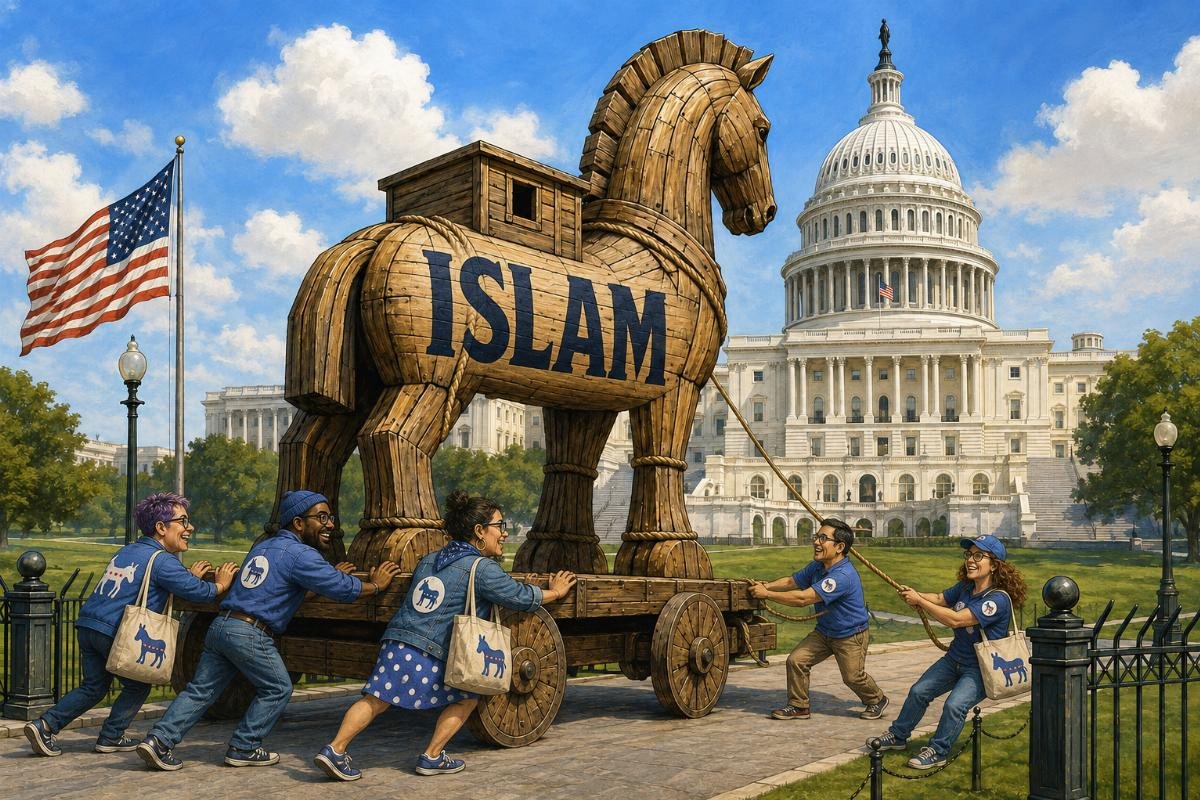
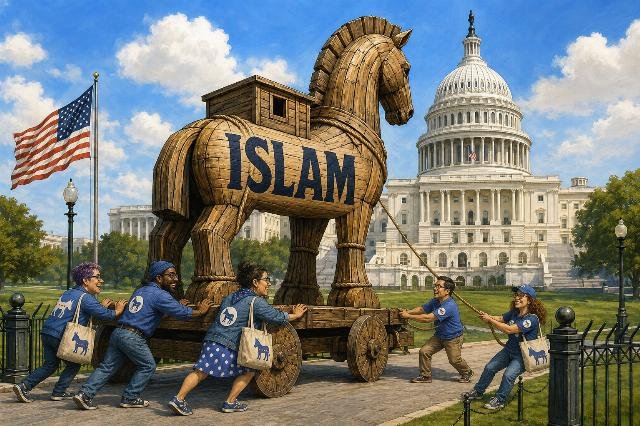
In the ancient Greek myth, the Trojans awakened to find a massive wooden horse outside their gates, with the Greek army seemingly gone. Assuming it was a victory offering, they hauled it inside their walls. That night, Greek soldiers slipped out through a trap door and opened the city gates to the waiting army. The lesson, as columnist James Zumwalt writes in American Thinker: deception thrives when the target doesn’t realize a war is even underway.
Zumwalt’s piece, published August 29, 2026, draws a direct parallel to America’s current immigration and assimilation debate. He argues that American tolerance—long a source of national strength—has become a vulnerability that could allow a demographic and cultural transformation of the country without a single armed conflict.
A ‘two-edged sword’ of tolerance
Zumwalt opens by acknowledging that immigration has been central to America’s success. Since the nation’s founding, waves of newcomers and a host culture willing to accept them have built the economic and democratic powerhouse the U.S. is today. The key, he says, was a shared goal: an America that guarantees freedoms and advances the common good.
He points to the 33,000 Japanese-American Nisei soldiers of World War II—born in the U.S. to Japanese parents—who fought against Tokyo, as proof that immigrants can assimilate while retaining some old customs. But he warns that tolerance has a dangerous flip side.
“Tolerance is a two-edged sword,” he writes. “On one edge we find virtue; but, when deception exploits tolerance, the other edge becomes weakness.” He contends that the good news is that tolerance has become part of the American DNA; the bad news is that it now limits the country’s ability to exercise common sense in preserving its values, especially when immigrant communities refuse to assimilate.
One Islam, no moderates
Zumwalt’s central argument is that Islam, as he frames it, is not just a religion but a singular religious and political ideology that demands all others submit. He writes that for a believer in the Quran, only three options exist for non-Muslims: convert, pay a tribute to Islamic authority while practicing an “infidel” religion, or face death. The Quran, in his reading, becomes “a license to kill,” with non-Muslims left uncertain which Muslims will exercise that option.
He quotes Turkish President Recep Tayyip Erdogan, who rejects the moderate-radical distinction: “These descriptions are very ugly, it is offensive and an insult to our religion. There is no moderate or immoderate Islam. Islam is Islam and that’s it.” Erdogan has also encouraged Turkish Muslims in the West not to assimilate, urging them to maintain separate identities.
The column highlights Islam’s traditional division of the world into “dar al-Islam” (territory of Islam) and “dar al-harb” (territory of war)—a binary that Zumwalt says has fueled 1,400 years of violence. He argues that even Muslims often labeled moderate are now openly expressing this worldview, not just the radicals.
CAIR and the 2050 plan
A significant portion of the column focuses on the Council on American-Islamic Relations (CAIR), headquartered in Washington, D.C. Zumwalt claims that CAIR leaders, in a recorded conversation, outlined a plan to “Islamize America by 2050.” The plan, he writes, calls for building 4,000 mosques and producing more than 50,000 Muslim congressmen, journalists, filmmakers, influencers, and historians—with the goal of transitioning the country from dar al-harb to dar al-Islam. He asserts that CAIR labels critics as “Islamophobic” to undermine opposition.
Zumwalt traces this agenda to a secret 1991 memorandum linked to the Muslim Brotherhood, which he describes as “nefarious,” and says little has been done since to stop it.
The column also cites Yasir Qadhi, an American Muslim scholar and theologian, as a “radical Muslim” who defends Iran and attacks the U.S. and Israel, and who has used a taxpayer-funded mosque in Texas—now linked to federal and state investigations—to promote “sectarian incitement and foreign-aligned subversion.” Qadhi, according to Zumwalt, advocates a long-term strategy of demographics, mosque-building, and infiltration of institutions like the FBI and CIA.
First Afghan-American elected to Congress
As a counterpoint, Zumwalt notes the special election in California that brought Aisha Wahab, a Muslim state senator, to Congress as the first Afghan-American ever elected to the House. While born in the U.S., her election, he says, demonstrates tolerance for ethnic differences but also “the sword’s weak edge,” calling her “a political radical.”
He cautions that America cannot allow immigrants to ‘join the team’ blindly. “Our tolerance is an important virtue,” he writes, “but it should not override observable signs that the America we love is not the same one such immigrants want.” He points to indications that some newcomers seek what they left behind.
A demographic shift
Muslims currently make up about 1.34% of the U.S. population—roughly 4.45 million people, according to the column. Zumwalt says many do not assimilate and instead comply with leaders who fuse religion and politics, so that “the way of government is the way of Islam.” He claims Islamic leaders boast that, with millions of Muslims united, “the country will come to us,” and that adherents came to America to “establish Allah’s deen [religion].” He notes that Texas pastors are now educating others about the “Islamification threat.”
Zumwalt closes where he began: “The citizens of Troy sealed their fate by assuming there was no war. Are we going to make the same mistake?”
The column is an opinion piece, and its claims—particularly about CAIR, Qadhi, and a 1991 memorandum—have been made by conservative commentators before. CAIR has long denied accusations that it seeks to impose Islamic law in the U.S., and Qadhi has publicly stated he believes violence against civilians is forbidden in Islam. Critics of such columns argue they conflate the views of extremists with the broader Muslim community.
Still, the piece raises a provocative question about the balance between openness and vigilance—one that resonates in an election season and a nation still wrestling with its identity.
Source: www.americanthinker.com — https://www.americanthinker.com/articles/2026/08/a-greek-mythical-trojan-horse-may-portend-an-islamic-reality-for-america/