
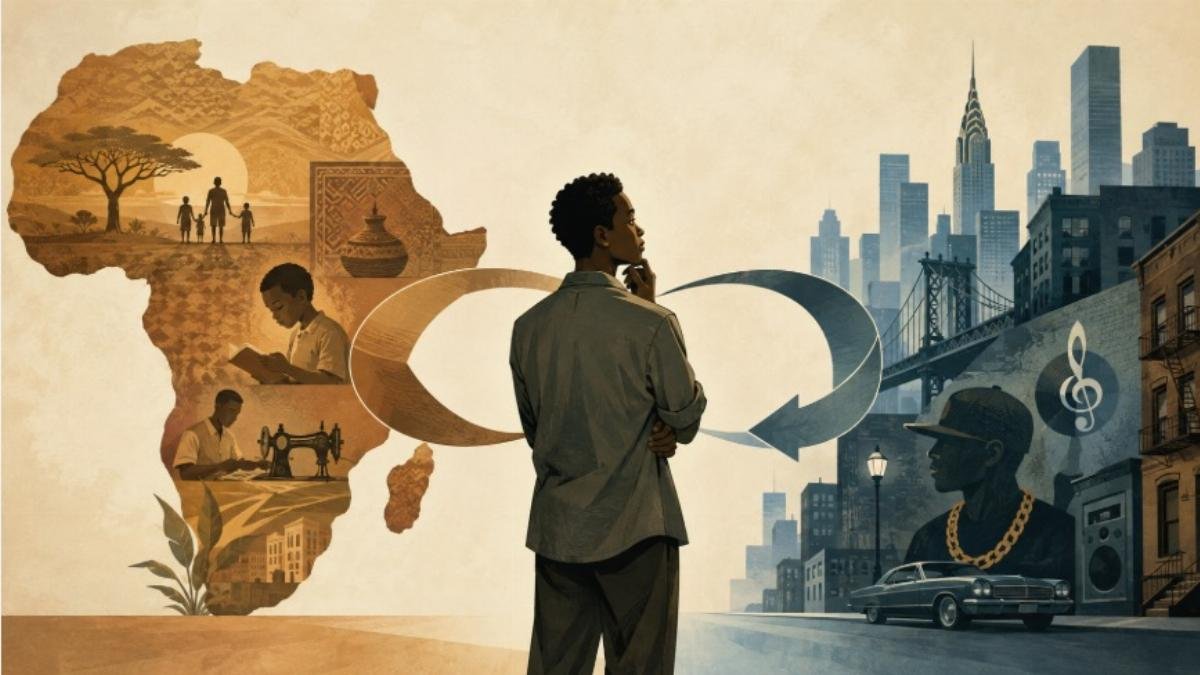
A provocative new essay in American Thinker argues that the relationship between American blacks and Africa is more complicated — and more fraught — than the popular narrative suggests. The piece, written by Andrea Widburg, contends that while a powerful strand of American black culture romanticizes Africa as an ancestral homeland, many African immigrants view certain elements of American black culture with disdain, and some have begun openly mocking it on social media.
Widburg’s essay, published August 30, 2026, wades into a sensitive cultural conversation with a blunt thesis: American blacks would be better served by embracing American virtues and the values of modern African immigrants than by romanticizing a “fantasy Africa” or celebrating what she calls “ghetto culture.”
The Historical Complication
Central to Widburg’s argument is the historical role Africans themselves played in the slave trade. She notes that the Atlantic slave trade “would not have existed without African complicity,” pointing out that African rulers, armies, raiders, and traders supplied the captives sold into slavery — often to Arab and African traders first, and later to Europeans.
That history, she writes, “complicates the modern narrative in which Africa appears solely as the innocent victim of Western predation.” It does not absolve the Europeans and Americans who bought and exploited slaves, she adds, but it does challenge the idea that Africa was purely a passive victim.
Widburg also pushes back on the notion that the United States bears unique responsibility for slavery. She notes that Native Americans practiced forms of slavery before European arrival, and that the British, French, Spanish, Dutch, and Portuguese all brought African slavery to the New World. Of the roughly 12.5 million Africans shipped across the Atlantic, only about 4% came to what became the United States, and 75–80% of those arrived before American independence.
That does not give America a pass, she is careful to say. The U.S. allowed slavery for 72 years after independence and only ended it through a Civil War whose death toll modern estimates place at around 750,000. But she argues the venom directed uniquely at America is “historically misplaced.”
The Rise of ‘Ghetto Culture’
The essay then shifts to the 20th century, tracing what Widburg calls the rise of “ghetto culture” in American black communities. She acknowledges that black Americans made substantial economic and social gains after World War II, with family income climbing relative to white families and educational attainment improving even before the war.
But she points to a troubling trend beginning in the 1950s: the increasing absence of black men from the family home. Given the well-documented connection between fatherlessness and crime, she argues, that family breakdown “almost certainly contributed to the social disorder that followed.”
Starting in the 1960s, Widburg writes, parts of the black intelligentsia and the political left began treating behaviors associated with the urban underclass as more “authentically” black. She cites the work of economists and social commentators Thomas Sowell and John McWhorter, both of whom have written extensively about the cultural consequences of treating disdain for education and other self-defeating behaviors as markers of racial authenticity.
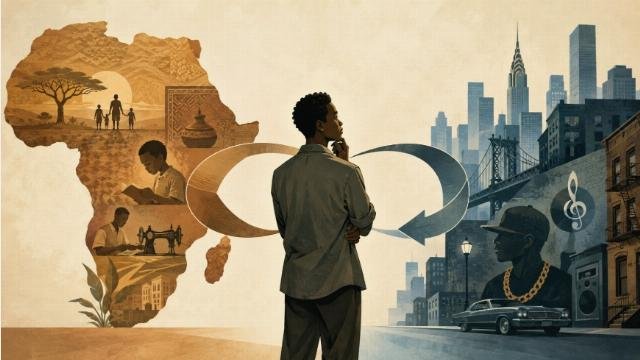
By the 1980s, and especially with the explosion of gangsta rap in the 1990s, that subculture developed a recognizable visual vocabulary — boom boxes, heavy chains, grills, hand signals, droopy pants, backward hats, prison-style tattoos, and a celebration of criminal swagger. The boom boxes may be gone, Widburg observes, but much of the rest remains.
Africans Look Back — and Sometimes Mock
The essay then turns to the striking disconnect between how American blacks view Africa and how many Africans view American black culture.
Citing a recent study, Widburg writes that many African immigrant families place enormous importance on education, family formation, work, and upward mobility. They often see America as a land of opportunity rather than oppression, and they deliberately distance themselves from what they see as destructive American black attitudes and behaviors.
That makes the current viral popularity of African videos mocking American ghetto culture especially notable. Widburg points to social media posts showing Africans — some with ancestors who sold Black Americans into slavery — uploading videos that mock Black Americans for their culture.
But the influence runs both ways, she cautions. There are also young Africans who look to American ghetto culture as a model, copying its clothes, gestures, slang, music, and “criminal posturing.” She calls this “profoundly sad and ironic,” noting that they are imitating the very subculture most closely associated with social failure.
One social media post she highlights observes that even the negative and poverty side of Black America — roughly 17% of the population — is “worshipped” by some young Africans, while the middle-class and wealthy majority (83%) is ignored.
A Call to Look to America’s Virtues
Widburg concludes with a direct appeal: “American blacks would do better to look to America’s virtues rather than the imagined virtues of a fantasy Africa.” And blacks on both continents, she argues, would benefit from embracing the best values found in modern African immigrant communities — education, family formation, work, and upward mobility — rather than romanticizing the worst elements found in America.
The essay is sure to provoke strong reactions on all sides of this sensitive cultural debate. It challenges both the romanticization of Africa in some American black circles and the glorification of American ghetto culture among some young Africans, while urging a more honest reckoning with history and a greater appreciation for the opportunities America offers.
Source: www.americanthinker.com — https://www.americanthinker.com/blog/2026/08/while-american-blacks-worship-africa-many-africans-have-disdain-for-american-blacks/