
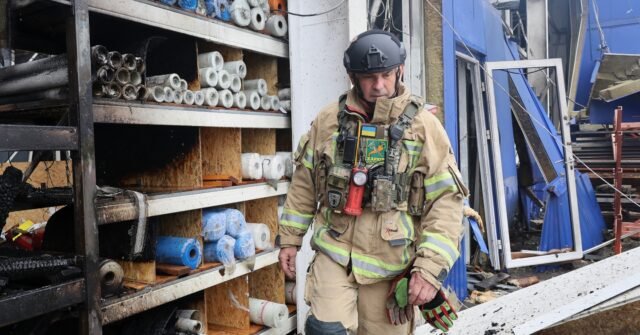
KYIV, Ukraine (AP) – For a fifth consecutive day, Russian forces pounded Kyiv and the surrounding region on Monday, launching relentless aerial attacks that have left some supermarket shelves bare and severely disrupted daily life in the Ukrainian capital. The sustained bombardment, which officials say has increasingly involved fast-flying jet-powered drones, has targeted warehouses and food distribution hubs, straining supply chains and fueling public concern about potential shortages.
The attacks come as Russia has intensified its aerial campaign against Ukraine, more than four years after launching its full-scale invasion. Almost constant air raid alerts in the Kyiv region have made it difficult for residents to maintain normal routines, and recent strikes have taken a heavy toll on civilian life. Two major attacks in July killed nearly 50 civilians, and a strike on Saturday alone killed at least 38 people.
On Monday morning, a pall of black smoke drifted over Kyiv, a visible reminder of the overnight and early morning attacks. In Brovary and Boryspil, cities in the Kyiv region, the aerial assault struck several warehouses, wounding four people, according to Tymur Tkachenko, head of the regional military administration.
The repeated strikes on food distribution centers and retail hubs have disrupted logistics, leaving some supermarket shelves empty and sparking worries among Ukrainians about the availability of basic goods. Those fears prompted Serhii Beskrestnov, an adviser to Ukrainian President Volodymyr Zelenskyy, to take to social media on Monday with a direct message: Ukraine will not go hungry.
Beskrestnov urged the public not to give in to rumors, disinformation, or panic, explaining that producers and retailers are currently restructuring supply chains. He added that European countries would be ready to fill any food supply shortfall if necessary, offering a measure of reassurance amid the growing anxiety.
Russia’s ‘Wear Down’ Strategy
The sustained attacks appear to be part of a deliberate Russian strategy to grind down Ukrainian morale and resilience. In a social media post late Sunday, President Zelenskyy described Moscow’s approach in stark terms: “Right now, Russia’s tactic is to wear down Ukraine and Ukrainians – first and foremost, our people.”
Ukrainian authorities have also sought to make Russian civilians feel the consequences of the war by striking major online retailers and oil facilities inside Russia. According to reports, those attacks have led to shortages for ordinary Russians, though they have been less deadly for civilians than the strikes Russia has launched against Ukrainian population centers.
The drone warfare has become a central feature of the conflict, with Russia increasingly relying on jet-propelled unmanned aircraft that are difficult to counter. Zelenskyy conceded in his social media posts that Ukraine is struggling to intercept these fast-moving drones. Between Thursday and Sunday, Russia fired almost 1,500 drones at Ukraine, and around 800 of them were jet-powered, the president said.
Ukrainian combat aircraft are currently attempting to stop the jet-powered versions, while the country races to develop more effective counter-technology. “Four companies have developed the relevant interceptor drones, and one company has the most successful technology,” Zelenskyy said, without offering further details.
Strikes on Energy Infrastructure Loom
The assault on food supply chains comes alongside continued attacks on Ukraine’s power grid, raising fears that civilians could face a brutal winter without electricity or running water. On Monday, officials reported a massive overnight drone attack on the northern Chernihiv region, which borders Russia. Viacheslav Chaus, head of the regional military administration, said an energy facility was damaged in the attack, though he provided no specifics.
Adding to the sense of impending crisis, the Russian Defense Ministry announced on Sunday that it is preparing “massive strikes” on Ukraine’s energy infrastructure. The threat signals that Moscow intends to escalate its campaign against critical civilian infrastructure as winter approaches.
The intensified drone attacks have also raised questions about the resumption of the school year. Classes were due to resume at Ukrainian schools on Tuesday, but it was unclear whether parents would send their children to classrooms. Schools are equipped with air raid shelters, and classes can also be conducted online, but the constant threat of aerial strikes has made the decision difficult for many families.
Russia, meanwhile, reported that it shot down 239 Ukrainian drones overnight across 14 regions, occupied Crimea, and the Black Sea, according to the Russian Defense Ministry. In the Russian border city of Belgorod, a Ukrainian missile attack on Sunday evening killed three people, acting regional Gov. Alexander Shuvayev said.
The situation on the ground remains fluid and tense, with both sides continuing to launch strikes. For Ukrainians, the immediate concern is the empty shelves and the uncertainty of what the coming weeks might bring. Officials are working to reassure the public that the country has the resilience and support to weather the storm, but the sustained attacks are taking a psychological toll, as well as a physical one.
“Right now, Russia’s tactic is to wear down Ukraine and Ukrainians – first and foremost, our people,” Zelenskyy reiterated, underscoring the existential nature of the struggle.
Source: www.breitbart.com — https://www.breitbart.com/europe/2026/08/31/ukrainian-supermarkets-running-empty-amid-sustained-russian-attacks-on-supply-chains/