
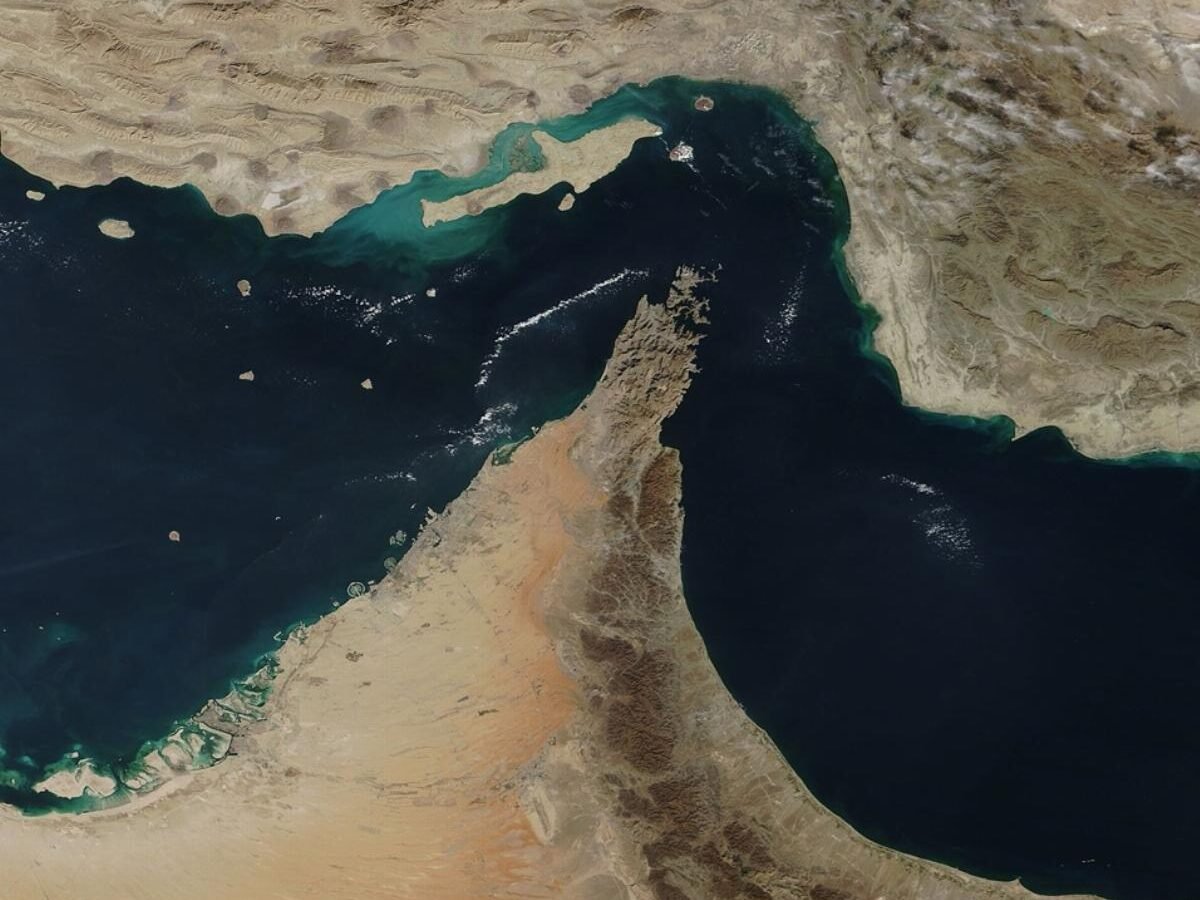
As tensions with Iran continue to simmer, a new story has been making the rounds online: that President Trump, through the U.S. Navy and unnamed construction and marine engineering firms, had quietly dug a new canal through a peninsula on the Omani side of the Strait of Hormuz—allowing oil tankers to bypass an Iranian blockade entirely. The tale, complete with an elaborate series of AI-generated images, suggests the passage was carved through the narrowest part of the peninsula, hidden from Iranian view by high ground and the curvature of the Earth, letting tankers slip through under the noses of the Islamic Revolutionary Guard Corps.
It’s a clever idea, and one that might have seemed plausible to many. But according to a new analysis at American Thinker, the whole thing is a hoax—one crafted with the help of artificial intelligence and spread by sites and channels eager for a great story.
Writing in the conservative outlet, analyst J.R. Dunn lays out why the story doesn’t hold up to scrutiny. For starters, he notes, you don’t “dredge” dry land. Dredging is something you do to harbors or rivers that are already underwater. To create a passage on a dry peninsula, you’d need to dig—and likely blast. That’s lengthy, tough, intensive work, not something that can be pulled off in a few months, as the story claims.
Then there’s the scale of the alleged construction. One image purporting to show a tanker in the new “canal” depicts a gap that appears to be at least half a mile wide, based on comparison to the vessel’s length. That’s serious overkill, Dunn argues. A basic passage for a tanker—which itself runs about 200 feet wide—would only need to be a little over a hundred yards across. The real constraint for tankers is depth, not width, with Very Large Crude Carriers (VLCCs) drawing 65 to 70 feet.
And as for the claim that the project would be out of sight of Iran? Dunn is blunt: “God made drones, didn’t he?”
The story has appeared on multiple websites and video channels, including one associated with Bennie Thompson, the Democratic congressman from Mississippi. Dunn doesn’t fault them for picking it up—”they’re in the business of passing on great stories, and this is a great story”—but he stresses that it isn’t a true one.
The timing of the story, hitting just as tensions over the strait were high, only added to its appeal. But Dunn’s broader warning is about the growing ease with which AI can be used to fabricate convincing images and narratives. “Things aren’t always what they seem,” he writes, “and that’s getting to be more and more the case as time goes by.”
This is far from the first time fake or misleading content has circulated in connection with geopolitical flashpoints. But the sophistication of this particular hoax—complete with a coherent storyline and seemingly plausible technical details—underscores a new challenge for readers and even seasoned analysts.
The Strait of Hormuz is a vital chokepoint through which about 20% of global oil supply passes, so it’s no surprise that any suggestion of a workaround would gain traction. But so far, there is no evidence that such a canal exists, and the U.S. Navy has made no official announcement of anything like it.
For those watching the region, the story offers a cautionary tale: in an age of AI-generated imagery and viral misinformation, even an elegant, Trumpian-sounding solution to a real strategic problem can be nothing more than a digital illusion. As Dunn puts it, “Fair warning to all.”
Source: www.americanthinker.com — https://www.americanthinker.com/blog/2026/09/bypassing-the-strait/