
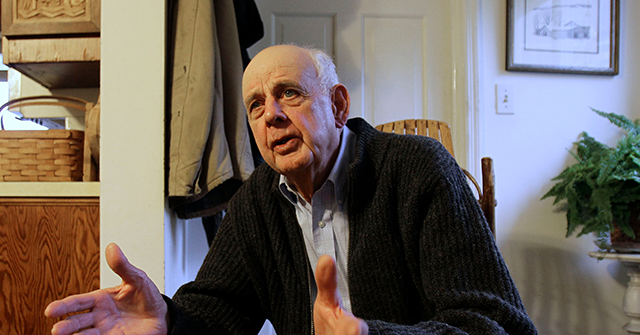
The news of Wendell Berry’s death at 92 reached the front porch of a Breitbart writer on the last night of August, interrupting an evening spent with dogs, daughters, and a very large toad. But the obituaries that followed, the writer argues, got Berry wrong—painting him as a harmless relic of America’s agrarian past rather than the intellectual godfather of an economic nationalism now ascendant in Washington.
Berry, who died at his home in Port Royal, Kentucky, was celebrated in mainstream obituaries as a poet and novelist who “extolled America’s agrarian past” and advocated for “a simpler life,” according to the New York Times and Associated Press. Yet those portraits, Breitbart contends, left out everything that made Berry politically significant: his defense of tariffs, his acceptance of the protectionist label, his opposition to NAFTA, GATT, and the World Trade Organization, and his support for immigration restrictions.
“Neither obituary tells the reader that Berry defended tariffs, accepted the name protectionist, and opposed the global trade regime built through NAFTA, GATT, and the World Trade Organization,” the Breitbart Business Digest piece states. “Neither tells the reader that he defended immigration limits and criticized the businesses that sought to exploit our lax border policies.”
The piece goes further: If the movement to Make America Great Again had a poet laureate, it would be Berry, the sage of Port Royal. It places him in a conservative lineage running from the Southern Agrarians and Richard Weaver through Russell Kirk, Pat Buchanan, and on to President Donald Trump and Vice President JD Vance.
Berry’s political views were not peripheral to his literary vision, the article argues—they grew directly from his moral philosophy of “membership.” In his book What Are People For?, Berry distinguished between consumerism, which asks what one can get with the least obligation, and membership, which asks what is one’s to love, maintain, and pass on.
A Wild Writer, Not a Tame One
The obituarists, Breitbart argues, created a “false Berry”—one stripped of views they found hard to reconcile with their admiration. Drawing on C.S. Lewis’s The Lion, the Witch, and the Wardrobe, the piece compares Berry to Aslan: not safe, not tame—but good.
“The real Wendell Berry was not a tame writer,” the article insists.
Berry’s localism, the piece contends, was often misunderstood as a rejection of nationalism. But his loyalties were nested: household, neighborhood, Port Royal, Kentucky, America. The larger membership defends the smaller ones, and the smaller ones give the nation its substance. “The truest nationalism is localism—and the only viable localism requires nationalism,” Breitbart writes.
The logic is practical as much as philosophical. A town council cannot impose a tariff on dumped steel. A county cannot renegotiate WTO rules. A congregation cannot police a national border. A family cannot stop a multinational from moving a factory to China and importing its products back. Detroit cannot defend itself against Canadian transshipment of Chinese components.
Defense Through Independence
Berry made this case in an essay titled “Property, Patriotism, and National Defense,” which Breitbart quotes at length. A defensible country, Berry wrote, has “a large measure of practical and material independence”—the ability to live independent of foreign supplies, resting on the broadest possible base of economic prosperity, and, most importantly, “generally loved and competently cared for by its people.”
He repeated the argument after September 11 in “The Failure of War.” A serious national defense, Berry argued then, begins with national and regional economic independence—“the ability of a people to live from their own resources and from their own work and skills.” What the United States was doing instead, he said, was “squandering in the most prodigal manner the natural and human resources” of the country.
The Breitbart piece connects Berry’s vision directly to the current administration’s approach, noting Treasury Secretary Scott Bessent’s reminder that “economic security is national security.” Berry’s economic nationalism, in this telling, is the spiritual core of the MAGA movement: the defense of membership against a machinery that wants every person replaceable and every place for sale.
For readers who only knew Berry as a Nature writer or a Kentucky novelist, the Breitbart piece offers a sharply different frame. Berry is not being remembered here as a figure of nostalgia but as a thinker whose ideas about trade, borders, and self-sufficiency anticipated the political realignment of the past decade—and whose warnings about globalism as “consumerism enlarged to the scale of the earth” now echo from the White House.
Whether or not one accepts Breitbart’s framing of Berry as a movement ancestor, the piece documents something real: the obituaries did largely omit his political economy. Berry spent decades defending positions that now define the Republican Party’s economic agenda, and he did so from moral and religious ground, not just political calculation.
“He asked how a people might have a future worth inhabiting,” the article says. “An argument about the future of the American republic becomes a fond remembrance of draft horses, organic vegetables, and pencil-written poems” in the obituaries, stripping Berry’s life work of its sharp edge.
The piece closes on the image with which it opened: Berry as a writer who understood that the future of the republic depends on whether its people can live from their own resources, love their own places, and defend their own households—and who was not afraid to say so, even when it made him unpopular. “There would be time for Berry,” the writer notes, “after the dogs and the girls had gone to bed.”
Source: www.breitbart.com — https://www.breitbart.com/economy/2026/09/01/breitbart-business-digest-wendell-berry-and-the-roots-of-economic-nationalism/