
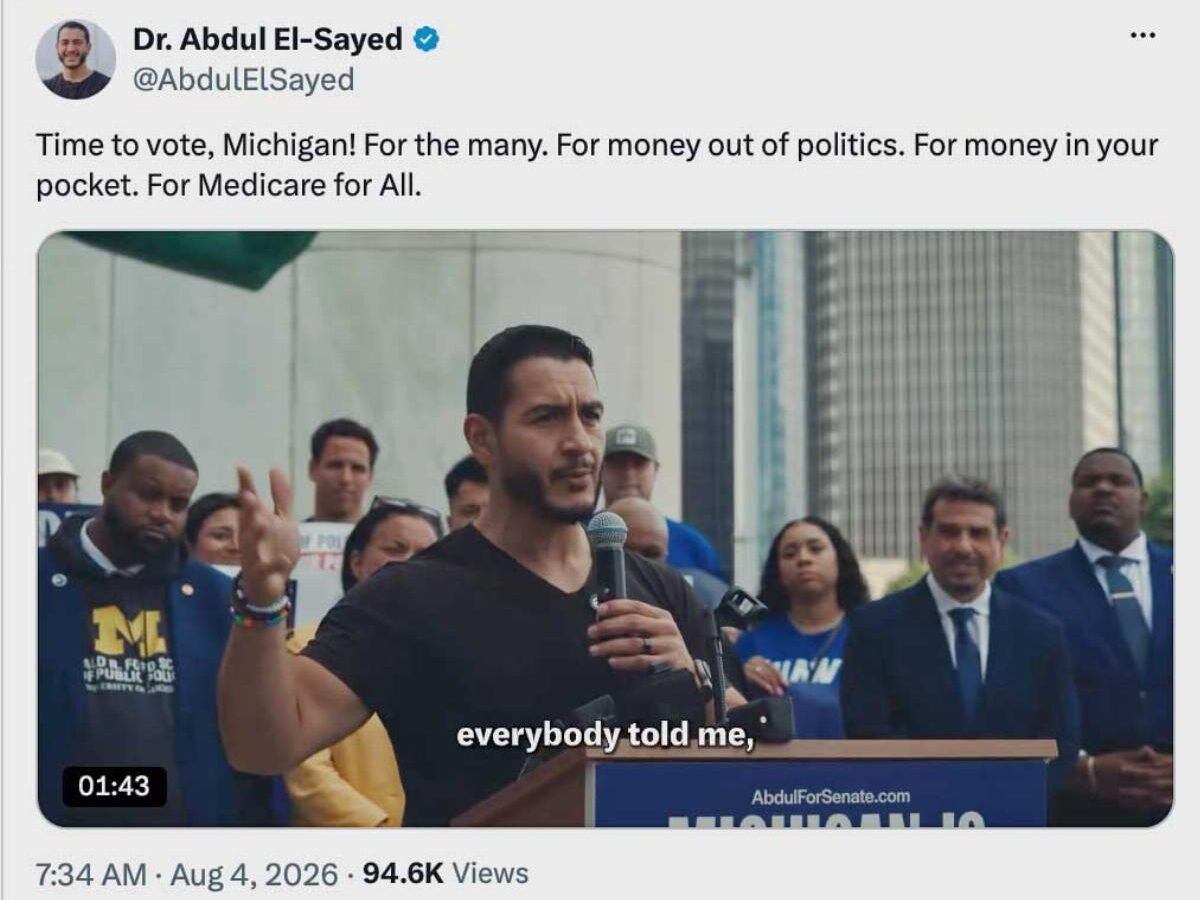
When politicians promise a ‘right to housing,’ a ‘right to affordable food,’ or a ‘right to free healthcare,’ the phrases roll off the tongue with the easy familiarity of campaign staples. But according to a new essay by Christian Vezilj at American Thinker, that very familiarity has obscured a crucial philosophical line—one that separates genuine rights from what he calls political entitlements.
Writing from a natural-law perspective grounded in the American Founding, Vezilj argues that a right, properly understood, is something a person holds simply by being human. It is inherent, self-contained, and—critically—does not require anyone else to surrender their labor, money, or property for you to enjoy it. The moment a claimed ‘right’ demands another person’s work, payment, or sacrifice, it ceases to be a right in the Founders’ sense and becomes an entitlement.
‘A right that requires another’s labor is an entitlement, not a right,’ Vezilj writes, distilling what he sees as the core test for distinguishing legitimate liberty from government-managed benefits.
The Founders’ checklist: Life, liberty, and the pursuit of happiness
Vezilj grounds his argument in the Declaration of Independence, which enumerates the classic triad: life, liberty, and the pursuit of happiness. The Bill of Rights, he notes, follows the same logic. Every amendment protects a freedom that demands no action from another citizen.
Consider his examples: Free speech does not obligate anyone to listen. Free exercise of religion does not compel anyone to fund a church. A free press does not require anyone to buy a newspaper. The right to bear arms does not mean the government must hand you a firearm. Due process does not force a neighbor to sacrifice their property or time.
‘This distinction is not a minor detail,’ Vezilj insists. ‘It is the foundation of American liberty.’
When ‘rights’ become claims on other people
The problem, as Vezilj frames it, is that modern political discourse increasingly labels as ‘rights’ precisely the kind of goods and services that require compulsory redistribution. Free healthcare, free housing, free childcare, free transportation—and even a ‘right to a livable wage’—all have a common structural feature: they depend on someone else working, paying taxes, or providing labor so that another may receive.
That structure, he argues, is the opposite of a natural right. It is a claim on another person, and when government enforces it, the mechanism is necessarily confiscation—taking the fruits of one person’s labor and transferring them to another.
‘These entitlements may be debated, supported, opposed, expanded, or limited,’ Vezilj concedes. ‘But they are not rights in the Founders’ philosophical sense.’
Two rival philosophies of government
Vezilj sees the current confusion as a clash between two distinct political philosophies. One, which he associates with the American Founding, holds that government exists to protect individual liberty, secure property, and prevent coercion. Its role is not to provide for citizens but to protect their freedom to provide for themselves.
The rival philosophy—rooted in the idea that government should manage society, allocate resources, and guarantee outcomes—treats citizens as recipients of state-managed benefits. When that view prevails, he warns, the citizenry shifts from free individuals to dependents of the state, and the language of rights becomes a tool for expanding governmental authority.
The consequences are not merely semantic. Vezilj notes that when ‘rights’ multiply, the word itself loses meaning, and the government’s power to redistribute, regulate, and control expands in the name of fulfilling those newly invented guarantees.
Why the language matters now
For Vezilj, this is not an academic quibble. The terms citizens use to describe their relationship to government shape their expectations—and, ultimately, the limits of state power. He advocates a simpler vision: ‘Rights come from God. Property comes from labor. Charity comes from choice.’
That formulation leaves room for social support, but it insists that such support must arise voluntarily rather than from coercive takings justified by the rhetoric of rights. When charity becomes compulsory, he argues, it transforms generosity into an entitlement—and turns personal responsibility into political dependency.
The Founders, Vezilj concludes, designed a system in which individuals could pursue their own happiness without forcing others to surrender theirs. ‘That is the American promise,’ he writes. ‘A right that requires another person’s labor is not a right. It is a political entitlement, and it must never be confused with the God-given rights that define American liberty.’
Whether one shares Vezilj’s natural-law assumptions or not, his essay highlights a persistent and consequential question in American politics: At what point does a Democratic promise of universal benefits conflict with a Republican-inflected, founding-derived understanding of negative liberty? The debate over that line—rights versus entitlements—is unlikely to subside anytime soon.
Source: www.americanthinker.com — https://www.americanthinker.com/blog/2026/09/the-difference-between-rights-and-entitlements-in-american-political-life/