

The Lindsay Clancy case is one of the most horrific crimes in recent memory — a Massachusetts mother accused of killing her three young children in 2023. And according to a new essay published by The Daily Wire, the public’s reaction on TikTok is taking a troubling turn.
There’s no real dispute about who killed the children: Clancy admitted to it, and even her own defense doesn’t contest the basic fact. The legal questions are about her mental state and criminal responsibility, not about whether she did it. But spend any time on TikTok, and you’d think that was still an open question.
Videos circulating on the platform push an endless array of alternative narratives. Some blame Patrick Clancy, the children’s father. Others claim the timeline doesn’t add up, or that there’s overlooked evidence that changes everything. A recurring theme involves Clancy’s use of SSRIs, with some videos suggesting the medication — not the mother — is the real culprit.
The human need for a different story
The essay’s author, Vanessa Santos — a political communications specialist and CEO of the PR firm Renegade D.C. — says she understands why these theories are especially appealing to women and mothers.
“This crime is so horrific that wanting another explanation is a human response,” she writes. “It is almost impossible to comprehend that a fellow mother could take the lives of the children she carried, delivered, fed, bathed, comforted, and tucked into bed.”
When motherhood is so fundamentally tied to protecting our children, the mind recoils at the idea that a mother could do this. So it searches for something else — some missing piece, some unknown factor that makes the horror easier to process.
Santos doesn’t think most of the women drawn into these theories are stupid or gullible. Instead, she says, many are “confronting a truth so unbearable that they desperately want something else to be true.”
And that very human impulse is precisely what social media exploits.
How the algorithm feeds the obsession
Santos, who has spent her career in PR and new media, points out that TikTok’s algorithm doesn’t know why a video holds your attention. It only knows that you paused on it, watched it, maybe commented on it.
Pause on one video questioning the timeline. Watch a few about SSRIs. Read the comments insisting there’s more to the story. TikTok learns what keeps you engaged — and then gives you more of it.
“What begins as an attempt to understand an incomprehensible crime can become an hours-long journey through content reinforcing the explanation you most want to believe,” Santos writes.
The algorithm doesn’t need to convince you that any particular conspiracy theory is true, she argues. It just needs to make the truth feel uncertain. Repetition feels like corroboration. Agreement feels like evidence.

Spilling into the real world
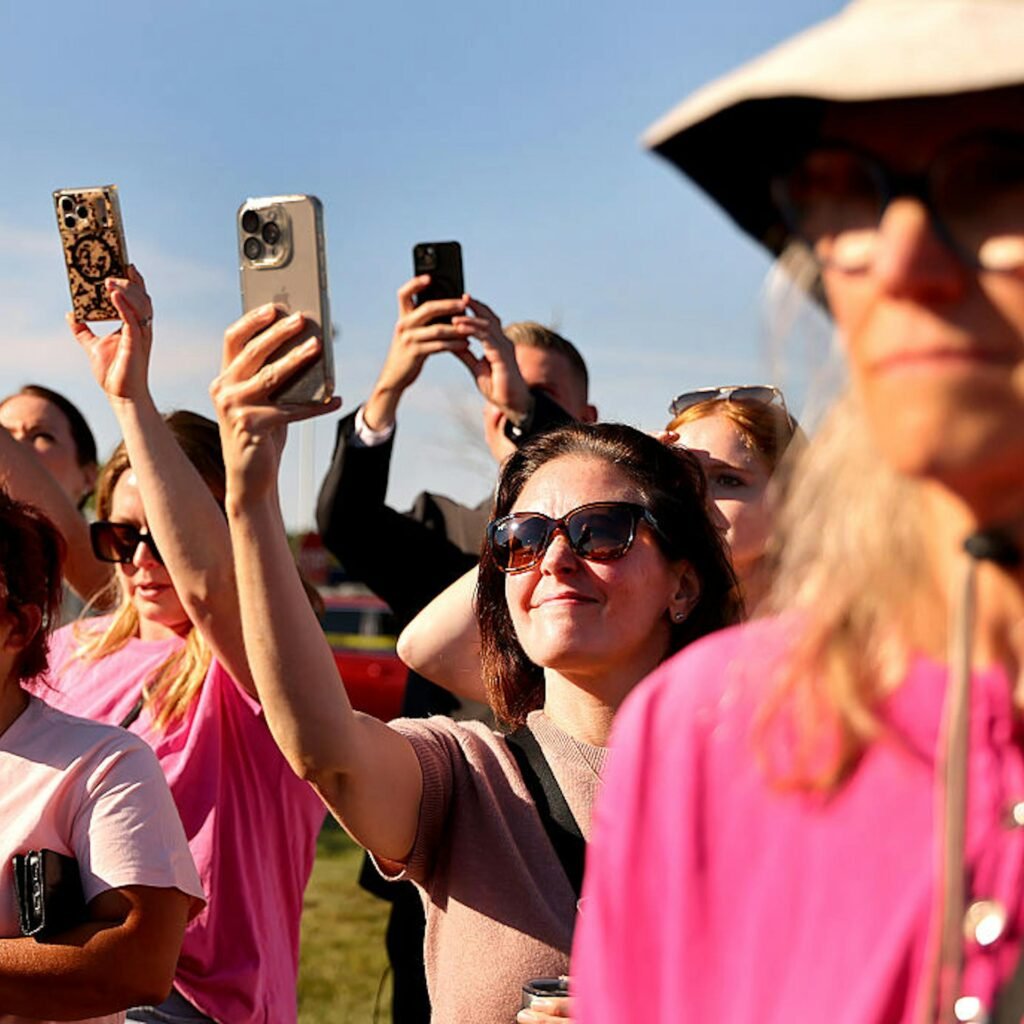
This online obsession has already leaked offline. For six weeks, supporters have gathered outside the courthouse where pretrial proceedings are underway — filling parking lots, wearing pink, with some traveling from as far away as the United Kingdom.
What should be a somber trial about the deaths of three children has come to feel, Santos says, “disturbingly like a cause, or even fandom.”
And in at least one case, that fervor has crossed a legal line. A 56-year-old woman was arrested for alleged jury intimidation after being accused of filming and photographing jurors from a restricted parking lot after they were dismissed.
Santos sees a clear progression at work: a narrative becomes content, content becomes community, and community becomes identity. Once a belief becomes part of someone’s identity, contradicting evidence stops feeling like information and starts feeling like an attack.
Compassion vs. accountability
Santos says something important is being lost in all this — the ability to hold two truths at once.
“We can have tremendous compassion for someone suffering from severe mental illness while still acknowledging what she did,” she writes. “We can have serious conversations about postpartum mental health and psychiatric medication without treating viral claims as established medical fact.”

And we can consider whether mental illness affected Clancy’s criminal responsibility without inventing a different perpetrator entirely.
The accusations against Patrick Clancy are, in Santos’s words, a “particularly cruel consequence.” A father who lost all three of his children has been turned into a character in strangers’ online theories.
Bigger than one trial
Santos stresses that this case is only one example of a much broader phenomenon. The same machinery operates across politics, health, parenting, and just about every major cultural debate. The algorithm finds whatever emotion keeps us watching and builds a content bubble around it.
That’s why she says mocking the women who fall into this rabbit hole misses the point entirely. Their initial reaction is entirely understandable, Santos argues. The danger is what comes next.
“The danger is what happens when empathy becomes identification, curiosity becomes obsession and an algorithm continually reinforces what we already want to believe,” she writes.
Misinformation doesn’t always start as an obvious lie, Santos concludes. Sometimes, it starts as a terrible truth we desperately wish weren’t real.
“Social media finds that wish, feeds it, and, if we aren’t careful, can turn it into something we believe,” she writes.
Source: www.dailywire.com — https://www.dailywire.com/news/lindsay-clancy-tiktok-is-melting-womens-brains