

As Americans prepare to mark the 239th anniversary of the Constitution’s signing on September 17, a legislative fight in California is raising questions about how far the state will go to honor religious traditions that some argue stand opposed to the document’s founding values.
The Golden State’s Assembly has passed a bill, authored by San Francisco Assemblymember Matt Haney, that would add two Muslim holidays — Eid al-Fitr and Eid al-Adha — to the state’s official calendar. The measure now awaits a vote in the state senate, and if passed, it would make California one of the first states to formally recognize the Islamic holy days.
The bill’s supporters frame it as a matter of inclusion and diversity, but its critics — including columnist James Zumwalt writing for American Thinker — see it as a direct challenge to the Judeo-Christian underpinnings of the republic’s founding document.
The ideological divide
Zumwalt argues that the Constitution, which he calls “the oldest single, codified framework for a national government still in operation,” was crafted by 39 signers who embraced Judeo-Christian principles. To honor a religion whose legal framework — Sharia — he contends is incompatible with constitutional freedoms, he argues, is not merely misguided but “preposterous.”
“The religion will never align with the U.S. Constitution,” Zumwalt writes, pointing to the Quran as evidence that Islamic law stands “in sharp contrast to the freedoms our Founding Fathers memorialized.” He compares the proposal to recognizing May 5th as the birthday of Karl Marx.
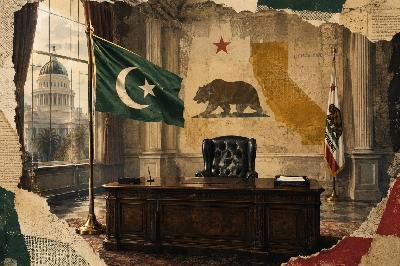
The author notes that the bill passed by an overwhelming margin of 64-1, suggesting that Haney’s initiative enjoys broad bipartisan support within the Assembly — a fact that Zumwalt suggests reveals how far California’s Democratic leadership has moved from the principles that guided the nation’s early leaders.
A historical parallel
Zumwalt invokes Thomas Jefferson’s experience with Islam as a cautionary tale. In 1786, Jefferson and John Adams traveled to London to negotiate a treaty with the Barbary pirates who had been attacking American merchant ships in the Mediterranean.
During those talks, Jefferson reportedly asked the pirates’ ambassador why they had attacked American vessels without provocation. The ambassador’s response, according to Zumwalt, stayed with Jefferson for the rest of his life: as Muslims, it was their duty to plunder and enslave “infidels.”
That encounter, Zumwalt suggests, shaped Jefferson’s later support for funding a U.S. Navy capable of defeating the pirates in subsequent military conflicts — a history that informs the author’s view that Islam’s “dark side” was well known to the Founding Fathers even as they drafted the Constitution the following year.
The politics of recognition
Zumwalt questions what could motivate a legislator to push this initiative, noting that Muslims make up only about one percent of California’s population — although San Francisco, which Haney represents, has one of the largest Muslim concentrations in the country.

The columnist wonders whether California’s lawmakers truly understand their history, asking rhetorically if they know that Jefferson himself never attended the Constitutional Convention in 1787, as he was serving as ambassador to France — and that Jefferson could never have envisioned Islam taking root on American soil the way it has today.
“Never would he have thought it possible that a state within his beloved republic would seek to honor two of that religion’s holidays,” Zumwalt speculates.
Had Jefferson been present at the signing, Zumwalt muses, he might have been tempted to insert constitutional provisions barring such religious-political ideologies. But the author ultimately concludes Jefferson likely would have trusted that educated Americans would never choose to dishonor the country’s Judeo-Christian values by embracing them.
Free speech and the republic
The piece closes with a broader warning about the state of American discourse. “Now more than ever, the ability to speak our minds is crucial to the republic we cherish,” Zumwalt writes, framing the California holiday debate as one front in a larger ideological battle between those who defend the nation’s founding principles and those he accuses of promoting an “anti-American tune.”
The article does not address the counterargument that recognizing religious holidays is not an endorsement of a faith’s legal code, nor does it engage with the growing trend of states and municipalities adding holidays to reflect their diverse populations. California’s bill would join other state recognitions of cultural and religious observances that have become increasingly common in recent years.
For now, the bill’s fate rests with the California Senate. If it passes there, California would become the first state to make both Eid al-Fitr and Eid al-Adha official state holidays — a move that, whatever its merits, is certain to keep this constitutional clash in the spotlight.
Source: www.americanthinker.com — https://www.americanthinker.com/blog/2026/09/california-seeks-to-honor-islam/