
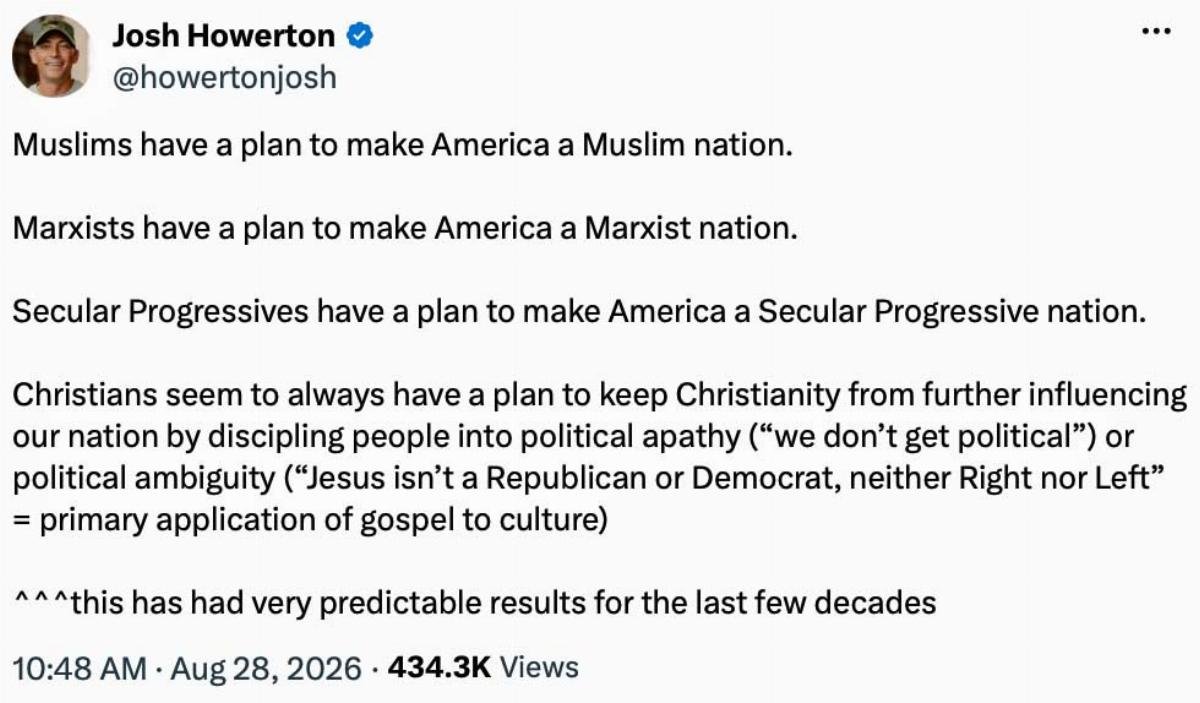
A recent essay at American Thinker has stirred fresh debate over the boundaries of religious freedom under the U.S. Constitution, invoking Supreme Court Justice Robert Jackson’s warning that the Bill of Rights must not become “a suicide pact.”
Author Mike McDaniel, a retired police officer and Air Force veteran, argues that Americans need to apply “practical wisdom” in determining the limits of religious liberty—specifically, whether Islam should be recognized as a religion under the First Amendment. McDaniel contends that Islam is not merely a faith but “a system of political conquest and domination,” and that its core texts and practices mandate the subjugation or elimination of non-believers.
The essay, published September 3, 2026, revisits Jackson’s 1949 dissent in Terminiello v. Chicago, a free speech case. Jackson warned that if the Court adhered too rigidly to doctrinal absolutes, it would convert the Constitution into a suicide pact. McDaniel argues that while that warning was originally about speech, the same logic should now apply to religion—especially as Islamists, in his view, pursue objectives incompatible with Western democracy.
Christianity vs. Islam: A pointed contrast
McDaniel contrasts Islam with Christianity, which he describes as a “voluntary religion” that respects separation of church and state. He quotes Jesus’s teaching to “render to Caesar the things that are Caesar’s, and to God the things that are God’s,” and emphasizes that Christianity does not mandate conquest or hatred.
He further notes that Islamic doctrine, particularly Sharia, functions as both a legal and political system, with severe penalties for apostasy—often death. “If you choose to leave Islam, you’re an apostate,” McDaniel writes, “There is only one fate Islam mandates for apostates: death.”
While acknowledging that some Muslims do not personally endorse violence, McDaniel insists that “Islamists, not they, are living the intent and text of their faith.” He argues that the Qu’ran and Hadith contain direct exhortations to fight Jews and infidels, and that Muslim-on-Muslim violence is common among those deemed insufficiently devout.
Political implications and accusations of sedition
McDaniel does not limit his critique to religious texts. He accuses the Democratic Party of becoming “the party of Antisemitism” and points to the Democratic Socialists of America (DSA) as advocating positions that resemble sedition under federal law. He quotes the U.S. Code definition of sedition—conspiracy to overthrow the government or use force to obstruct laws—and suggests that some political rhetoric and activism may cross that line.
The essay also references U.S. Representative James Talarico, a Texas Democrat, who has described Jesus as a “radical” and “DSA feminist.” McDaniel dismisses such characterizations, asserting that Christianity’s founder was clear about the proper relationship between religious and political authority.
McDaniel argues that Islam has “been waging war on America for decades” and that its inclusion under the First Amendment—simply because it claims to be a religion—undermines national security. “It is a religion because it says it is,” he writes, “It’s time we understand that, as with trans ideology, that’s not nearly enough.”
A call for redefinition—or a dangerous step?
The essay has drawn sharp reactions from both supporters and critics. Supporters say it raises legitimate questions about the interface of religion and national security, especially in light of ongoing conflicts abroad. Critics argue that defining Islam out of First Amendment protection would set a dangerous precedent, eroding religious liberty for all minority faiths.
Legal scholars note that the Supreme Court has historically defined religion broadly, often avoiding doctrinal tests. In cases like United States v. Ballard (1944) and Torcaso v. Watkins (1961), the Court made clear that it would not favor one religion over another, nor question the truth of religious beliefs. However, the Court has also allowed restrictions when actions pose a clear threat to public safety, as seen in Reynolds v. United States and more recent cases involving COVID-19 regulations.
McDaniel’s essay calls for a new approach—distinguishing between genuine religious exercise and what he sees as a politically motivated system that uses the First Amendment as a shield. Whether that argument gains traction remains to be seen, but it certainly revives a perennial debate: how far religious freedom extends when the faith in question may advocate for the destruction of democratic institutions.
As Jackson famously wrote, the Constitution should not be interpreted so rigidly that it becomes a suicide pact. McDaniel’s essay asks whether protecting Islam as a religion under the First Amendment does exactly that—a provocative question that Americans may need to answer sooner rather than later.
Source: www.americanthinker.com — https://www.americanthinker.com/blog/2026/09/defining-islam-to-avoid-national-suicide/