
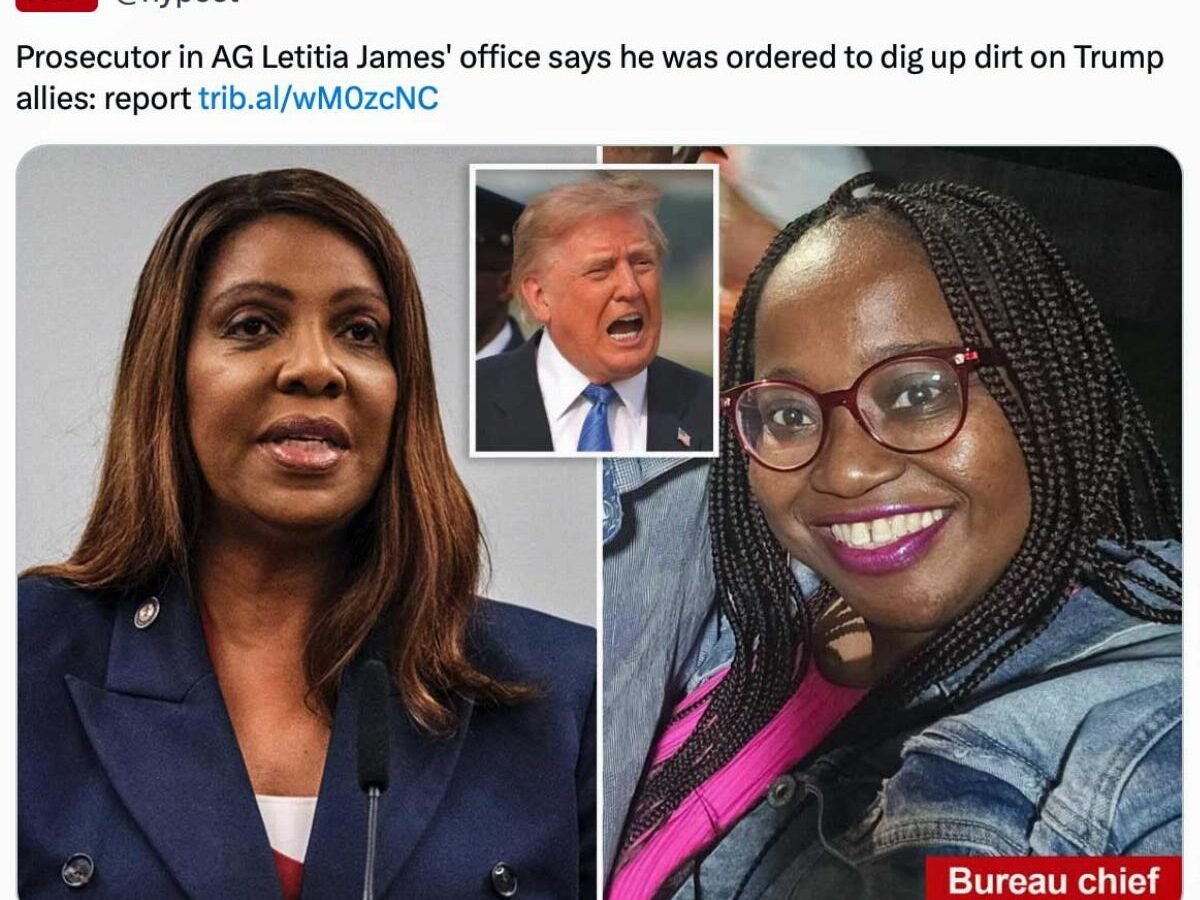
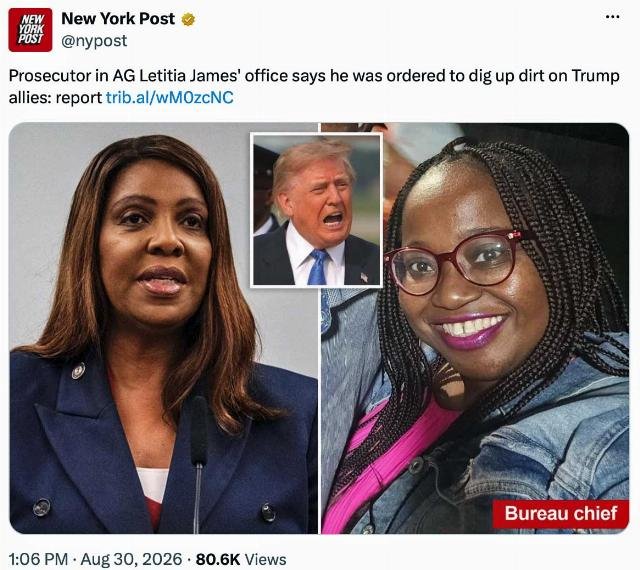
The long-running debate over whether New York Attorney General Letitia James’ prosecution of Donald Trump was politically motivated may have taken a significant turn. According to a report from the Times Union, a prosecutor inside James’ own office has alleged that he was directed to target individuals and organizations associated with the former president — without a credible legal basis.
The allegations, contained in an agency-wide email sent by Assistant Attorney General Daniel Wiesenfeld on August 28, 2026, claim that his supervisor, Investor Protection Bureau Chief Shamiso Maswoswe, instructed him to “find and pursue crimes committed by specific individuals and organizations affiliated with Donald Trump.” The email reportedly named “Trump himself, Truth Social, Hewlett Packard (DOJ approved merger)” as targets, according to a copy obtained by the Times Union.
Wiesenfeld, who has worked in the attorney general’s office for about two years, alleged that the directive came “without having a credible reason for targeting this organizations and individuals.” The email was sent to hundreds of colleagues before being quickly deleted from office servers, vanishing from the inboxes of more than 2,000 employees.
A second email and a pointed warning
After the first email was removed, Wiesenfeld reportedly sent a follow-up that opened with a defiant note about having “f*** you money” and being able to tell the truth “without fear of consequences.” In that second message, he directly compared James’ actions to the kind of politicized prosecutions that Trump’s critics have accused the former president of endorsing.
“If you believe Trump is using (Department of Justice) attorneys to prosecute his enemies and further his political interests, you should find it equally troubling that Tish is doing exactly the same thing,” Wiesenfeld wrote. He urged colleagues not to “serve as Tish’s personal attorneys by targeting her political enemies” and instead to “prosecute crimes and find the individuals accountable, rather than targeting individuals and then finding crimes.”
He also accused James of spending “significant public taxpayer dollars to target convenient public enemies” while ignoring “rampant nonprofit homeless shelter fraud and antisemitic crimes in and around synagogues.”
Official response
Following the incident, the attorney general’s general counsel, Kumiki Gibson, sent a follow-up email to staff describing the matter as “internal” and assuring employees that no one in the office was “in danger,” according to three people familiar with the communication.
James’ spokeswoman, Alexis Richards, responded to the Times Union’s request for comment with a statement: “This is a personnel matter, and the employee in question has been placed on administrative leave with full pay. The office of the attorney general is committed to upholding New York’s laws and protecting the rights and freedoms of all New Yorkers, regardless of political beliefs. We strongly reject any assertion to the contrary.”
Context: The Trump civil fraud case
The allegations come as Trump’s appeal of the 2024 civil fraud judgment against him continues to wind through the courts. That case, brought by James, resulted in a fine that was later overturned as a violation of the Eighth Amendment’s prohibition on excessive fines — a ruling that critics of the prosecution seized upon as evidence of overreach.
At the time of the trial, James and her office insisted the case was a straightforward enforcement of New York’s financial laws, pointing to evidence that Trump’s company had submitted inflated valuations to lenders. But defenders of Trump noted that the banks involved made substantial profits from their dealings with him and testified that they wanted to continue doing business with him. No victims came forward, and no fraud was alleged against any party who complained.
The use of a statute that had never been deployed in such a manner, combined with a judge known for left-leaning rulings, led many observers to conclude that the case was less about justice and more about politics — a view that Wiesenfeld’s email, if accurate, would seem to support.
Implications for the appeal and beyond
Legal analysts suggest that the alleged internal directive could have bearing on Trump’s appeal, which has argued that the prosecution was politically motivated from the start. The claim that a supervisor instructed a prosecutor to find crimes among Trump affiliates — rather than to investigate suspected wrongdoing — directly undermines the narrative of neutral enforcement that James has consistently presented.

The development also raises broader questions about the use of prosecutorial power in an era of intense political polarization. Both sides of the political spectrum have accused the other of weaponizing the justice system: Trump’s critics point to his efforts to pressure the DOJ and his threats against political opponents, while Trump’s supporters cite cases like this one as evidence that progressive prosecutors are no less willing to use the law as a political cudgel.
Wiesenfeld’s emails, if authenticated, would represent a rare instance of an insider-level acknowledgment of such targeting from within a high-profile state attorney general’s office. The fact that the emails were quickly deleted and the author placed on administrative leave may do little to quell suspicions that the office is more concerned with message control than with addressing the underlying allegations.
For now, the full contents of the emails have not been made public, and James’ office has denied any impropriety. But the episode has already given new ammunition to those who have long argued that the Trump prosecution was never about the law.
As the appeal moves forward, the courts may have to grapple not only with the legal merits of the original case but also with whether the alleged political motivations behind it — as described by one of James’ own attorneys — render the judgment fundamentally unfair.
Source: www.americanthinker.com — https://www.americanthinker.com/blog/2026/09/shocker-letitia-james-trump-prosecution-really-was-political/