
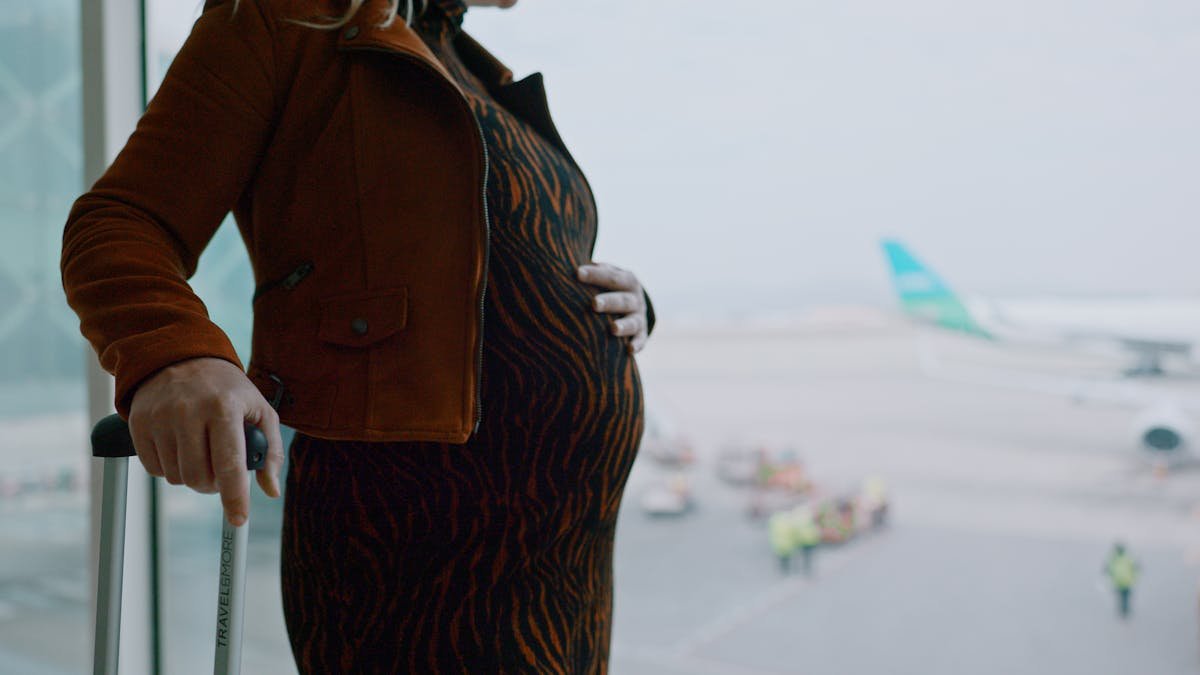
Homeland Security Secretary Markwayne Mullin said Thursday that his department is exploring a policy that would bar heavily pregnant foreign women from entering the United States, a move aimed at curbing what he described as the abuse of birthright citizenship.
In a FOX News interview Thursday morning, Mullin said he is working with the Justice Department and the Department of Health and Human Services (HHS) to determine “how we can stop some of this birthright citizenship by saying maybe you shouldn’t come to the country if you are late into your third [trimester].”
Mullin drew a parallel to existing travel restrictions for public health reasons. “We don’t allow sick individuals to come here if they are coming from an area that could possibly come in and spread a disease,” he said. “There is precedent for us to look into saying it’s not safe for you to travel.”
He added a personal note: “I know my grandson was just recently born and her OB-GYN didn’t want her flying late into her third trimester.” Mullin argued the same logic should apply to foreigners seeking to enter the U.S. late in pregnancy. “So maybe we should be looking at this — they shouldn’t be coming in late into pregnancies because I think at that point, we could cut down a lot of this birthright citizenship too,” he said.

Court setback spurs new action
Mullin’s comments come a day after a federal judge blocked the Trump administration’s latest attempt to end birthright citizenship. U.S. District Judge Deborah L. Boardman, appointed by President Joe Biden, ruled Wednesday that the policy conflicts with the 14th Amendment, writing, “The Supreme Court has spoken: Children in the certified class are ‘citizens at birth.’”
The ruling followed a Supreme Court decision in June that rejected an earlier executive order from President Donald Trump seeking to deny citizenship to children born to noncitizens on U.S. soil. After that high-court defeat, Trump signed two new executive orders — one specifically aimed at curbing “birth tourism” and another targeting visa fraud by individuals intending to give birth in the United States. The administration is now looking for administrative options, like the one Mullin outlined, that might survive judicial scrutiny.
The birth tourism landscape
Estimates vary on the scale of birth tourism — the practice of traveling to the U.S. specifically to deliver a baby and secure automatic citizenship for the child. The Center for Immigration Studies (CIS), a group that generally favors stricter immigration controls, estimates that between 20,000 and 26,000 birth tourists enter the United States each year.
The issue has drawn increasing attention from lawmakers and law enforcement. This week, Dr. Wladimir Lorentz — the founder of a birthing center marketed to foreign nationals as “Have My Baby in Miami” — was subpoenaed to testify before Congress on Tuesday. He invoked the Fifth Amendment and refused to answer questions.

Another facility, De’Ai Postpartum Care Center in Houston, is the subject of a pending state lawsuit in Texas. State officials accuse the clinic of “exploiting birthright citizenship by unlawfully facilitating the invasion of Chinese nationals … for the sole purpose of giving birth.” According to court documents, the clinic claims to have facilitated 1,000 births. The Daily Wire previously reported on homes the clinic allegedly used to house pregnant Chinese women.
Texas investigates billboard marketing
Earlier this year, Texas officials launched an investigation into a hospital that advertised “birth packages in South Texas” on billboards in Mexico, a scheme they described as part of an alleged “birth tourism” operation. The billboards promoted packages priced up to $5,525 and directed customers to a website, havemybabyinTEXAS.com. That webpage later quietly went offline, according to Chron.com.
Mullin’s proposal would represent a significant shift in U.S. entry policy, effectively adding pregnancy status to the grounds on which visa applicants or travelers could be denied admission. While the administration has framed the move as both a public health measure and an anti-fraud effort, legal experts note that restrictions based on pregnancy could face challenges under existing immigration law and constitutional protections.
The plan remains in the discussion phase, with Mullin saying his department is still working with DOJ and HHS on how to structure the policy. No formal rule change or executive order has been announced yet.

Birthright citizenship is guaranteed under the 14th Amendment, which states that “all persons born or naturalized in the United States, and subject to the jurisdiction thereof, are citizens of the United States.” The Supreme Court has long interpreted this to apply to nearly everyone born on U.S. soil, regardless of their parents’ immigration status. That interpretation has made the United States one of roughly 30 countries that offer unconditional birthright citizenship.
Advocates of restrictions argue that the amendment’s phrase “subject to the jurisdiction thereof” excludes children whose parents are in the country illegally or on temporary visas, and they see birth tourism as an exploitation of the system. Opponents counter that the law is clear and that any attempt to restrict birthright citizenship by administrative action would be unconstitutional.
The administration’s latest push comes amid a broader crackdown on immigration-related fraud. In addition to the July executive orders, federal authorities have ramped up investigations into maternity-related businesses that market to foreign nationals, often advertising “birth packages” that include transportation, housing, and hospital coordination.
What remains unclear is whether a policy based on pregnancy would apply only to tourists on short-term visas or also to those with valid longer-term visas, and how the government would determine “late into the third trimester” — a threshold that could be medically variable. Mullin mentioned he is consulting with HHS, which may provide guidance on viability, travel risk, and definition of terms.
Civil liberties groups are likely to oppose such a rule, arguing that it discriminates based on sex and pregnancy status, and that it could bar women from legitimate travel for family, business, or medical reasons. The administration has not yet released specific drafting details, and any proposed rule would first go through a public comment period before being finalized.
For now, Mullin’s remarks signal that the White House is looking for new angles to restrict birthright citizenship after two court defeats. Whether any such policy can pass legal muster remains an open question — one that could ultimately be decided by the courts again.
Source: www.dailywire.com — https://www.dailywire.com/news/dhs-considers-blocking-some-foreign-pregnant-women-from-entering-u-s