
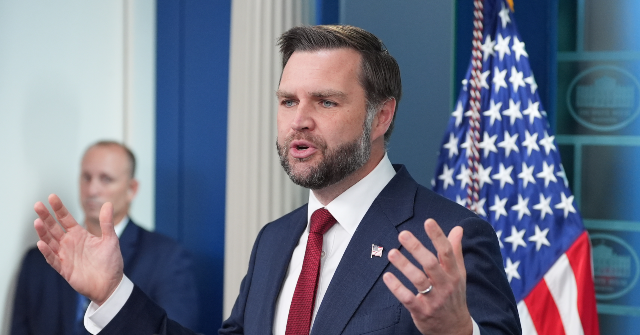
Vice President JD Vance used his first appearance at the White House podium in over a month to champion the role of alternative and non-legacy media, telling reporters Thursday that outlets like Breitbart News help democratize information and better represent Americans who feel ignored by traditional news organizations.
Speaking at the first official press briefing in 40 days, Vance opened by acknowledging the legacy of former White House Press Secretary Karoline Leavitt, who stepped down after a tenure marked by an unprecedented expansion of press access. He credited Leavitt with adding more voices to the Briefing Room and creating the so-called New Media Seat, an initiative aimed at giving independent and digital outlets a regular perch at White House briefings.
“I hope she was not watching,” Vance joked as he took the podium, thanking Leavitt for “opening the press room to non-legacy media.”
The first question of the briefing went to Breitbart News correspondent Nick Gilbertson, who asked whether the access granted under Leavitt’s tenure would continue under the new press operation. Vance answered directly, signaling that the Trump administration intends to keep those doors open.
“A lot of people have been able to get access to information and tell stories to the American people because they have something interesting to say. I would include you and our friends at Breitbart in that category,” said Vance.
His remarks come amid an ongoing debate in Washington over the composition of the White House press corps. Traditional outlets — including wire services, major newspapers, and broadcast networks — have historically dominated the front rows of the Briefing Room. But under Leavitt, the administration pushed to include podcasters, independent journalists, and digital-native platforms, arguing that the old credentialing system favored a narrow slice of the media landscape.
“For too long, people in this room and this city have tried to lock out non-legacy media and see it as a threat. It’s a way to democratize information,” Vance said. “You should not have to have a fancy credential or a lot of money to tell a story to the American people.”
The vice president framed the issue in constitutional terms, tying access to the First Amendment’s core guarantee of free expression. He argued that restricting the microphone to a select group of outlets undermines the ability of ordinary Americans to both speak and be heard.
“If only some people are given a microphone or only some media outlets given access it strikes at the heart of the ability to tell a story, it makes it harder for people to get access to their First Amendment rights,” Vance said.
Vance then pivoted to a criticism of mainstream media coverage, asserting that a significant portion of the public does not see itself reflected in the reporting produced by traditional newsrooms. “With all due respect, there are a lot of Americans who feel like they aren’t properly represented by a lot of the information on the airwaves in traditional media,” he said.
The vice president’s comments underscore the administration’s broader strategy of elevating outlets that are often sympathetic to its message while simultaneously working to diminish the influence of legacy press organizations, which have frequently clashed with President Trump and his allies. Leavitt, who became one of the administration’s most visible figures, made media access a central part of her portfolio, drawing praise from supporters and criticism from press freedom advocates who accused the White House of favoring friendly outlets over independent journalism.
On Thursday, Vance asserted that the White House under President Trump is committed to expanding that approach. He said the administration will continue to build on the ability of new media to access the president and his team “in the months and years to come.”
The briefing itself was notable not just for its content but for its rarity — the first in 40 days, a gap that drew attention from reporters and press watchdogs. The Biden administration, by contrast, held briefings almost daily during its early months, though frequency dropped off in later years.
Vance’s defense of alternative media is likely to be welcomed by conservative and independent outlets, many of which have seen their audiences grow in recent years even as traditional newsrooms face declining trust and revenue. For those outlets, the promise of continued White House access represents a tangible win — a seat at the table that was long denied to them.
But the administration’s media policy remains contentious. Critics argue that elevating partisan-friendly outlets while marginalizing established journalistic institutions undermines the watchdog role of the press. Supporters counter that the media landscape has changed, and the government’s credentialing process must reflect the reality that Americans increasingly get news from podcasts, newsletters, and social media rather than newspaper front pages or evening newscasts.
Thursday’s briefing offered no hint that the administration is easing up on its aggressive stance toward legacy media. Vance’s remarks, delivered with a mixture of humor and directness, made clear that the Trump White House considers the expansion of press access to be both a policy priority and a political imperative.
As the first questioner, Gilbertson’s presence underscored Breitbart’s elevated status within this administration. The outlet, which has long championed Trump’s agenda, has been a regular presence at White House events since 2017, but Leavitt’s reforms institutionalized that role, giving Breitbart and other non-legacy outlets a guaranteed spot at briefings rather than relying on the vagaries of the daily scramble for seats.
Whether those changes survive beyond the current administration remains an open question. But for now, Vance’s message was unambiguous: the era of locking alternative media out of the White House is over, and the administration intends to keep it that way.
Source: www.breitbart.com — https://www.breitbart.com/the-media/2026/09/03/vice-president-jd-vance-says-breitbart-news-alternative-media-important-for-representing-americans/