

For decades, Gloria Steinem’s words served as a guiding light for countless women—including Jennifer Sey, the CEO of XX-XY Athletics, a retired gymnast, and a filmmaker. In a new essay published by The Daily Wire, Sey reflects on how Steinem’s feminism shaped her life, while also drawing a hard line against Steinem’s later positions on transgender ideology.
Sey opens with the quote she used for years when interviewers asked for a favorite line: “We are linked, not ranked.” Steinem coined it in 2013 to encapsulate her vision: women as a circle, not a hierarchy. For Sey, that message was a lifeline during her corporate career in the 1990s and early 2000s, an era when conventional wisdom said there was room for only a few women at the top—and the smart play was to push aside the woman next to you.
“The problem was the ranking, not the other woman,” Sey writes.

Sey identifies as a feminist, a term she adopted in college. Before that, she was a competitive gymnast training eight hours a day, with little interest in politics. She describes her body as something coaches treated as theirs to break for their own goals—an experience she later recognized as part of a broader pattern of abuse in sport. Her awakening came when she realized her story was not a private misfortune but a systemic one.
When Sey speaks at conservative events, she often opens with the same phrase: “I am a feminist.” At Turning Point USA’s Young Women’s Conference in 2024, she faced a dilemma when she saw the conference theme printed on t-shirts: “Feminine, not Feminist.” She almost dropped her opener, but chose authenticity over comfort. She told the room she believes women should have the right to vote, to own property, to get credit in their own names without a husband’s signature, and to keep private spaces—including battered women’s shelters and locker rooms—protected. The young conservative women cheered. Sey calls that no contradiction; it is feminism that treats women as full human beings.
Without the movement Steinem helped build, Sey argues, American women would still be fighting for financial independence, locked out of professions and college majors, and without recourse against domestic abuse. She acknowledges her own criticisms of third- and fourth-wave feminism, which she says often confuse promiscuity with equality and treat the female sex as a costume anyone can don. But Steinem’s contributions to earlier, concrete freedoms are undeniable, she writes.

In college, Sey read Steinem’s 1983 essay collection, “Outrageous Acts and Everyday Rebellions,” twice. Steinem’s exposé of her undercover work as a Playboy Bunny in 1963—revealing the low pay and sexual harassment that Hefner’s clubs imposed on women—resonated deeply. “It all added up to what I already knew in my bones: women’s personal experience is a political matter,” Sey writes.
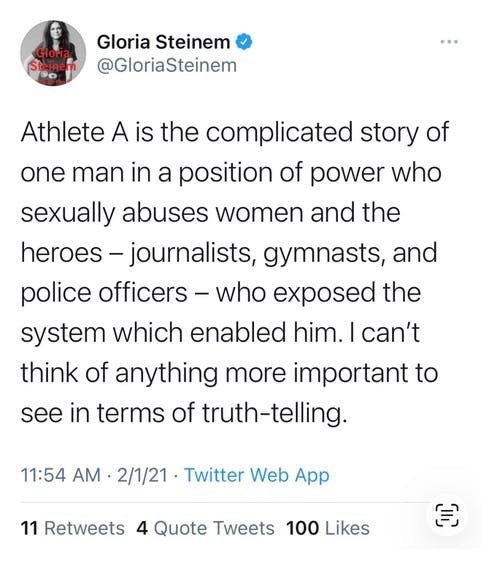
Sey met Steinem in 2018, when Sey was chief marketing officer at Levi’s. She had interviewed Alicia Keys, Justin Timberlake, and Jill Ellis, but Steinem was the only one who made her nervous. In 2020, when Sey’s documentary “Athlete A” about Larry Nassar and the system that enabled him was released, Steinem posted about it on X, praising it as a story of truth-telling about a powerful man who sexually abused women. Sey was honored—a woman who had spent her life naming power systems recognized the same architecture in sport.
But Sey’s admiration stops short of Steinem’s later views on transgender ideology. She calls them “a huge disappointment” and a continuation of the oppression of women, not a break from it. “Men in dresses insisting they are women, taking privacy, rights, and opportunities from actual women,” she writes. Sey rejects Steinem’s framing of transgender women as “linked” within the community of women. “They are men,” Sey insists, “and they are ranked at the top of the hierarchy whenever their feelings are placed above women’s sex-based rights.”
Sey points out that this conclusion was not inevitable, citing feminist icon Germaine Greer, who has said that transgender women are not women and that surgery does not change sex. “Being without a penis doesn’t make you a woman any more than being without a womb makes you a man,” Greer said. Sey says Steinem was “terribly wrong” on this issue and was “fooled” by what Sey calls “the man in the dress.”
Steinem once said a woman has two choices: “She is a feminist or a masochist.” Sey hears that line now as an indictment of women who call themselves feminists while surrendering privacy, categories, and women’s real identity to men. “On this question, that would include Steinem herself, as a masochist,” she writes.
Yet Sey refuses to discard Steinem’s legacy wholesale. “We can praise the good without incinerating the whole person,” she writes. She chooses to keep what Steinem built while rejecting the error that would undo it. “We are linked, not ranked” remains true about women—but it becomes a lie, Sey argues, when it is used to smuggle men into the circle and rank their claims above women’s real ones.
The work Steinem did in the first half of Sey’s life made the second half possible, she says. The work left to do is to defend the category Steinem spent decades insisting was real: woman.
Jennifer Sey is the CEO of XX-XY Athletics. She is an author, filmmaker, and retired national champion gymnast. This article is adapted from her essay published on The Daily Wire.
Source: www.dailywire.com — https://www.dailywire.com/news/gloria-steinem-changed-my-life-i-wont-pretend-she-was-right-about-everything