
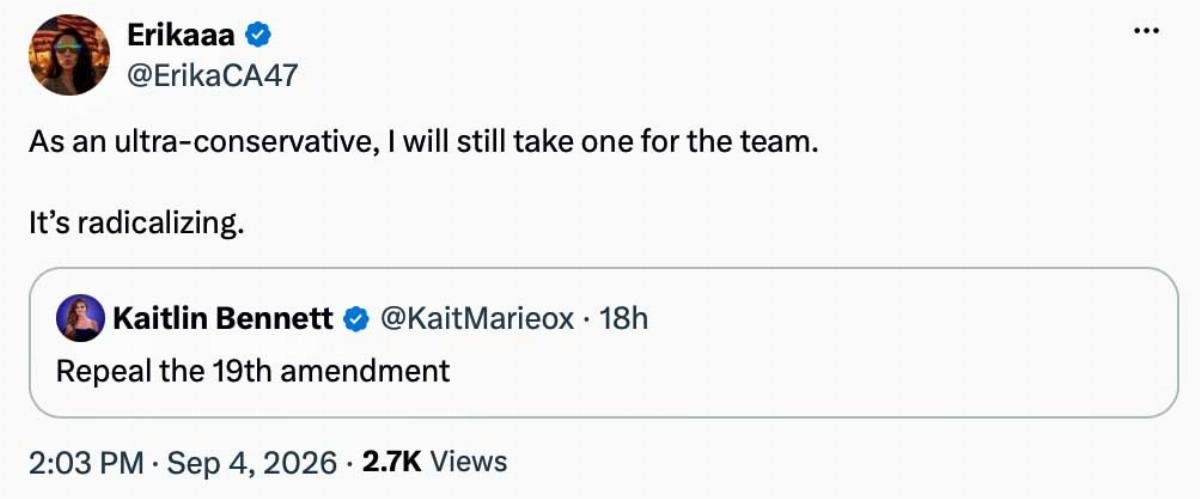
It was, by all accounts, a triumph of liberty. The 19th Amendment, ratified in 1920, finally affirmed what the suffragists had argued all along: that the Founders didn’t prohibit women from voting — they just didn’t affirm the right. “Well, let’s affirm it,” they said.
A century later, some conservative women are having second thoughts. Not about the amendment itself, mind you — but about the company it has them keeping.
Writing for American Thinker, conservative commentator M. Walter delivers a provocative and deeply sarcastic lament: “The sisterhood is roiling. More and more conservative women are watching liberal women with horror and deciding it might be best for all concerned if we just let the menfolk vote.”
The piece, titled “It seemed like a good idea at the time,” is an extended meditation on how the amendment — once championed by largely conservative, anti-abortion, anti-slavery suffragists — now stands “worse for wear” after being “touched” by progressives.
A brief history lesson, with a partisan twist
Walter takes care to note the original intent and the political history of the amendment, pointing out that the suffragists “made the simple argument that they weren’t trying to upend the classical order of things, but merely trying to fulfill it.”
The article emphasizes that it was Democrats, in Walter’s telling, who repeatedly defeated the amendment. “It wasn’t until a Republican-controlled Congress came along in 1919 that they got real traction,” she writes, noting that “twenty-six of the 36 states that ratified it had Republican legislatures.”
“So yay, right? Good for us,” Walter writes with more than a hint of irony. “As usual, the Republican Party moved toward Liberty, not away from it. But now? A century later? We have to wonder what on earth happened.”
The 60s, Gloria Steinem, and the fall
Walter’s answer to that question is blunt: “The 60s happened.”
She points to the late Gloria Steinem and the idea that “women need men like a fish needs a bicycle” as a turning point, along with “progressives who’d infiltrated absolutely every influential corner of society, like a swarm of ideological ants.” And, she adds, “the removal of God from all our public spaces, notably schools, has to be accounted for as well.”
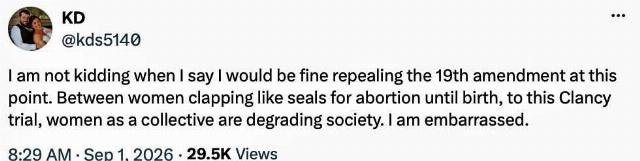
From there, Walter argues, the cultural rot set in. “The Me Generation produced a bunch of narcissists who then went on to raise a bunch of narcissists,” she writes, “and that’s who we’re seeing outside the Plymouth, Massachusetts, courthouse supporting (self-confessed) child killer Lindsay Clancy.”
Clancy, the Massachusetts mother who admitted to killing her three children in 2023, has been a lightning rod in conservative circles — and her support base, which includes some progressive women who argue she was driven to psychosis by postpartum depression, is exactly the kind of thing Walter cites as evidence of liberal sociopathy.
She also points to the recent scene in Boston, “where progressive Governor Maura Healey” signed an abortion-until-birth bill into law, surrounded by women who “smiled, clapped, and cheered.”
“If that’s not a marquee example of sociopathy, I don’t know what would be,” Walter writes.
‘We don’t want to be associated with these monsters’
The through-line of Walter’s piece is a feeling many conservative women are apparently grappling with: embarrassment at being lumped in with liberal women by virtue of shared biology.
She compares the feeling to when she first moved from Massachusetts to North Carolina and felt the need to reassure everyone that her out-of-state license plates didn’t mean she was an “insane lefty” come to ruin their state. Now, she writes, she feels a similar need to distinguish herself from other women — “the women we are seeing acting out so sociopathically lately.”
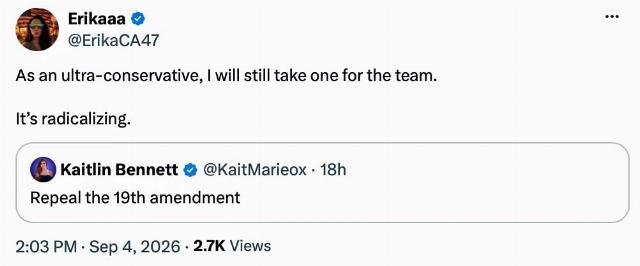
And while she acknowledges that repeal is “not going to happen,” Walter says the calls for it — coming from women themselves — are “eminently understandable.”
“We don’t want to be associated with these monsters,” she concludes.
It’s a deliberately provocative closing line from a blog that is, by its own description, a “(near) daily snapshot of Democrat words and deeds.” Walter blogs at mwalterwriter.com, where she maintains her “Lunatic Left Series.”
Context and reaction
It’s worth noting that Walter’s framing of the 19th Amendment’s history, while accurate in its broad strokes about Republican support at ratification, tends to gloss over the complex and often messy reality of the suffrage movement. Suffragists themselves were divided on race and strategy, and the amendment’s passage was far from a purely partisan affair. But as an opinion piece, Walter’s essay is less a work of historical scholarship and more a cultural commentary on where things stand a century later.
Whether conservative women are actually ready to hand the franchise back to men remains, of course, an open question. But Walter’s piece captures a genuine sentiment among some on the right: that the political divisions between women — once assumed to be a natural voting bloc — are now so stark that shared gender feels almost incidental.
For a movement that once argued that women’s votes would purify American politics, the suggestion that women’s votes are now part of the problem is nothing short of ironic.
Source: www.americanthinker.com — https://www.americanthinker.com/blog/2026/09/it-seemed-like-a-good-idea-at-the-time/