

Nearly a decade and a half after the Supreme Court upheld the Affordable Care Act, a provocative new argument has resurfaced: that Chief Justice John Roberts didn’t just save ObamaCare — he applied what one commentator calls the “Frankfurter fix,” a legal sleight of hand borrowed from the New Deal era that allowed the Court to rewrite the law after the fact.
Writing in American Thinker, John L. Smith draws a direct line from Franklin Roosevelt’s appointment of Felix Frankfurter to the Roberts Court’s 2012 decision upholding the individual mandate as a tax. Frankfurter, Smith notes, was placed on the Supreme Court as a reward for orchestrating the legal maneuvers that got much of the New Deal through Congress and the courts. His cleverest tactic, according to Smith, was labeling things as taxes rather than penalties or mandates — because the taxing power of Congress is explicitly enumerated in the Constitution.
Decades later, Smith argues, Obama’s allies overlooked that history when drafting the Affordable Care Act. Whether it was an oversight or an intentional setup, he says, the result was the same: a law whose own language never called the mandate a tax, and a Court that stepped in to decide what Congress “really meant.”
The Cato Institute’s confirmation
Smith points to the Cato Institute as confirmation that the law’s actual text never uses the word “tax” for the individual mandate penalty. And yet, in National Federation of Independent Business v. Sebelius, Roberts joined the majority in ruling the penalty constitutional under Congress’s taxing power — a move that echoed young Frankfurter’s New Deal-creating strategy, as Smith puts it.

The irony, Smith suggests, is rich: the same Chief Justice who would later be criticized for judicial activism in other contexts effectively rewrote the ACA’s language to save it. In his telling, Roberts acted like the cavalry in a Western, appearing at the last minute to rescue Obama’s signature achievement.
Painting the roses red
Smith invokes Lewis Carroll’s Red Queen — the character who paints white roses red to avoid the Queen of Hearts’ wrath — as a metaphor for Roberts’s approach. The Chief Justice, he argues, fixed the Democrats’ drafting mistake by reclassifying a penalty as a tax, much as the Red Queen alters reality to suit her needs.
The article also takes a swipe at Nancy Pelosi’s famous 2010 remark, “We have to pass the bill so that you can find out what is in it, away from the fog of the controversy.” Smith calls it a “bold, facts be damned” command, attributing to her a willingness to push legislation through before its consequences were fully understood.
A broader critique of court power
Beyond the ACA, Smith raises a broader question about judicial authority: whether the Court is “arbitrary or accurate as it chooses,” citing debates over the size of the Court — whether it should have 9 or 13 justices — as evidence that the institution’s legitimacy is increasingly contested. “Justice sometimes for some,” he quips.
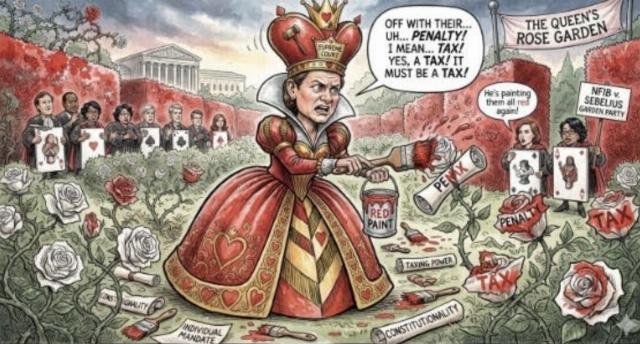
The piece also notes that calls for repeal of the ACA came from prominent Republicans, including Mitt Romney and Mitch McConnell, shortly after its passage. Yet, Smith observes, the law remains “partially on the books, and still not working well.”
The Frankfurter legacy
Smith draws heavily on Amity Shlaes’s history, Great Society: A New History, which described Frankfurter’s approach as sophistry — a term that suggests clever but misleading reasoning. The implication is that Roberts engaged in a similar kind of intellectual contortion to achieve a desired political outcome.
Whether one agrees with Smith’s framing, it raises a question that has dogged constitutional law for generations: Should the Court uphold a law based on what Congress wrote, or based on what Congress could have written under a different constitutional rationale?
Critics of the ACA decision have long argued that Roberts’s tax rationale was a stretch — that the penalty was designed to be a penalty, not a tax, and that the Court merely avoided a constitutional crisis by pretending otherwise. Supporters counter that the mandate was always a reasonable exercise of Congress’s taxing power, even if the drafters were too politically timid to say so.
Smith’s commentary lands squarely in the former camp, but his lens is historical: he sees Roberts not as a textualist or a pragmatist, but as a jurist who revived a New Deal-era playbook to settle a political fight.
The result, he suggests, is a Court that increasingly sees itself as editor-in-chief of Congress’s work products — and a democracy that’s poorer for it.
Source: www.americanthinker.com — https://www.americanthinker.com/blog/2026/09/chief-justice-roberts-applied-the-frankfurter-fix/