

The soaring cost of higher education and the proliferation of majors have turned the choice of a college major into one of the most consequential financial decisions many young Americans will make. Yet a new analysis argues that too many students are still being nudged toward that decision by romantic notions of “finding their passion” rather than by a hard-headed look at the labor market.
The analysis, published by the Daily Wire, is the fourth installment in a series examining the pressures reshaping American higher education. It lands amid growing national anxiety over student debt and the value of a degree, and it punches hard at the idea, often promoted by colleges themselves, that the piece of paper is what matters most.
“A college degree does not confer prosperity by itself,” the piece warns. “Marketable, advanced skills do.”
Passion vs. Practicality
The report takes aim at the “find your passion” trope that dominates college advising, arguing that it distracts students from questions with far greater consequences for their financial futures. Students are led to believe that studying something they love will never feel like work, that passion is innate, or that difficulty in a subject is a sign they’ve chosen wrong. But the advice, the piece says, often ignores the economic realities of different fields.
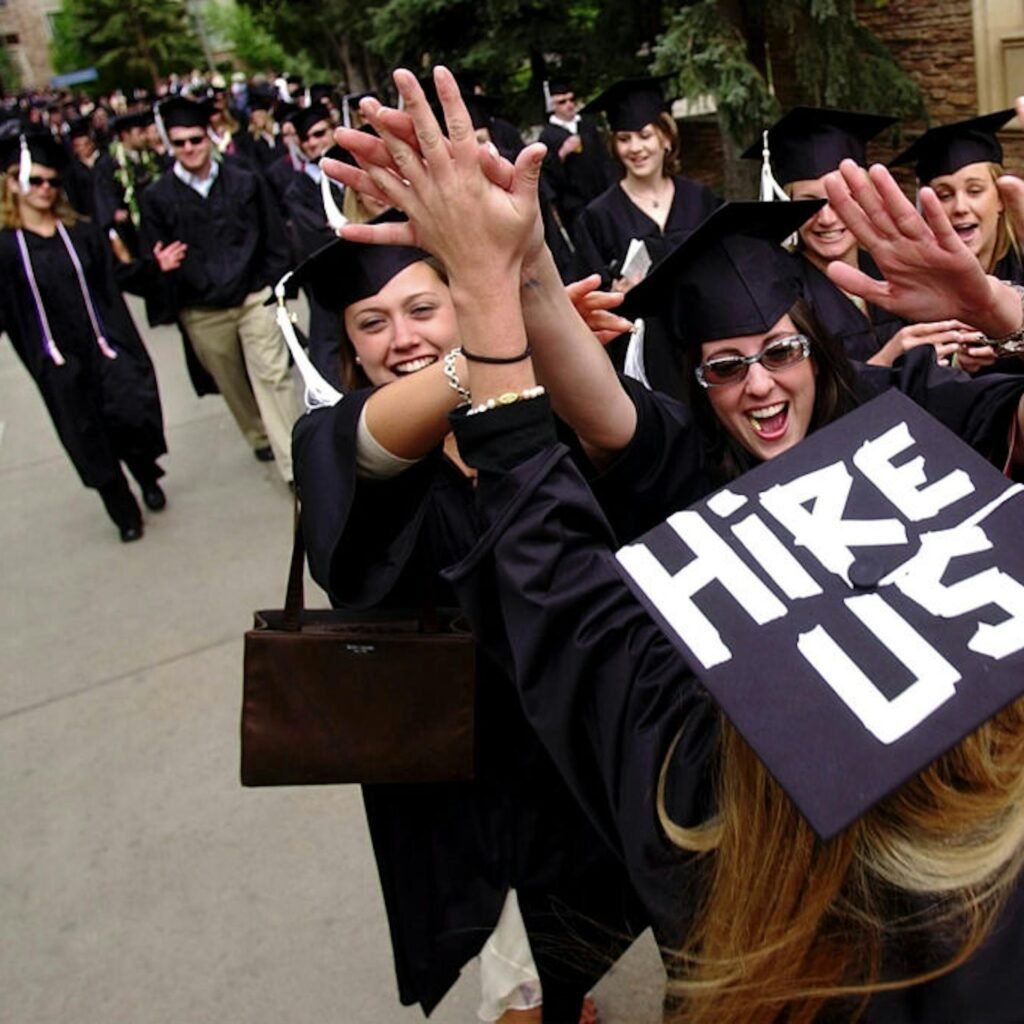
“As society becomes increasingly technology- and information-driven, scalable skills that are difficult to replicate tend to command higher premiums,” the article states, pointing to STEM fields as the clearest examples.
The data it cites are stark. According to the National Association of Colleges and Employers (NACE), the average starting salary for computer science graduates in the Class of 2024 was $101,661 — more than double the $43,639 average for graduates in fine and studio arts. Georgetown University’s Center on Education and the Workforce reports that prime-age workers with bachelor’s degrees in STEM fields earn a median of about $98,000, compared with roughly $58,000 for those in education and public-service fields — a gap that persists even when STEM graduates take jobs outside STEM.
Even popular non-STEM majors do not always deliver the career outcomes students expect. Psychology, which has ranked among the five most popular majors for decades, saw starting salaries average about $40,000 in 2026, with five-year salaries reaching roughly $52,000, according to the analysis. Many professional psychology positions require additional degrees and credentials, meaning a student can spend four years and significant money on a bachelor’s degree and still find themselves unqualified for the career they imagined.
The report also notes a troubling pattern of “doubling down.” When graduates discover their employment prospects are weak, they often pursue a master’s degree in the same field — without asking whether the additional investment will pay off. That can lead to six or more years of education, substantial debt, and job prospects not much better than those of a high school graduate.

The Case for Community College
The analysis, however, is not an argument against college entirely — nor does it urge students to abandon their interests in favor of a paycheck. Instead, it makes a case for approaching the decision analytically, asking: What am I good at? What valuable skills can I develop? How much will they cost? And what am I likely to earn after graduation?
For students focused on cost and value, the piece points to community colleges as an underappreciated option. Once known mainly for providing the first two years of a traditional education, community colleges have evolved into comprehensive institutions that now offer transfer programs, vocational and technical training, industry credentials, and, increasingly, bachelor’s degrees of their own.
The financial advantages are hard to ignore. Average tuition and fees run about $4,150 per year for in-district community college students, compared with $11,950 at a public four-year college for in-state students and $45,000 at a private nonprofit four-year college. The analysis notes that, as of 2026, roughly 35 states have programs making community college tuition-free for at least some students.
The article cites federal College Scorecard data showing that earnings for holders of some community-college degrees and certificates can exceed those of many bachelor’s-degree holders. Short-term certificates and career-focused programs in fields like nursing, HVAC, welding, cybersecurity, and health services can lead directly to jobs — some with median salaries reaching six figures.

The piece also suggests a strategic approach: a student could complete the first two years of a bachelor’s degree at a community college at substantially lower cost — especially while living at home — then transfer to a four-year institution. Or they could pursue one of the growing number of four-year degrees offered by community colleges themselves.
The Bigger Question
The analysis argues that the conventional framing of the college decision — “Should I go or shouldn’t I?” — is far too narrow. That is only the first question. The more important one is: What should I study? And too often, students answer that question by enrolling, sampling courses, and picking a major based on where their interests happen to land, without ever pushing themselves to consider the economic return on their investment.
“This is not an argument against majoring in psychology or any field,” the article says. “Nor does it mean students should abandon their interests or choose a major based solely on salary. Students should, however, understand the economic consequences of their choices.”
The analysis comes at a time when the value of higher education is being debated from the White House to the kitchen table. The report’s authors note that, for some Americans, college was the worst financial decision they ever made — leaving them with debt that can “hamstring them for decades, even after earning a diploma.”
The piece does not conclude that a degree is never worth it. It concludes that the decision must be made with eyes open — because the degree itself is not the destination.
“Graduation is the beginning of a career journey, not its destination,” the article reads.
Source: www.dailywire.com — https://www.dailywire.com/news/rethinking-college-choose-the-path-not-just-the-degree