
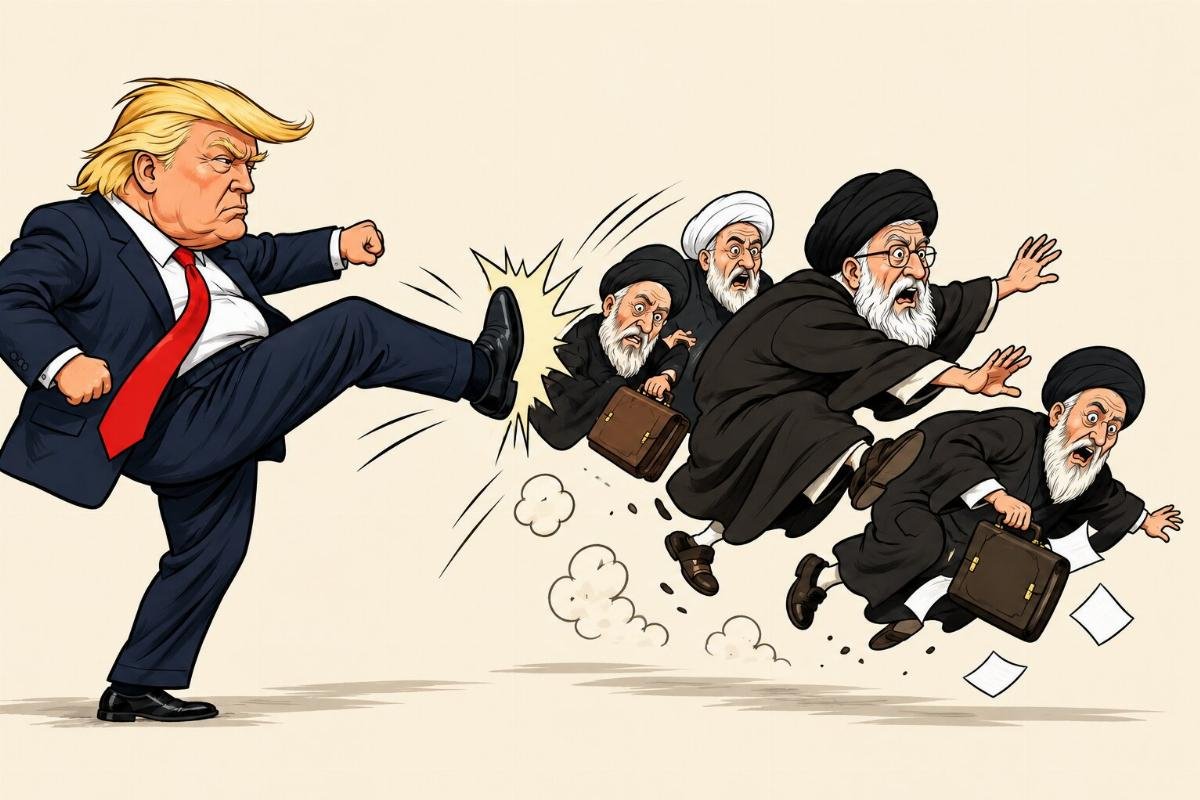
What would it actually take for the United States to declare victory over Iran’s nuclear program? According to retired Marine Corps officer and author James Zumwalt, writing in American Thinker, there are only two possible endings—and neither involves a signed treaty.
In a column published September 8, 2026, Zumwalt argues that any peace agreement leaving the mullahs in power is “totally meaningless.” The only paths to victory, he contends, mirror the fates of two other Middle Eastern autocrats: Syrian President Bashar al-Assad, who fled to Russia after his government collapsed, and Libyan strongman Muammar Qaddafi, who was captured and killed by his own people in 2011.
The mullahs’ wealth problem
Zumwalt’s argument begins with a portrait of today’s Iranian clerical leadership—one starkly different from the austere revolutionaries of 1979. Under Ayatollah Ruhollah Khomeini, he writes, the mullahs were poor men whose income came mostly from preaching at mosques. Their primary transportation, he jokes, was “quite appropriately, the ass.”
But after taking power, Khomeini created an institution called Setad, which steadily expanded state assets under the direct control of the Supreme Leader. That institution, Zumwalt says, transformed today’s mullahs into beneficiaries of a “gravy train”—religious leaders whose private greed is disguised as devotion to Twelver Shiite Islam.
He points to the late Supreme Leader Ayatollah Ali Khamenei, who was killed in an Israeli air attack on February 28, 2026. While Khamenei publicly projected a simple, spiritual life, Zumwalt says his hidden wealth was estimated between $95 billion and $200 billion. Among those hidden assets was a horse-raising hobby worth tens of millions of dollars.
“Regardless of how wealthy one is, one is unable to take it with him when death calls,” Zumwalt writes.
The Assad blueprint
Zumwalt notes that in January 2026, national protests across Iran had already prompted Khamenei to prepare a contingency plan to fly to Russia. Though he never executed it, the plan’s existence—and its likely replication among other senior mullahs—suggests the regime is already contemplating escape routes as domestic unrest grows.
The template for such an exit, Zumwalt argues, is al-Assad. The former Syrian president, who ruled for 24 years, quietly fled his country on December 8, 2024, after lying to his followers that Russian troops would save them. He now lives in exile in Russia.
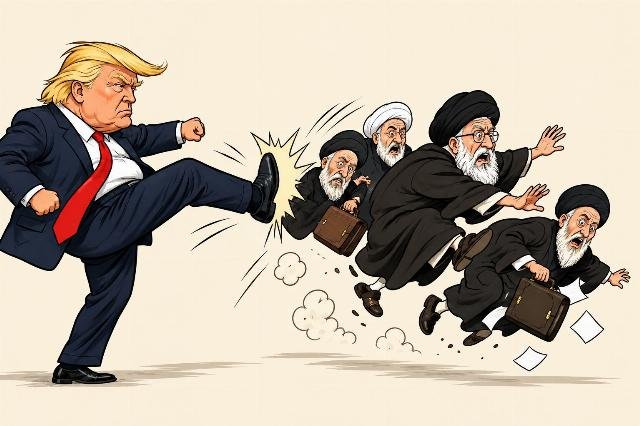
If Iran’s mullahs were to follow suit, Zumwalt says, the result would be a victory in the sense that they would no longer be able to wield direct influence. Wealthy as they are, they have the assets to “beat feet out of the country”—and hopefully, the departure of one mullah would trigger a chain reaction among the others.
The Qaddafi alternative
The other possible outcome, Zumwalt writes, is the Qaddafi end. The Libyan strongman took power by coup in 1969 and ruled brutally for 42 years before his people revolted in 2011. When he tried to flee Tripoli by ground, a 75-vehicle convoy drew the attention of French aircraft, which split it apart. Qaddafi’s remaining eleven vehicles were destroyed, and he fled on foot before being captured and executed by his own people.
Zumwalt sees a common thread in the mindset of Middle East autocrats: a delusion that they own the countries they rule. To dispossess them of that fantasy, he says, there are only two paths—the Assad route of forced exile, or the Qaddafi route of popular justice. The changes in Libya and Syria, he argues, came about precisely because those leaders met those fates.
Why a peace deal isn’t enough
The stakes, Zumwalt says, are that any negotiated settlement with Iran that preserves the mullahs’ influence would simply leave the nuclear threat intact. “Frankly,” he concludes, “it would make for a much better world should the mullahs go the way of Qaddafi.”
Zumwalt acknowledges that Libya remains chaotic, citing a recent U.S. State Department travel advisory. But his larger point stands: removing the autocrat, whether by exile or elimination, is the only way to truly end a regime’s threat.
As the Iranian protests grow and the mullahs’ contingency plans evolve, the question Zumwalt raises is not whether Iran’s rulers will fall, but which model their downfall will follow—and whether Washington is prepared to accept nothing less than their complete removal.
Source: www.americanthinker.com — https://www.americanthinker.com/blog/2026/09/only-two-ways-to-ensure-us-victory-in-iran/