
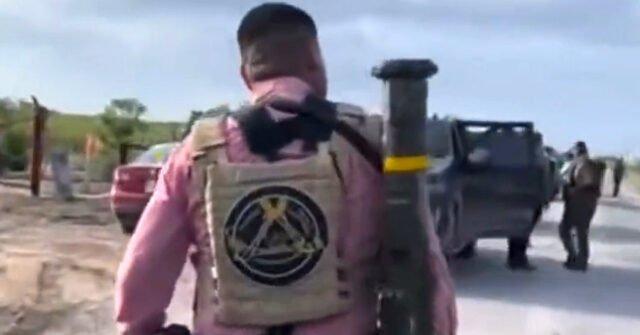
Secretary of State Marco Rubio said large portions of Mexico remain under the de facto control of criminal organizations he described as terrorist cartels, warning that the threat will have to be confronted whether or not Mexico’s government signs on to the effort, according to reporting by Breitbart.
Speaking during a visit to Ecuador, where he met with that country’s leadership to bolster its own fight against organized crime, Rubio offered a blunt assessment of Mexico’s security situation. He credited Mexican authorities with doing more than ever before against the cartels, but said the results fall far short of what is needed.
“The Mexicans have done more than ever before to go after these groups, but it is still not nearly enough,” Rubio said. “They know that. We have expressed that to them.”
Rubio’s trip to Ecuador was aimed at deepening cooperation with a government that has shown willingness to accept direct U.S. assistance against criminal networks. Several countries across Central and South America have opened the door to that kind of support, including the deployment of American military assets working alongside local forces to identify and take out cartel targets.
A Sovereignty Dispute With Mexico
Mexico, by contrast, has not agreed to allow U.S. troops on its soil. President Claudia Sheinbaum has invoked national sovereignty to keep American forces out, even as she has permitted intelligence sharing between the two countries and allowed Mexican troops and police to carry out raids based on that information.
That arrangement has drawn international criticism, particularly as several members of Sheinbaum’s political party have been implicated in cartel-linked activities. As Breitbart Texas has reported, the sitting governor of Sinaloa, Ruben Rocha Moya, is wanted by the U.S. Department of Justice on drug trafficking conspiracy and weapons charges over his alleged work with the Sinaloa Cartel. Sheinbaum has publicly defended Rocha Moya, saying the United States has not provided evidence of wrongdoing on his part.
Rubio framed the current arrangement as a partial step rather than a solution. He said the preferred path is a joint operation with Mexico’s government, but he left little doubt that the United States sees the cartels as a threat that cannot be left unaddressed indefinitely.
“Our hope, our intent is to do it in partnership with Mexico,” he said. “That’s the ideal, but eventually that threat will have to be confronted one way or the other.”
The secretary pointed to the daily toll of cartel violence as evidence that large areas of the country operate outside the reach of the Mexican state. He said public opinion polling consistently ranks security as the top concern for Mexicans, and he listed the targets that criminal groups strike with impunity.
“The people of Mexico will tell you that,” Rubio said. “The number one issue in Mexico, poll after poll shows, is security. Political candidates are routinely assassinated in Mexico, judges routinely assassinated, journalists who report on the cartels routinely assassinated by these groups.”
A Regional Push, With Mexico Holding Back
Rubio’s comments in Ecuador reflect a broader push by the Trump administration to build a coalition in the hemisphere against drug trafficking organizations, which it has moved to designate as terrorist entities. Countries that accept the framework gain access to U.S. military assets and intelligence support; those that decline, like Mexico, remain partners in a more limited, law-enforcement-focused capacity.
That distinction has become a friction point in U.S.-Mexico relations. Sheinbaum’s government has emphasized that it will not permit American military operations on Mexican territory, while U.S. officials have grown increasingly impatient with the pace of progress. Rubio’s language — that the threat will be confronted “one way or the other” — is likely to be read in Mexico City as a signal that Washington is keeping unilateral options open.
The secretary’s remarks also come amid a widening corruption scandal in Sinaloa, where Rocha Moya remains in office despite the U.S. charges against him. The case has become a symbol of the difficulty Washington faces in pressing Mexico to act against officials suspected of ties to the very organizations they are supposed to be fighting.
For now, cooperation continues in a narrow lane: shared intelligence, Mexican-led raids, and public pressure from Washington. Whether that arrangement expands into the kind of joint military campaign Rubio described as the “ideal” remains an open question, one that will shape the security relationship between the two neighbors for years to come.
Source: www.breitbart.com — https://www.breitbart.com/border/2026/09/10/rubio-there-are-vast-territories-in-mexico-controlled-by-terrorist-cartels/