
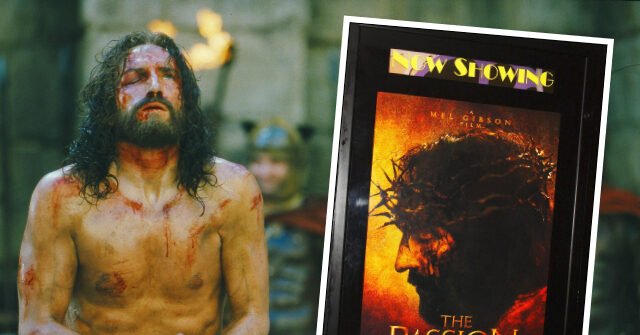
Mel Gibson’s The Passion of the Christ is back in theaters, more than two decades after it stunned Hollywood by turning a graphic, Aramaic-language depiction of the crucifixion into a global box office phenomenon.
Lionsgate has mounted an official re-release of the 2004 film running from September 10 through September 17, according to Breitbart News. Screenings will include an exclusive behind-the-scenes look at The Resurrection of the Christ, the long-gestating sequel Gibson has been developing for years.
The revival places the film in a rare category of biblical epics that have stayed in the cultural bloodstream long after their initial runs — titles like Ben-Hur, The Ten Commandments, and Jesus of Nazareth. But unlike those predecessors, Gibson’s film arrived in an era of multiplex dominance and carried an R rating, a combination that made its commercial performance all the more unusual.
A box office run nobody predicted
When The Passion of the Christ opened on February 25, 2004, it did so amid heavy skepticism from industry observers. A film told largely in dead languages, with subtitles and prolonged sequences of violence, was not considered a formula for mainstream success.
It became the highest-grossing R-rated film of its time, finishing with $612 million worldwide. Critics who approached the film on its own terms were often effusive. Roger Ebert awarded it four stars in the Chicago Sun-Times, writing that he preferred “to evaluate a film on the basis of what it intends to do, not on what I think it should have done,” and concluding that Gibson clearly wanted to make “graphic and inescapable the price that Jesus paid (as Christians believe) when he died for our sins.”
Twenty-two years on, the film’s audience has not dispersed. It has become a fixture of Holy Week viewing for many Christian households, a pattern of repeated annual engagement that few releases of any genre manage.
Gibson on why the film landed
In a recent interview with EWTN’s Raymond Arroyo, Gibson described his aim as stripping away the polish that had characterized earlier screen depictions of the crucifixion.
“I just wanted to make it as real as possible for people to enter into that journey, which is pretty grueling,” Gibson said. He argued that prior versions “had been pretty much sanitized, and they made it look easy, and it wasn’t.”
Reflecting on the film’s reception, Gibson said audiences had a “hunger for it” that drove them to “see it in droves.” He added that the success encouraged other filmmakers of faith to pursue their own projects — what he described as “zeal amongst faith-based people and filmmakers to explore it further.”
Gibson also noted that star Jim Caviezel initially hesitated about taking the role, saying the actor “didn’t want to do it.”
What the sequel will look like
The two-part Resurrection of the Christ is set for release in May 2027. Gibson has said the project will stay anchored in Christian orthodoxy while filling in narrative space the Gospels leave open.
Speaking to the Christian Post, the director pointed to the synoptic nature of the Gospels — the idea that they do not record everything Jesus said and did. He cited the Gospel of John’s remark that the world could not contain the books that would be needed to record all of it.
“One can look at these things and go, ‘I wonder what was around that?’ and try and analyze those things and make suppositions about what might have been,” Gibson said. He described the approach as “not to go against anything in orthodox teaching but to enhance, I think, what’s there for everyone to see,” adding that he hopes audiences “will be surprised by some of those revelations.”
Gibson invoked Franco Zeffirelli’s 1977 miniseries Jesus of Nazareth as a model for that kind of creative expansion — a production that likewise wove imaginative detail around the scriptural skeleton.
Why a re-release now
The timing of the theatrical run is not accidental. With the sequel roughly eight months from its scheduled debut, the re-release functions as both a commercial revival and a promotional runway, reintroducing the original film to audiences who may have seen it only on home video or never in a theater at all.
That distinction matters for this particular title. The Passion of the Christ was designed as an immersive, large-format experience, and its intensity has long been cited by both admirers and detractors as central to its effect. A theatrical screening restores the conditions under which it first provoked such strong reactions.
The behind-the-scenes footage attached to each showing gives audiences their first substantial look at what Gibson has been building — and a reason to buy a ticket rather than wait for streaming.
For Lionsgate, the week-long run carries relatively low risk with a known quantity. For Gibson, it offers an early temperature check on whether the appetite that greeted the crucifixion story in 2004 will extend to what he has suggested comes next.
Source: www.breitbart.com — https://www.breitbart.com/entertainment/2026/09/10/mel-gibsons-passion-of-the-christ-enshrines-its-legacy-with-theatrical-re-release/