
The United States quietly joined Britain and Norway in confronting a covert Russian operation in Arctic waters earlier this year, according to newly reported details of an episode that NATO allies deliberately publicized to deter Moscow from targeting the undersea cables that carry global internet traffic.
Reuters reported Thursday that the April operation, first disclosed at the time by British and Norwegian authorities, involved a Russian submarine squadron tracked for more than a month as it surveyed a pair of cables running nearly 9,000 feet deep between mainland Norway and the Svalbard archipelago near the North Pole. What had not been reported until now, the news agency said, was the location of the operation, the nature of a specialized Russian weapon involved, and the previously undisclosed U.S. role in helping break it up.
A weapon built to leave no fingerprints
According to Reuters, the Russian submersibles were carrying a “secret weapon” designed to sever undersea cables without leaving evidence pointing back to Moscow, and the April mission amounted to a clandestine rehearsal for deploying it. Three Russian submarines were detected operating in British territorial waters in connection with the effort, the report said.
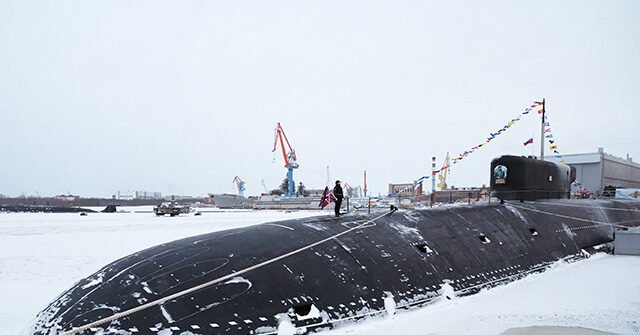
British and Norwegian forces shadowed the Russian vessels for over a month before the British Defense Ministry went public and effectively forced a withdrawal. Then-UK Defense Minister John Healey, in remarks cited by Reuters, said the squadron included an Akula-class attack submarine and two specialized submersibles belonging to Russia’s Main Directorate for Deep Sea Research, known as GUGI.
Healey described the GUGI vessels as “designed to survey underwater infrastructure during peacetime, and sabotage it in conflict.” His public message to Russian President Vladimir Putin was blunt: “We see you. We see your activity over our cables and our pipelines, and you should know that any attempt to damage them will not be tolerated and will have serious consequences.”
He added that the allied response left the Russian crews “in no doubt that they were being monitored, that their movements were not covert, as President Putin planned, and that their attempted secret operation had been exposed.”
Showing Moscow what NATO knew
Reuters reported that beyond the public callout, the NATO members deliberately signaled to Russia that they understood the secret weapon and how it functioned — a calculated move intended to convince the Kremlin that the device could not be used without attribution. Two unnamed officials confirmed the U.S. involvement in tracking and confronting the submarines for the first time.

Norway was the only party willing to speak on the record about the operation. Defense Minister Tore Sandvik said Thursday that the joint effort “sent a clear message to Russia that they cannot operate covertly.”
“We have made it unequivocally clear to Russian authorities that any attempt to target our critical infrastructure will be detected and met with consequences,” Sandvik said, adding that “it is in no one’s interest to escalate tensions in the High North.”
The White House and the CIA declined to comment, according to Reuters. The British Defense Ministry pointed back to its earlier statements, and Russia — which has never acknowledged maintaining an undersea sabotage program — offered no response.
Why Svalbard matters
The target of the Russian exercise was the Svalbard Undersea Cable System, originally laid to carry data from satellite ground stations in Svalbard for NASA and now the primary internet link for one of the world’s northernmost inhabited communities.
The vulnerability of such infrastructure has become a growing preoccupation for security analysts. Reuters noted that the fiber-optic cables forming the backbone of the global internet stretch for hundreds of miles yet are scarcely thicker than a garden hose — difficult to police and, at extreme depths, difficult to repair or defend.
The Reuters report also highlighted a pattern of suspicious maritime activity in recent years, in which ships “sailed slowly over or near sensitive subsea infrastructure including pipelines, power cables and telecoms cables to map their location.” The practice, known as drifting, has drawn particular scrutiny when conducted by Russian and Chinese vessels, since the resulting charts of cable routes have no obvious civilian purpose. At least 11 incidents of undersea cable damage were reported between 2023 and 2025, according to the report.
NATO navies have managed to reduce the frequency of drifting incidents through increased surface and air patrols, though the underlying asymmetry remains. Bruce Jones, a senior fellow at the Brookings Institution, framed the problem for Reuters as a quarter-century of twin mistakes in Europe: a dramatic expansion in reliance on seabed infrastructure paired with a dramatic shrinking of the capacity to protect it.
“It’s belatedly rebuilding now, in the face of a burgeoning Russian threat,” Jones said.
Source: www.breitbart.com — https://www.breitbart.com/national-security/2026/09/10/u-s-joined-nato-allies-to-thwart-russias-arctic-sabotage-plot/