
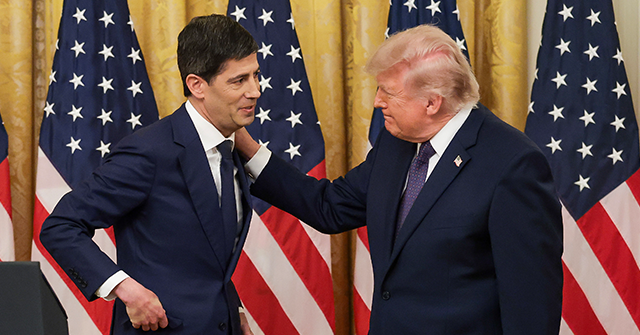
President Donald Trump declined to criticize Federal Reserve Chair Kevin Warsh after the central bank raised interest rates this week, a decision that Breitbart’s Business Digest framed as a refusal to “launch World War Warsh” and a deliberate sidestep of what it described as a media trap.
The Federal Open Market Committee raised its overnight federal funds rate by a quarter of a percentage point, a move widely anticipated. What drew less attention, according to the Breitbart digest, was the reaction from the White House. The outlet noted that much of the financial press had expected the president to lash out at Warsh, whom he appointed, for agreeing to the hike.
Trump instead expressed confidence in Warsh. Breitbart wrote that the president did not take the bait and that, if you listened closely, you could almost hear the weeping of the financial press as they were forced to rewrite stories depicting a fight between Trump and Warsh.
Rate Hike Meets Little Market Pushback
By the Fed’s own measures, the hike affected two rates directly: the overnight federal funds rate that the committee targets and the interest on reserves rate it sets. The benchmark 10-year Treasury yield, which influences mortgages and corporate borrowing costs, barely budged. It closed Thursday at 4.9470 percent, down from the prior Friday’s close of 4.9750 percent, and sat near 5 percent by Friday afternoon, slightly below where it stood when the FOMC announced its decision.
The 30-year Treasury yield, which Breitbart said had drawn unusual attention in prior weeks, dipped from 5.354 percent to 5.328 percent over the same period — meaning longer-term rates actually fell even as the Fed raised its short-term target.
The Quiet Shift in the Fed’s Longer-Run Forecast
Breitbart highlighted what it called arguably the most important element of the Fed’s Summary of Economic Projections: the longer-run estimate of the fed funds rate, a figure it said hardly anyone watches. Warsh has signaled he wants less emphasis placed on the SEP, but the digest argued it remains worth tracking.
That longer-run estimate had drifted steadily downward for years after the Fed began publishing it in 2012, a period defined by debates over secular stagnation and a global savings glut. It started at 4.3 percent in 2012 and fell to 2.5 percent by 2019, then stayed roughly flat through the pandemic and the inflationary surge that followed. Breitbart suggested this stickiness may help explain the Fed’s slow response to inflation during the Biden era, since officials did not view rates as especially low even when they were near zero.
The estimate rose to 3 percent in 2024, held there until this summer, then climbed to 3.1 percent in March and 3.2 percent at the most recent meeting. With the longer-term inflation estimate unchanged at 2.0 percent, the Fed now effectively believes the fed funds rate should sit 1.2 percentage points above its inflation target — more than double the gap that prevailed from 2019 through 2024.
At the same time, the median unemployment forecast for this year and the next two was revised down and growth revised up. Core PCE inflation was revised up by 0.1 percentage point for 2026, left unchanged for 2027, and raised 0.1 percentage point for 2028.
Growth Outlook Strengthens, and Risks Tilt One Way
The Fed’s growth expectations have shifted notably. When the median GDP growth forecast was first included in the SEP in mid-2015, the longer-run tendency stood at 2 percent. It was trimmed to 1.8 percent in September 2016 and stayed roughly there for about nine and a half years, until March, when it returned to 2.0 percent. Breitbart noted that compounding such a change over a decade amounts to a significant difference in the size of the U.S. economy.
Near-term projections also improved. In June, the Fed projected 2.2 percent real growth for this year and 2.3 percent for next year. It now sees 2.3 percent this year and 2.4 percent next year, with growth above the 2 percent longer-run estimate even in 2028 and 2029.
Breitbart pointed out that no Fed officials in the SEP recorded downside risk to their growth projections — only upside risk, which the outlet said was the first time that has happened.
The digest also argued that Warsh’s comments at his press conference made clear he does not view business investment, capital expenditures, the AI boom, or low unemployment as inflationary, treating the inflation discussion as separate from the growth discussion. Breitbart read this as a sign that Warsh does not subscribe to the Phillips Curve, the theory that strong growth or high employment drives prices higher. It added that the median inflation projection for next year shows a substantial decline with only one more hike, no rise in unemployment, and accelerating growth.
Immigration policy also entered the picture. Breitbart observed that many economists had criticized Trump’s immigration restrictions on the grounds that they would reduce economic growth, but Fed officials now expect more growth — implying improved productivity growth, and an even better per capita picture than when officials assumed immigration-driven population gains.
A Historical Echo From 1873
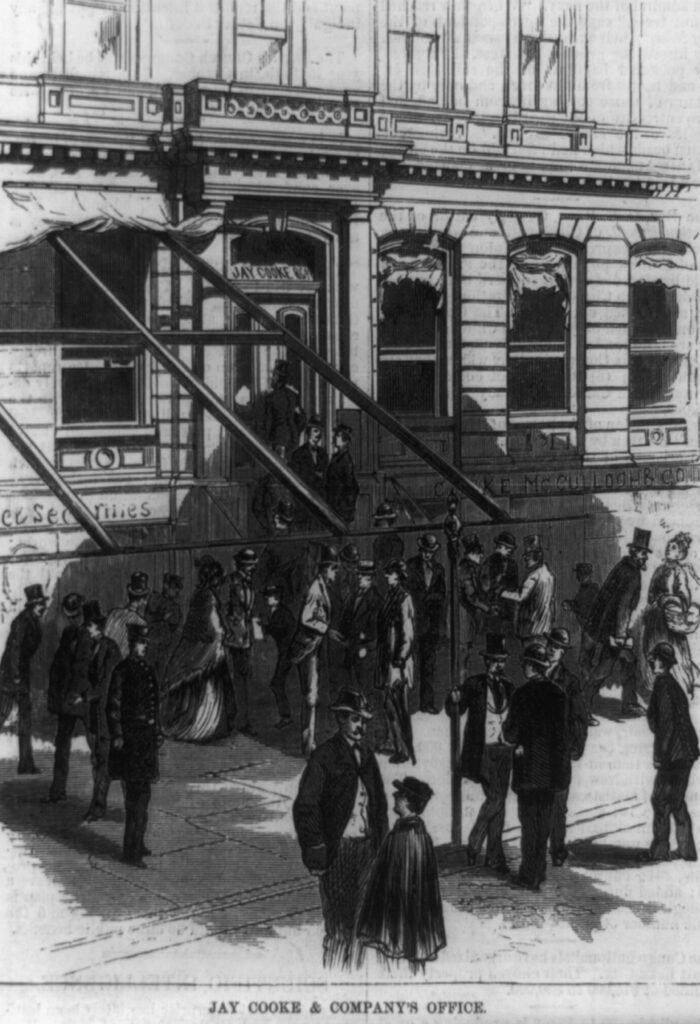
The digest closed with a historical note marking the anniversary of the Panic of 1873. On September 18 of that year, Jay Cooke & Company closed its doors after exhausting its resources financing the Northern Pacific Railway. The firm had prospered selling government bonds to Americans, but railroad bonds proved a harder sell, as construction demanded capital long before tracks could carry paying customers.
Financial trouble in Europe prompted investors to sell American securities, complicating railroad financing further. Cooke’s failure panicked investors, creditors, and depositors across the banking system. The New York Stock Exchange shut down on September 20, and trading remained suspended for ten days; at least 100 banks failed. Railroad bankruptcies multiplied, businesses closed, and within two years 18,000 businesses had failed. The railroad boom had added 35,000 miles of track between 1866 and 1873, and the depression that followed outlasted the immediate banking emergency, troubling the country through the rest of Grant’s presidency.
Source: www.breitbart.com — https://www.breitbart.com/economy/2026/09/18/breitbart-business-digest-trump-refuses-to-launch-world-war-warsh/