
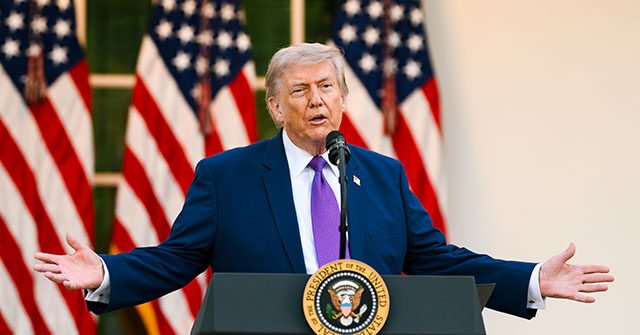
President Donald Trump suggested in an interview aired Thursday on Fox News’ “Ingraham Angle” that the election could be a factor in how far he takes the conflict with Iran, telling host Laura Ingraham that full-scale action against the Iranian regime may be something he holds off on for electoral reasons.
According to a clip flagged by Breitbart News, Ingraham pressed the president on the internal debate within his own coalition, noting that even prominent neoconservatives have been urging him to move decisively if he moves at all.
“But even the neoconservatives are saying, if you’re going to go in, go in full, just go in and take them out,” Ingraham said, per the excerpt.
Trump’s reply, as aired, tied the scope of any such operation directly to the political calendar. “Well, maybe I don’t do that because of the election,” he said.
A Strait, 22 Boats, and a Pressure Campaign
The president went on to describe what he framed as a posture of strength that does not require a full-scale push into Iran to be effective. As Breitbart relayed it, he said his administration is “taking a lot of oil,” adding that “last night, we took 22 boats out of the strait. We control the strait. They don’t control the strait.”
The Strait of Hormuz, the narrow waterway at the mouth of the Persian Gulf through which a large share of global oil trade moves, has been a central arena of the Iran standoff. Trump’s assertion that the United States, rather than Tehran, controls the strait amounts to a claim that the strategic balance has already tilted decisively.
Whether that claim holds is a matter likely to be contested by both Iran and independent analysts, but it is the president’s own characterization of the state of play, delivered to a friendly interviewer in prime time on Fox News.
His language also leaned heavily on economic distress inside Iran. Per the interview, Trump said Iran “controls nothing,” citing “300% inflation” and asserting that the regime is “not paying their military” and “not paying their law enforcement.”
He added a prediction about where that failure of payment could lead: “at some point, the military and the law enforcement are going to stop shooting the protesters.”
That remark gestures toward a theory of internal collapse — that a government unable to fund its own security forces eventually loses the will or the capacity to suppress dissent, and that pressure from within, not a U.S. invasion, does the decisive work.
An Election Shaped Foreign Policy
The most newsworthy element of the exchange is not the boast about the strait or the catalog of Iran’s economic woes. It is the president’s explicit acknowledgment that politics — an upcoming election — is one of the reasons he might stop short of the maximal option.
Candidates, of course, routinely deny that the campaign influences national security decisions. Trump did the opposite. He treated the question of whether to “go in full” and, as Ingraham put it, “take them out” as something that can be weighed against electoral cost.
It is a striking framing from a president whose opponents have long accused him of conducting foreign policy with one eye on his own political standing — and, at the same time, it is a candid statement of the logic that both parties often pursue while pretending not to.
The practical read is that the current pressure campaign — interdictions, oil seizures, economic strangulation — is intended to keep the conflict contained through election day. What happens after is left deliberately open.
The exchange also illuminates a live fault line on the right. The neoconservative wing, as Ingraham’s question indicated, is uncomfortable with half-measures that it sees as leaving an adversary in place. The president’s answer suggested a different priority: limiting the war’s exposure now and letting the regime’s internal troubles do their work over time.
Representatives for the president and the White House had no additional comment on the interview in the clip initially circulated by Breitbart.
What Was Left Unsaid
The president did not specify what threshold might change his calculus, nor what he would do differently depending on how the election goes. He did not define “going in full,” and he did not address what the U.S. military role in the strait would look like beyond the 22 boats he said were removed.
He also did not respond directly to the neoconservative argument Ingraham raised — that a partial operation is the worst of both worlds. Instead, he offered a list of Iranian weaknesses as evidence that time is on his side.
That is a bet. “300% inflation” and unpaid soldiers do not translate automatically into regime change, and a security apparatus that stops shooting protesters is a scenario the president presented as an inevitability rather than a forecast. If it does not materialize, the decision to stop short will be judged differently.
What the interview does make clear, in the president’s own words, is that the election is not a bystander to how the Iran conflict is prosecuted. “Maybe I don’t do that because of the election,” he said — a sentence that will be quoted by supporters as restraint and by critics as an admission.
The full interview aired Thursday on Fox News’ “Ingraham Angle.”
Source: www.breitbart.com — https://www.breitbart.com/clips/2026/09/10/trump-maybe-i-dont-go-after-iran-fully-because-of-the-election/