
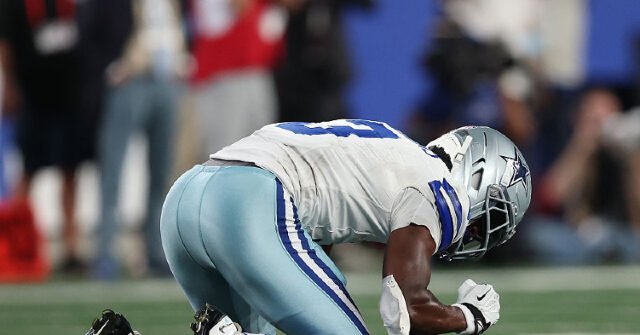
The NFL opened its 2026 season with a double-digit decline in per-game viewership, according to figures reported by Sports Business Journal and relayed by Breitbart Sports.
Week 1 games averaged 19.5 million viewers, a 13 percent drop from the 22.3 million the league averaged during last year’s opening weekend. The falloff came despite a historic performance from ESPN’s Monday Night Football, where the Chiefs-Broncos matchup drew 23.2 million viewers — the largest audience for any Week 1 MNF game since the network acquired the package two decades ago.
That Monday-night high point was not enough to offset weakness in the Sunday windows, where the league’s scheduling choices appear to have cannibalized its own audience.
A scheduling collision in the late window
As Pro Football Talk’s Mike Florio noted, Fox and CBS ran competing national windows in the 4:25 p.m. ET slot. In the second half of the double-doubleheader, Packers-Vikings drew 18.6 million viewers on CBS while Commanders-Eagles pulled 20.3 million on Fox, per Front Office Sports’ Eric Fisher.
Florio’s analysis points to the extra window as a likely culprit for the diluted per-game average, which was measured against a 2025 Week 1 slate that featured Fox’s national broadcast of Lions-Packers without the same head-to-head competition.
That explanation is plausible and, by the account of the reporting, probably accounts for much of the decline. It is also unlikely to soften the blow inside league headquarters, where sustained year-over-year audience growth has long been treated as a baseline expectation rather than an aspiration.
A broader trend or a one-week blip?
The breadth of the drop — spanning multiple windows rather than a single underperforming slot — gives league executives plenty to examine heading into Week 2. The rival networks that pay billions for NFL rights will also be watching closely, since ratings performance feeds directly into advertising pricing and future contract negotiations.
For comparison, college football’s opening weekend also produced unremarkable numbers, though the two products are not easily measured against each other. College football offers a larger inventory of games, many of them lopsided, while the NFL airs a smaller slate with far more competitive balance. That structural difference means a down week in college football is less conspicuous than one in the professional ranks.
Whether the 13 percent decline reflects a one-off distortion caused by overlapping broadcast windows or the start of a more durable viewership problem won’t be clear until the next several weeks of data arrive. For now, the league’s opening act landed with a thud — a fact that no amount of context can entirely paper over.
Source: www.breitbart.com — https://www.breitbart.com/sports/2026/09/17/nfls-week-1-total-audience-drops-by-13-percent/