
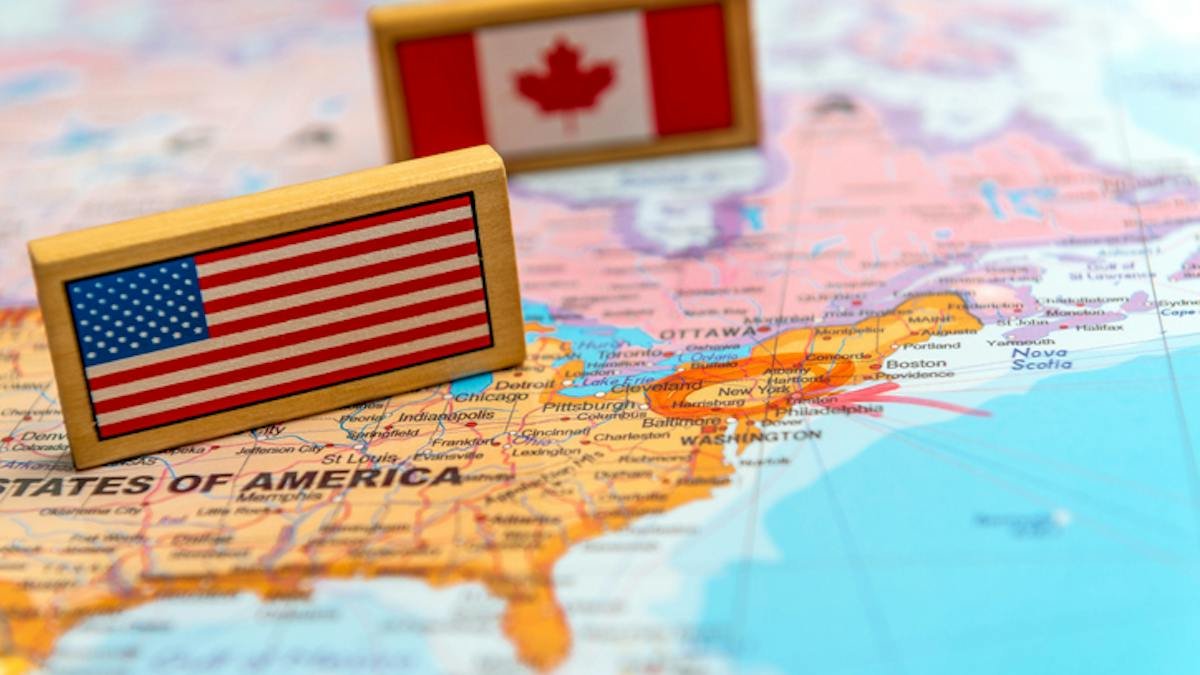
President Trump’s running trade fight with Canada has never really been about economics or national security, according to a Daily Wire op-ed by Ryan Young, a senior economist at the Competitive Enterprise Institute. The article, published this week, argues the president’s tariffs on Canadian goods are driven by personal animus and a plain fondness for tariffs themselves — with administration officials retrofitting justifications after the fact.
Young’s central claim is that politics in Washington “is almost never about the merits,” and that the Canada file is a textbook case. While the White House has offered a rotating list of rationales for the tariffs imposed since 2018 — national security, trade deficits, fentanyl trafficking, and forced labor — each falls apart on inspection, he writes.
National security as a stretch
The national security rationale underpins the steel, aluminum, and copper tariffs, which Young notes currently sit at 50%. The problem, in his telling, is that Canada is not a security threat to the United States. He points to the countries’ shared military history, noting that Canadians have fought alongside American forces in nearly every major U.S. war of the last century, including the post-9/11 conflicts in Afghanistan and Iraq — wars he describes as unrelated to Canadian interests.
Canada is also a member of the Five Eyes intelligence-sharing alliance alongside Australia, New Zealand, and the United Kingdom. Young argues that 85 years of shared secrets between the two countries would have surfaced any real security concern by now.
The op-ed recounts that when then-Prime Minister Justin Trudeau called Trump during his first term to object to the initial steel and aluminum tariffs, the president reached for the War of 1812 as his justification. For Young, that exchange is proof the dispute was never about the merits. He notes the tariffs rest on Section 232 of the 1962 Trade Expansion Act, which requires a national security justification — a justification he says may be met in letter but not in spirit.
Trade deficits and other rationalizations
Trade deficits are another recurring target. Young writes that the administration cited them to justify the so-called Liberation Day tariffs, which he says the Supreme Court struck down. He dismisses the deficit as a health indicator for an economy, invoking Adam Smith and offering a domestic analogy: he isn’t worried about his long-running trade deficit with his local grocery store, because he gets things in return that he values more than his money.
On fentanyl, Young argues Trump threatened tariffs over trafficking across the Canadian border that is “nearly non-existent,” following what he calls the same pattern — deciding on tariffs first and having advisers rationalize them afterward.
He also flags the administration’s use of forced labor as a rationale, tied to what he describes as the same Depression-era tariff law that Ben Stein mocked in the 1986 film “Ferris Bueller’s Day Off.” Canada already bans forced labor, Young notes, and the USMCA trade agreement Trump himself negotiated contains provisions prohibiting trade in goods produced with forced labor.

Insults and a fraying relationship
Beyond the policy arguments, Young points to a running stream of personal provocations: Trump’s habit of calling Trudeau and current Prime Minister Mark Carney “Governor,” his repeated suggestions that Canada become the 51st state, and most recently an executive order renaming Lake Ontario as Lake America.
That combination, he writes, explains why Canadians are upset. The article describes a shift in Canadian public sentiment from shock and a sense of betrayal that America would impose tariffs and hurl insults across the border, to outright anger — a mood Young warns could make the situation worse.
He suggests Carney has little room to absorb the provocations with dignity, because his supporters would not allow it. Shock and betrayal have given way to a demand for revenge, even at economic cost to Canada itself.
A self-harming spiral
Young’s core objection is structural: tariffs are a self-harming policy. Drawing on the 1983 film “WarGames,” he borrows the lesson that the only way to win a nuclear war is not to play, and applies it to trade. If the United States wants to hurt itself with tariffs, he writes, it makes little sense for Canada to respond by hurting itself with its own tariffs — but the dispute is not being conducted on the merits.

The current moment, per the op-ed: after Canada enacted a new tranche of tariffs on September 8, Trump announced a further tariff increase just this week. Young expresses hope the spat does not escalate as far as the U.S.-China trade war did in 2025, when some tariff rates briefly reached 145%.
He also notes that Trump declined in recent months to renew the USMCA free trade pact with Mexico and Canada, though the agreement remains in place through 2036.
Eventually, Young writes, temperatures will cool. But rebuilding the trust the two countries shared for generations will take years, if not decades. While there are ample merit-based economic and geopolitical reasons for a strong U.S.-Canada alliance, he concludes it comes down to a simple fact: cooperation is better than conflict, and peace is better than war.
The piece reflects a skeptical view of the administration’s trade posture from within the free-market policy world, and it arrives as the tariff back-and-forth between Washington and Ottawa continues to escalate with no sign of a negotiated off-ramp.
Source: www.dailywire.com — https://www.dailywire.com/news/the-self-harming-logic-of-the-u-s-canada-trade-war