

Every September, the footage comes back. The towers, the smoke, the second plane. But in a personal essay published by American Thinker on the twenty-fifth anniversary of the September 11 attacks, former newspaper reporter Kelly Rae Robertson argues that the images themselves were never the hardest part — the hardest part was the seventeen minutes before anyone understood what they were watching.
Robertson, who today writes on public safety for Law Enforcement Today, the Daily Caller, and the Washington Times, was 22 years old and a few months out of college in September 2001, working for a small paper in Waynesburg, Pennsylvania. She was not supposed to be home that morning. She had been assigned to cover the opening of one of the town’s first murder trials in years, but a migraine at 6 a.m. forced her to call off and go back to bed.
A blue sky, a bottle, and a sentence that didn’t last
When she woke again, still in pain, she went looking for Excedrin. Her mother — blind since Robertson was two, and widowed when Robertson was 14, leaving just the two of them — found the bottle first and pressed it into her hand with news the rest of the country was only beginning to absorb.
According to her account, her mother described it plainly: a small private plane had hit the World Trade Center, and there had been an explosion.
Robertson sat in her late father’s recliner and watched the North Tower burn. She asked her mother how the pilot could have missed a building under a clear blue sky. In her telling, that was the last sentence of the morning that still belonged to the world of accidents. Then something appeared in the distance on the screen, grew larger, and the anchors gasped. Her mother, sitting two feet away, heard them — but could not see what had just happened. Robertson had to find words for it while she was still assembling the meaning herself.
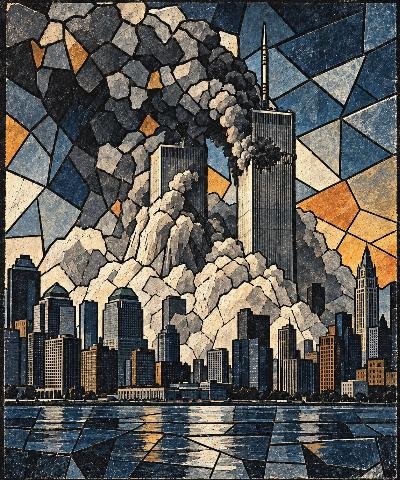
She spent the rest of the day as her mother’s eyes, describing what she saw until her throat hurt. People coming down the sides of the buildings — not climbing, falling. A man and a woman in business suits jumping while holding hands. The Pentagon. The South Tower collapsing, then the North. Then a local news cut-in: United 93 had gone down just outside Pittsburgh, after flying over the city. Robertson wondered who downtown had looked up and seen it pass.
What the footage can’t carry
The essay’s central claim is about memory rather than imagery. Anyone can pull up the footage now, Robertson writes; the pictures are the easy part. What the recordings cannot transmit is the texture of the morning before the day had a name — the migraine, the bottle on the sink, the question about a pilot and a blue sky, the 17 minutes between the two planes when, as she puts it, the country was still an ordinary Tuesday with a hole in it.
That gap, she suggests, is precisely what an entire generation now lacks. They can cue up Flight 175 in seconds, but they never had the moment of not knowing to remember.
Her account of the days that followed is small and specific. That night, she and her mother found a restaurant still open late, and she bought both Pittsburgh papers’ late editions — print runs she describes as almost unheard of. Her mother slept on the floor beside her bed because Robertson was afraid to be alone, and woke her in the middle of the night to ask whether she could come to work with her and sit in the car all day. By morning, the radio was on, her mother was talking to her sister, and saying she’d be fine until Robertson got home.
Driving to work, she passed La Roche College as a fighter jet flew overhead, blocks from her home. Every FM station was carrying news. There was no music. Her route took her past Pittsburgh International Airport, where she was used to seeing airliners coming in low to land.

From witness to reporter
Arriving in Waynesburg, Robertson writes that she had to stop being a witness and start being a reporter. She dropped her keys on her desk, took a notebook and pen, and walked. She went into churches looking for people turning to prayer — candles burning, pews empty. She walked through town and onto the Waynesburg College campus, stopping students who wondered whether it could happen again the next day.
Eventually she came across officers she knew working a traffic stop. They asked whether she had really walked all the way out there, and where her car was. They offered her a ride. She declined, reasoning that they were working and she wasn’t going to give them one more thing to do. She wondered how many of their brothers and sisters were buried in the rubble in New York.
Robertson later spent 14 and a half years working inside a jail and criminal court system, and she draws a line from that morning to what she says first responders already understood: the call that is still an accident until it isn’t, the scene before anyone knows how it ends. While everyone else is trying to understand what happened, someone still has to answer the call.
The story she filed that day became her first front-page byline, a milestone for any reporter. Twenty-five years on, she writes that she remembers the recliner more clearly than the front page — remembers trying to find words for a woman who could not see what the country was watching, and remembers looking back at those officers.
An inheritance of images, a debt of memory
Robertson notes that some of the police officers, firefighters, paramedics, EMTs, and dispatchers serving today were children on September 11 or had not yet been born. They inherited the images, she writes, but not the feeling of the morning — and what is owed to them is the memory, not the replay.
Her closing argument is that “never forget” was never meant to be a phrase repeated every September. It was a promise to keep the feeling attached to the images, and to pass it on when the images are all that remain. First responders, she adds, still do not get the finished story.
The piece lands as a reminder that the archival record of September 11 is now complete and instantly accessible — and that the part of it most at risk of being lost is the part that was never recorded at all: seventeen minutes of ordinary morning, before the day had a name.
Source: www.americanthinker.com — https://www.americanthinker.com/blog/2026/09/the-17-minutes-before-we-knew/