

Why does a political system responsible for more than 100 million deaths in the 20th century — with the toll, in Kris Larsen’s telling, still climbing in the 21st — attract so little sustained condemnation in the modern West? That is the question at the heart of a new essay in American Thinker titled “An ode to communism?” in which Larsen admits he finds the persistence of pro-communist sentiment genuinely baffling.
Larsen’s piece, published September 11, 2026, opens with a blunt accounting. Communism, he writes, “murdered north of 100 million people in the 20th century,” and the regimes built on it reduced their countries to what he calls “economic basket cases.” His tone suggests he thinks the case against the ideology is so self-evident that it should not require restating. Yet he says it clearly does.
The pushback he keeps encountering
What interests Larsen is not the historical record itself but the reception that criticism of communism receives. In his experience, attacks on the ideology generate “very little assent.” Instead, he identifies several recurring responses from Western audiences.
The first is a kind of moral equivalence: “our side [specifically Western democracy] is just as bad.” The second is the argument that “real communism has never been implemented” — a claim Larsen attributes to modern Western communists, whom he cites by example as the Democratic Socialists of America, and which he characterizes as an assurance that they will succeed where so many others have failed.
A third camp, he writes, simply dismisses any criticism as propaganda. For Larsen, that position amounts to asserting that the People’s Republic of China, Cuba, Venezuela, Pol Pot’s Cambodia, Zimbabwe, and the former Soviet Union “really weren’t so bad” — a conclusion he finds impossible to square with the Great Purge, the gulags, the killing fields, politically motivated arrests, strict censorship, mass starvation, and slave labor.

Larsen also singles out the economic dimension. State seizure of private property — farmland in particular — took breadbaskets managed by competent private-sector farmers and turned them into failures run by regime-favored bureaucrats who, in his words, knew nothing about farming. He folds Mao’s Cultural Revolution and Great Leap Forward into the same indictment.
Against all of this, he asks, what is the basis for claiming that the West — imperfect as it may be — is equally heinous?
The silence he says is worse than the argument
Perhaps the most pointed section of Larsen’s essay concerns not the committed defenders of communism but the noncommittal. He describes encountering people who, when communism is criticized, decline to engage — either because they disagree but are too polite to say so, or because they agree but are afraid to say so publicly.
That second possibility is the one that troubles him. “We have a problem when people are afraid to give consent to a no-brainer claim that communism is evil,” he writes. The fear itself becomes the story. If people cannot take a political stand openly, he asks, how free are they really?
Where he locates the blame
Larsen traces what he calls “oikophobia” — defined in the essay as a feral hatred of the West — to academics, who, in his account, have either apologized for communism or given it a pass. He extends that influence to what he calls their indoctrinated graduates, who have moved into teaching, media, the helping professions, government, and business, and who believe they are bucking a status quo they were taught to hate: Western democracy, Western civilization, Judaism, and Christianity.
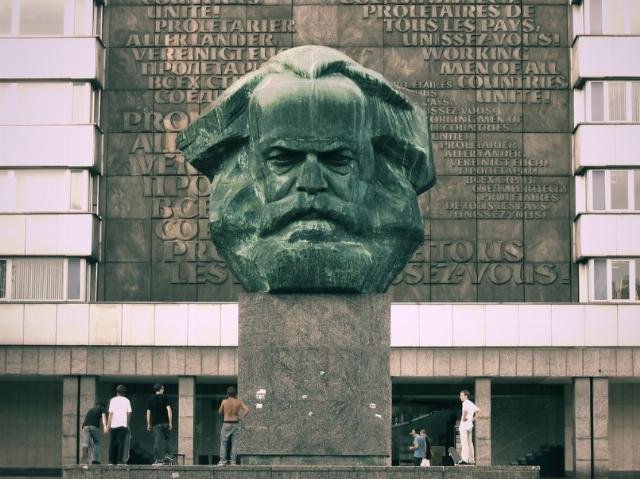
The result, he argues, is that criticizing “our civilization’s antithesis” comes to be seen as unsophisticated. He labels this the “enemy of my enemy is my friend” fallacy and suggests it explains a broader pattern — a fawning embrace of Islam paired with contempt not only for Israel but for Jewish people who live nowhere near Israel and have no connection to Middle East politics at all.
He offers a psychosocial explanation for the dynamic as well. Such people, he writes, resemble the “cool kids” of high school, for whom blind conformity to the group’s fads is everything — a tendency he ties to insecurity. In his assessment, they never advanced past that adolescent phase, even though many are now in their seventies and were the sixties radicals of their youth. He calls this immaturity a character weakness and says it is all too prevalent across the postmodern West.
An essay aimed at its own readership
The piece closes with a pitch for the outlet itself. “Now more than ever, the ability to speak our minds is crucial to the republic we cherish,” the essay states, followed by a solicitation for donations to support American Thinker’s staff and keep its “ideas heard and our voices strong.”
Read as a whole, Larsen’s argument is less a historical survey than a complaint about social permission — about who is allowed to say what, and at what cost. His claim is not that communism lacks critics, but that the criticism fails to land, and that the failure has less to do with the strength of the counterarguments than with the social penalties attached to making them.
Whether that diagnosis holds is, of course, a matter of dispute. What Larsen has produced is a case study in how one corner of the American right understands its own isolation on the question — not as a failure of persuasion, but as evidence of a cultural fear that keeps the argument from being made at all.
Source: www.americanthinker.com — https://www.americanthinker.com/blog/2026/09/an-ode-to-communism/