
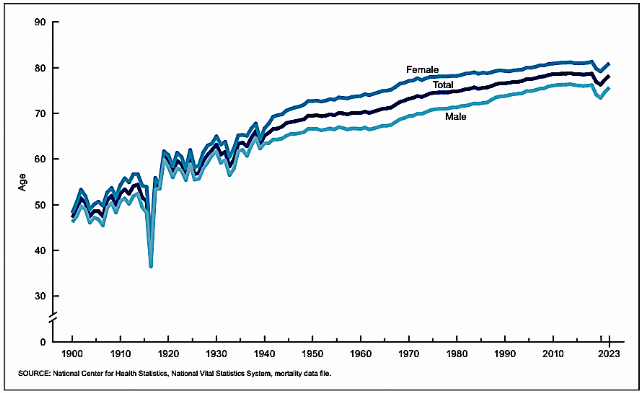
U.S. life expectancy fell by roughly two years between 2019 and 2021, and the conventional explanation has been COVID-19. But in a piece published by American Thinker, actuary and study author Antonio R. Chaves argues that the numbers tell a different story — one centered on a drug overdose crisis that was already accelerating well before SARS-CoV-2 reached American shores.
Chaves, who identifies himself as the author of a study published in the Asian Pacific Journal of Health Sciences, builds his case on actuarial data from Social Security rather than on the pandemic dashboards that dominated headlines during those years. His central claim is that the age group hardest hit by rising death rates in 2020–2021 was not the elderly but Americans between 25 and 45, whose death rates nearly doubled in 2021. Just as significantly, he writes, the sharp climb in death rates for those aged 30 to 40 began at least five years before the virus arrived in the United States.
A Timeline That Predates the Pandemic
That timing is the crux of his argument. If younger Americans were dying at elevated rates well before 2020, then something other than a novel respiratory virus was doing the killing. Chaves points to CDC data indicating that most of the excess deaths among those aged 25 to 45 were the result of overdose, primarily from synthetic opioids. He cites Our World in Data’s documentation of the steep post-2000 rise in opioid deaths and an interactive CDC chart showing that the surge in overdose fatalities during the so-called COVID years claimed more than 400,000 American lives.
He also notes that a body of reporting published between 2010 and 2020 had already flagged declining U.S. life expectancy as a consequence of drug overdose. In his telling, that story was eclipsed in 2020 by a pandemic that — unlike the influenza of 1918 — targeted mainly the elderly.
The piece is pointed about what that shift in attention cost. Chaves argues the prioritization of COVID-19 over the opioid epidemic was remarkable on two fronts. First, death rates for Americans aged 75 and older rose 10 to 17 percent above their 2019 baseline during 2020–2021. Second, younger Americans who die lose far more potential life. From that vantage point, he writes, countermeasures that prioritized seniors at the expense of younger people struggling with addiction amount to something close to criminal.
An Unapologetic Author
The commentary is unusual in the transparency of its self-promotion. Chaves openly acknowledges authorship of the APJHS study and says he makes no apologies for bringing it to a wider audience. He describes the study as organizing data by timelines, age groups, and states in a way that leaves little room for the novel virus in its condemnation of what he calls misguided countermeasures that exacerbated an existing drug epidemic. He also links to a 26-minute presentation summarizing the charts for readers who find the raw data daunting.
Chaves anticipates pushback of a particular kind: the dismissal of substance abuse as, in his words, the removal of misfits who are a drag on society. He rejects that framing outright, arguing that a drug epidemic of this magnitude reflects worse on the society that permits it than on those addicted — especially, he adds, when it was downplayed to prioritize a pandemic that he contends minimally increased death rates among its main victims. He attributes the exaggerated perception of the pandemic’s death toll largely to a demographic transition, in which a critical mass of Baby Boomers reached an age where a larger share were more likely to die of respiratory disease.
The author also makes a broader claim about peer review, noting that journals are vetted before publication but that the truly comprehensive analysis happens afterward, as the wider scientific community responds. He points to the same journal’s 2023 publication of a Norwegian study examining a possible link between COVID-19 vaccination and higher death rates in Europe. Chaves says he is unaware of commentary on that study and argues that the fact it has not been retracted indicates either that critics have failed to find a fatal flaw or that it is simply being ignored. He hopes readers will make the current study’s conclusions harder to ignore.
The Wider Fight Over the Numbers
What makes the piece notable is less any single figure than the interpretive frame it places around well-documented trends. The overdose crisis and its toll on working-age Americans are not contested facts; the question Chaves raises is one of emphasis and causation — whether the public health establishment’s singular focus on COVID-19 obscured, and perhaps worsened, a deadlier and longer-running emergency. His conclusion is unambiguous, but readers should weigh it as an argument advanced by the study’s own author, published in an outlet inclined to share its skepticism of pandemic-era policy.
He closes his acknowledgements by thanking data analyst Mark Kulacz of Housatonic for insight on the opioid epidemic and biology coach Jonathan Couey of Gigaohm Biological for insight on population pyramids — a reminder that the debate over why American lives got shorter in 2020 and 2021 is far from settled.
Source: www.americanthinker.com — https://www.americanthinker.com/blog/2026/09/the-real-reason-us-life-expectancy-declined-in-2020-and-2021/