
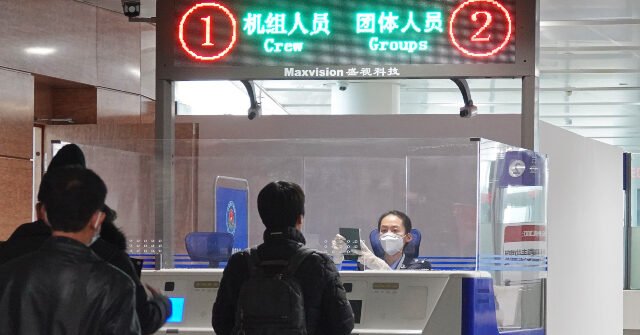
China began enforcing sweeping new travel rules on Tuesday that give the state broader power to stop citizens from leaving the country if they are deemed to have “endangered national security,” as reported by Breitbart News. The regulations, first announced by China’s State Council in late July and signed by Premier Li Qiang, also allow authorities to bar nationals from exiting if they work in sensitive fields — including artificial intelligence — a move analysts describe as an effort by Xi Jinping to tighten control over the country’s technology workforce.
What the rules actually do
Under the new framework, citizens returning to China could face exit bans lasting anywhere from six months to three years if they are found to have committed a crime or taken actions that “harm national security or interests,” according to Reuters. Foreigners, meanwhile, may be blocked from entering the country for one to five years for making “false statements” on visa applications. Individuals judged to be in violation of the restrictions face substantial fines and exit bans ranging from three months to an “indefinite” period.
The rules grant authorities what one legal expert called “considerable discretion.” Dai Menghao, a trade compliance partner at international law firm King & Wood, told the Financial Times that while the regulations do not explicitly single out China’s private sector, they nevertheless provide a clearer path to impose travel bans on Chinese nationals working for private companies. The phrase “may endanger” gives officials wide latitude in deciding who falls under the restrictions. The law firm DLA Piper told the Times the new measures represent the “most significant” regulations of their kind in more than a decade, noting that export control violations are now expressly linked to exit bans.
A return to pre-reform era restrictions?
Immigration experts and analysts who spoke with the Financial Times said the restrictions effectively push China back toward Mao-era travel limitations — controls that were loosened only once Beijing opened itself to trade. Henry Gao, a law professor at Singapore Management University, told the Times the trajectory could amount to a reversal of decades of liberalization.
“The result could be a gradual shift back towards a pre-1990s model in which international travel is treated less as an individual right and more as a privilege subject to administrative approval,” Gao said, adding that beyond restricting movement, the approach “helps keep both people and capital more firmly within the party-state’s sphere of control.”
The rules arrive as Beijing builds what the Financial Times described as a “web of regulations” aimed at countering foreign sanctions, part of its broader technology competition with the United States. Earlier this year, Chinese authorities imposed travel bans on the cofounders of AI startup Manus, preventing them from leaving the country. Weeks later, the government blocked Meta — Facebook’s parent company — from acquiring Manus in a planned $2 billion deal.
Beijing pushes back
China’s state-run Global Times acknowledged the Reuters and Financial Times reports on Tuesday but dismissed characterizations of the rules as restrictive, insisting they protect the “lawful rights and interests of exit and entry personnel” while safeguarding “national sovereignty, security, and development interests.” Officials from China’s Justice and Public Security Ministries and the National Immigration Administration (NIA) told the Global Times the coverage amounted to “misreading and sensationalism.”
The NIA said the “fundamental purpose” of the new restrictions is to “facilitate lawful and normal cross-border travel for the vast majority of people and safeguard the legitimate rights and interests of those entering and leaving the country.” The Global Times wrote that the administration stressed the regulation “is by no means intended to impose additional controls or restrictions on ordinary citizens and will not affect normal activities such as overseas tourism, family visits, study or business.”
Whether those assurances hold in practice remains an open question. The regulations’ reliance on broad language — “national security or interests,” “may endanger” — leaves the final say with Chinese authorities, and the recent Manus case suggests the provisions can reach private-sector workers whose profiles Beijing deems strategically sensitive. For now, the rules are in force, and the discretion they create will be tested case by case.
Source: www.breitbart.com — https://www.breitbart.com/asia/2026/09/15/china-imposes-strict-travel-restrictions-threatening-ban-exit-those-who-endanger-national-security/