
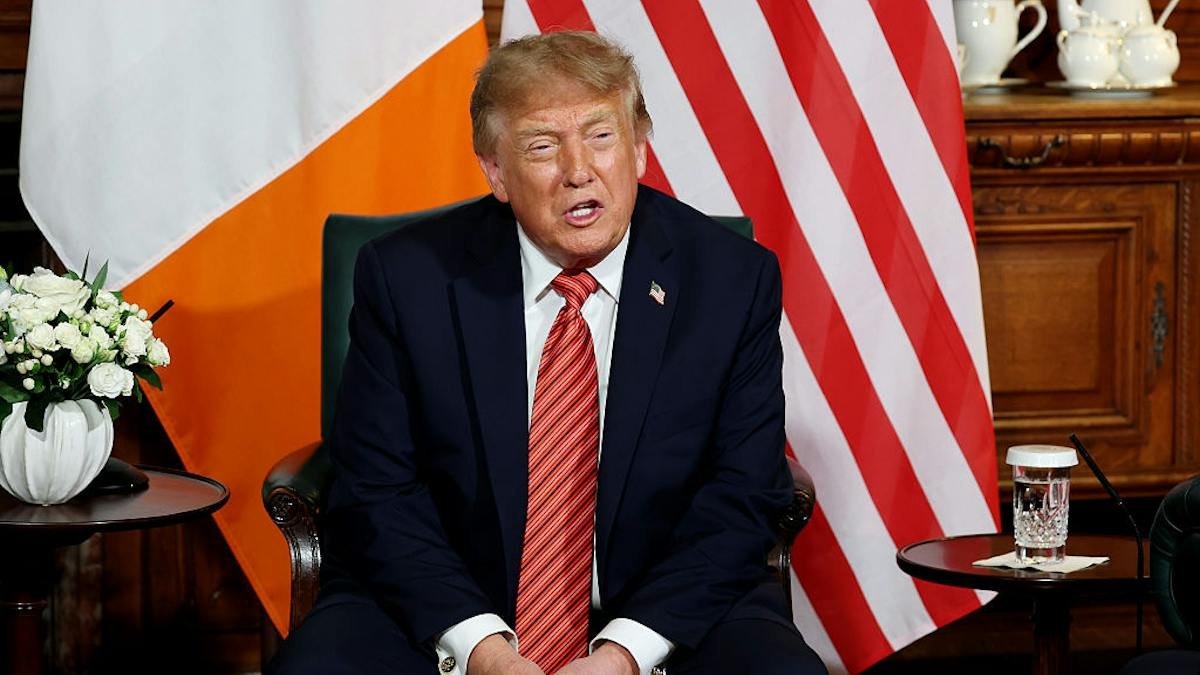
President Donald Trump upended one of the most carefully maintained American positions on the British Isles on Saturday, telling reporters in Dublin that he would “love to see” the island of Ireland unified — a remark that cuts against decades of U.S. practice of supporting the Northern Ireland peace process without endorsing either side of its constitutional divide.
“I don’t want to cause any problem. I will tell you, I’d love to see it unified,” Trump said, standing alongside Irish Taoiseach Micheál Martin, according to the Daily Wire. “It’s going to happen eventually.”
The president went further, describing reunification as “a fantastic thing” and “a great feather in everybody’s cap,” while conceding that London would necessarily have a role. “How can it be bad?” he asked.
Successive administrations, Republican and Democratic alike, have historically supported the peace process while declining to take a position on whether Northern Ireland should remain part of the United Kingdom or join the Republic of Ireland. Trump’s comments departed from that posture.
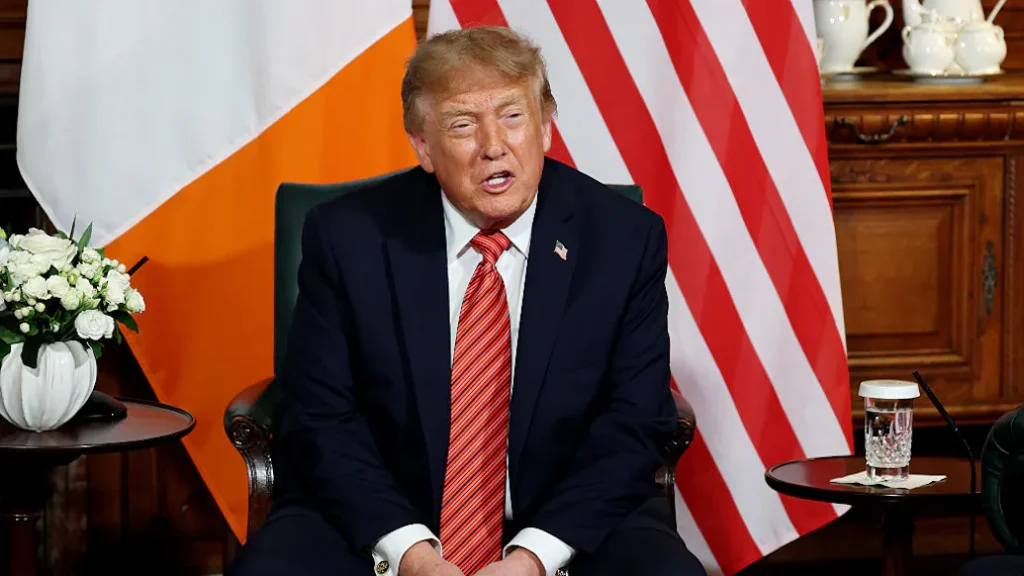
He appeared to grasp quickly that he had waded into dangerous political terrain. Later Saturday, speaking at the U.S. ambassador’s residence, Trump circled back to the subject and allowed that there was “no good answer” to the underlying question.
“I gave a nice answer, I think,” he said. “We’ll worry about it tomorrow.” He still described Irish unity as “a very cool thing.”
A question that has shaped generations
Few political questions in the British Isles carry as much historical weight. During “The Troubles,” the three-decade period of violence between Irish nationalists seeking a united Ireland and unionists determined to remain part of the United Kingdom, 3,600 people were killed.
The 1998 Belfast Agreement — better known as the Good Friday Agreement — built the framework that largely ended the bloodshed. Central to it is the principle of consent: Northern Ireland stays in the United Kingdom unless a majority of its own people vote to change that status. The United States was a significant diplomatic player in the talks that produced the agreement, which still underpins the region’s power-sharing institutions.

Given that history, Trump’s remarks drew swift reaction on both sides.
Unionists push back
Gavin Robinson, leader of Northern Ireland’s Democratic Unionist Party, rejected the president’s intervention outright.
“President Trump knows better than most that elections matter,” Robinson wrote on X. “Northern Ireland’s constitutional future will be decided by the people of Northern Ireland, not by commentary in London, Dublin or Washington.”
He added: “Northern Ireland is part of the United Kingdom because that is the settled democratic will of its people.”

The British government signaled that nothing had changed in its own position. Prime Minister Andy Burnham has said there is currently not enough public support to justify a referendum on Northern Ireland’s constitutional status, and that such a vote is therefore not on the table. Trump himself acknowledged London’s inevitable involvement, saying, “The U.K. will have something to say about it, obviously.”
Nationalists seize the moment
Irish nationalists, by contrast, treated the comments as a signal that the ground had shifted. Sinn Féin leader Mary Lou McDonald said Trump’s remarks demonstrated that the conversation about Irish unity had moved, and she called on the Irish government to begin preparing for the possibility of reunification.
Claire Hanna, leader of Northern Ireland’s Social Democratic and Labour Party, told her party’s annual conference that Trump had effectively announced his support for a united Ireland — a line that drew cheers from the crowd, per the Daily Wire.
In a post on X dated September 12, 2026, Hanna wrote that Trump backing Irish unity “wasn’t on our conference Bingo card,” adding, “I suppose even a broken clock is right twice a day,” and joking, “Has anyone checked on the DUP?”
Not entirely without precedent
The president has touched on the idea before. Earlier this year he suggested Northern Ireland and the Republic should have a “merger,” though Northern Ireland’s deputy first minister, Emma Little-Pengelly, treated that remark as a joke at the time.
Saturday’s comments came during a two-day visit largely framed around economic ties and a stop at Trump’s golf resort in County Clare. He met with Martin in Dublin and held a ceremonial meeting with Irish President Catherine Connolly, who has previously been critical of Trump’s foreign policy. The reunification remarks were only one of several points in the trip that touched on Britain’s role in the region.
Nothing Trump said amounted to a formal policy announcement, and the White House has given no indication that his words represent a shift in the American position. Still, in a country where constitutional questions are measured in centuries rather than news cycles, a sitting U.S. president saying he’d “love” to see a united Ireland landed as anything but routine.
Source: www.dailywire.com — https://www.dailywire.com/news/trump-says-hed-love-to-see-ireland-unified-breaking-decades-of-us-neutrality