

With the midterms bearing down, a retired California detective is making the case in the pages of American Thinker that President Trump should declare a national emergency on election integrity — not as a prelude to martial law, but as the only remaining tool available to a president whose other options, he argues, have been systematically shut down.
Ron Wright, who spent 35 years with the Riverside Police Department and a decade working election nights at an Associated Press data center, writes that the legislative window has closed, the courts have intervened, and the states have refused to cooperate. His September 13 piece amounts to a prosecutor’s closing argument aimed at the White House, and it is worth taking seriously as a statement of how one faction of the right is thinking about November.
The Legislative Path, Closed
Wright’s starting point is the SAVE America Act, which he describes as legislation that would have cleaned voter rolls and secured elections. It cleared the House, he writes, and died in the Senate. House and Senate recesses ate the calendar. Trump then tried to accomplish the same goals by executive order — proof of citizenship, a reliable federal voter list, limits on mailed ballots.
That effort, according to Wright, ran into two walls. Election officials in what he calls fraud-prone areas refused to produce ballots and rolls, invoking privacy and warning that disclosure would expose illegal aliens to ICE. Wright dismisses that rationale outright: the real motive, in his view, is to conceal officials’ own conduct. Meanwhile, activist federal district judges blocked the executive orders that would have counted in this cycle.
The result, as he frames it, is a straightforward dilemma. No court has ruled on the merits, so renegade states can claim nothing is wrong. But if nothing moves until there is a conviction, the republic waits for a verdict the other side can prevent by sitting on the evidence. “That hands them another free shot at installing their people through an election that no one is allowed to check,” he writes.
A Detective’s Doubts About 2020
Wright is not a neutral commentator, and he does not pretend to be. He states plainly that in his professional opinion, systemic election fraud is real. He draws a distinction that runs through the piece — isolated voter fraud, like mailing a dead relative’s ballot, is statistical noise. Systemic fraud is what can swing an outcome. Officials and the legacy press, he argues, deliberately interchange the two so the public never has to examine the system itself.
He points to his own experience working the 2020 election at an AP data center. He says he had never seen swing-state feeds go down together and return with a 180-degree switch between winning and losing candidates. He takes direct aim at the Cybersecurity and Infrastructure Security Agency’s famous claim that 2020 was “the most secure in American history.” Wright’s response is blunt: he worked that night, and he disagrees.
He also restates a larger conspiracy claim he says he made in 2020 and again in 2026 — that a massive, ongoing RICO conspiracy involving the “Deep State and others” existed to unseat a duly elected president in his first term and succeeded in 2020, with retaining power and concealing theft of federal funds as part of the enterprise. He cites government auditors who have put annual improper payments and fraud in a range reaching hundreds of billions of dollars.
These are serious allegations, and Wright presents them as his own beliefs and professional opinions rather than as proven findings. They form the backdrop for his central question, and readers should weigh them accordingly.
Two Tracks, One Calendar
Wright separates what he sees as two distinct problems that officials and the press conflate. The first is criminal: whether there is probable cause to believe election fraud occurred and was used as an instrumentality to commit other related federal crimes. The second is public policy: whether the country sits still while that investigation crawls.
On the criminal track, he says indictments before November are doubtful. He notes that former U.S. Attorney Joe DiGenova resigned this week after a “no evidence” quote that DiGenova said was taken out of context — the evidence is there, DiGenova maintained, but these cases take time. Wright says he believes RICO investigations are underway in the Southern District of Florida.
He also flags the frozen election-fraud case in Riverside County, California, where a citizen audit found a hole in the county’s own paper, the sheriff seized more than 650,000 ballots under search warrants, and the state attorney general went to the California Supreme Court, which put the investigation on ice. Wright’s question is one word: why?
His answer is that the Justice Department and the FBI could adopt the case, put a forensic audit team on evidence already seized, and pursue indictments under 18 U.S.C. §§ 241 and 242. Indictments before the midterms are possible, he allows. Trials are not.
The Case for an Emergency Declaration
That leaves the policy question, and it is where Wright’s argument becomes most contentious: if criminal investigations cannot produce answers before November, can the executive branch lawfully act now?
His answer leans on the president’s unique position as the only nationwide elected official, on the idea that a corrupt election system is an existential threat to the constitutional republic, and on the claim that the Constitution, federal statutes, and case law allow policy changes when an emergency disables ordinary political channels. He argues the president does not need a district judge’s blessing to treat election integrity as a national-security issue.
Wright reaches for precedent. He notes that a national emergency is not martial law — it is a finding under the National Emergencies Act that an unusual and extraordinary threat exists, unlocking tools already used in Executive Order 13848, where foreign interference with election infrastructure was named a national-security threat. On August 31, he writes, Trump continued EO 13848 for another year. The open question is whether he attaches midterm rules to it or merely keeps the sanctions file open.
The Act does not define “emergency,” Wright notes, and the call is the president’s. That buys time, in his view, until Congress writes a lasting fix. He adds that Congress can terminate an emergency only by joint resolution, presentment, and, after a veto, two-thirds of both Houses, citing INS v. Chadha. That, he says, is staying power against a thin majority — though he concedes it is not a bar on a judge attacking a particular order.
He is also candid about the limits. Youngstown Sheet & Tube Co. v. Sawyer and Article I, Section 4, he acknowledges, still leave the times, places, and manner of congressional elections with the states and with Congress.
What He Wants Before November
Wright lists the conditions he believes must be in place: proof of citizenship to vote, rolls limited to eligible citizens, no mass mailing off a dirty list, early voting cut to a short window, hand-marked paper, no black-box machines, and no endless recount. His closing metaphor is a checkbook — do not let the person who writes the company checks also reconcile the account.
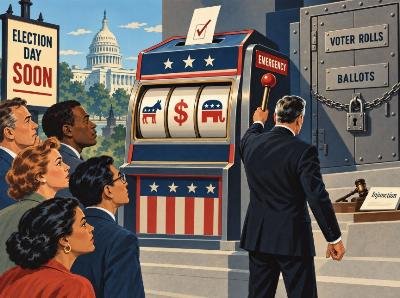
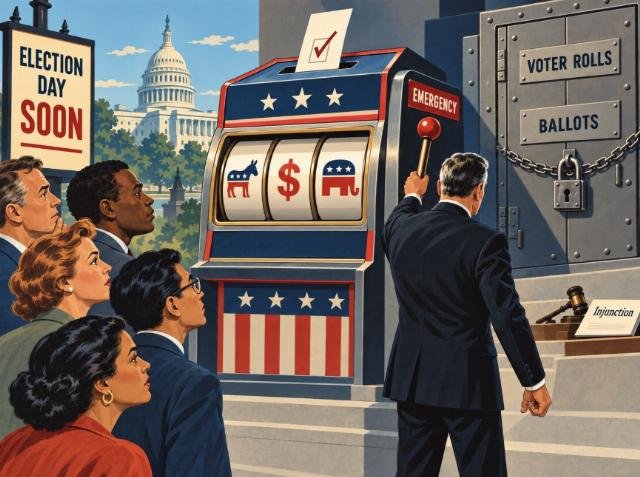
If a state cannot change in time, Wright is unsentimental: that is the state’s problem. The states killed the SAVE Act, enjoined the orders, and kept the vault shut, he writes. They can ask Congress to move the date. “The President’s job is to stop the casino and the theft, not to rescue the people who rigged the clock.”
He anticipates the pushback. DNC attorney Marc Elias, he predicts, will file an injunction by breakfast and call it a coup. Wright’s response is two sentences: “Let him. The house is on fire.”
A Note on the Emergency Powers
The piece carries a footnote from American Thinker’s Andrea, reminding readers that the applicable statute says a president who declares an emergency may not exercise powers granted under a statute unless he specifies which statutes he intends to use. That limitation, the note adds, does not restrict him from using other Article II powers, so he may still have wide latitude — and the administration, in her assessment, has shown itself clever at combing through the law to find authority.
Whether Trump takes Wright’s advice is, for now, an open question. What the piece offers is a window into the legal and political reasoning of those urging him toward it, and a preview of the fight that would follow.
Source: www.americanthinker.com — https://www.americanthinker.com/articles/2026/09/why-trump-should-declare-an-election-emergency/