

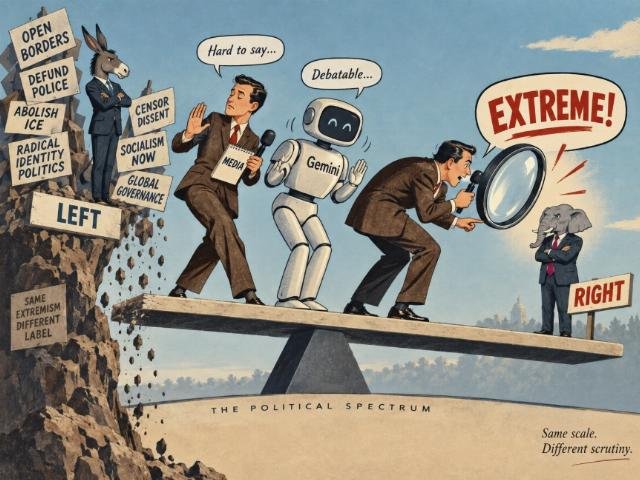
Can a mainstream position held by a major American political party be described as extreme? The answer, according to one conservative writer’s experiment with Google’s Gemini, appears to depend on which party holds it.
Writing for American Thinker, Jack Hellner describes a Q&A session in which he pressed Gemini on the political labels that dominate media coverage. His questions, he writes, were driven by a recurring observation about European and American news: reporters are quick to warn about “far-right politicians” winning elections in Germany, and quick to slap the “far-right” tag on Donald Trump and other Republicans, yet almost never use “far-left” to describe Democrats. Equally rare, he argues, is any explanation of which specific policies supposedly earn a politician one label or the other.
So he asked the artificial intelligence system directly, treating it as a proxy for what the mainstream press already reports. The exchange, as Hellner recounts it, repeatedly produced the same asymmetry.
A pattern on immigration and law enforcement
Hellner began with immigration. Asked whether supporting open borders is a far-left position given that most people and countries favor border controls, Gemini conceded that it is “considered a far-left or radical political position” because mainstream governments, international norms, and most voters across the spectrum favor sovereign border controls. Hellner notes that most Democratic politicians support very loose immigration policies — but, he writes, the label rarely follows.
The pattern sharpened when he raised sanctuary cities and states that refuse to enforce federal immigration laws. Here, he writes, Gemini pivoted to legal scholars and organizations such as the Cato Institute, framing the policies as resting on mainstream constitutional principles rather than radical politics. Hellner countered by pointing out that politicians take an oath to enforce laws; Gemini acknowledged that officials swear to support and defend the Constitution but still declined to call sanctuary policies far-left.
On the “Abolish ICE” movement, Gemini did agree that wanting to dissolve Immigration and Customs Enforcement is widely viewed by critics and conservative politicians as a progressive or far-left stance. Hellner adds that a large majority of Democrats now back abolishing the agency — yet in his telling, that Democratic support does little to change how the media frames the position.

The school choice double standard
Hellner found a similar split on education. He asked whether opposing school choice is far-left, noting that a large majority of people, including minorities, support choice. Gemini’s answer, which Hellner calls “ridiculous,” was that opposing school choice is a mainstream Democratic Party position rather than an exclusively far-left view.
That prompted the columnist’s central question: can’t a mainstream Democratic position be far-left? Gemini’s response, as he relays it, was that a mainstream Democratic position is generally not considered far-left because mainstream politics occupy the center-left, while the far-left involves more radical or anti-capitalist views.
Then he flipped the question and asked whether a mainstream Republican position can be far-right. Gemini said yes — that a mainstream Republican position can be considered far-right depending on the baseline used for comparison. To Hellner, that exchange is the moment the bias becomes explicit: a mainstream Democratic position cannot be far-left, but a mainstream Republican position can be far-right.
Where Gemini agreed — and where it balked
The conversation wasn’t uniformly one-sided. Gemini readily classified eliminating private health insurance as a far-left or progressive policy, and likewise described wanting to completely shut down the oil, natural gas, and coal industries as a far-left or radical environmental position. Hellner notes that a large majority of Democrats have supported Medicare for All, and that 45 percent of Democrats favor eliminating oil, natural gas, and coal entirely.
But on other contested issues, the AI declined to apply the label. Asked about sex-change operations for young children without parental consent, Gemini rejected the premise outright, saying such procedures do not occur in medical practice and that the position is not standard for the left or any mainstream group. Hellner argues this sidesteps the larger issue by disputing the premise rather than addressing the labeling question.
On transgender women in female sports and locker rooms, Gemini characterized support as a progressive or liberal position “rather than strictly far-left,” while allowing that definitions vary. On abortion, it said whether “abortion on demand” counts as far-left depends entirely on how the term is defined. Hellner points to polling showing 84 percent of Democrats support abortion being legal in all or most cases, and suggests that the definitional dodge avoids a straightforward answer.
Naming names
Perhaps the most telling pair of questions, in Hellner’s account, concerned governors. When he asked which Democratic governors the media describes as far-left — despite their support for many policies Gemini itself had labeled far-left — Gemini replied that categorizing specific Democratic governors that way is a frequent subject of partisan debate rather than an objective consensus.
When he asked which Republican governors the media describes as far-right, Gemini had no trouble answering. It said mainstream and national outlets frequently apply labels like “far-right,” “hard-right,” or “ultra-conservative” to high-profile Republican governors who champion populist, nationalist, or deeply conservative social policies, and it named Ron DeSantis of Florida, Greg Abbott of Texas, Sarah Huckabee Sanders of Arkansas, and Kim Reynolds of Iowa.
That contrast — an inability to name a single Democratic governor labeled far-left, set against a ready list of Republican governors labeled far-right — is the heart of Hellner’s complaint. Gemini, he concludes, accepts that a mainstream Republican position may be “far-right” while insisting a mainstream Democratic position generally cannot be “far-left.”
The standard problem
Hellner’s argument is not that every Democratic policy is radical, nor that every “far-right” label is invented. It is a narrower claim about consistency: if the terms “far-right” and “far-left” are to mean anything, the same yardstick should apply to both sides, and a position should not stop being radical simply because one party has adopted it as a platform plank.
His closing point is about where the center gets drawn. If mainstream Democratic positions can never be far-left while mainstream Republican positions can be far-right, he writes, then the labels reveal less about actual political extremism than about the vantage point of whoever — or whatever — is doing the labeling. That includes the AI systems now summarizing and framing political news for a growing share of readers, and the outlets whose coverage those systems absorb.
Whether Gemini is faithfully mirroring a genuine media consensus or amplifying a tilt of its own is a question Hellner raises but doesn’t fully resolve. His point is that, either way, the asymmetry is visible — and that readers relying on AI summaries to navigate political coverage should know which way the baseline leans.
Source: www.americanthinker.com — https://www.americanthinker.com/blog/2026/09/for-the-media-and-ai-there-s-no-extremism-on-the-american-left/