
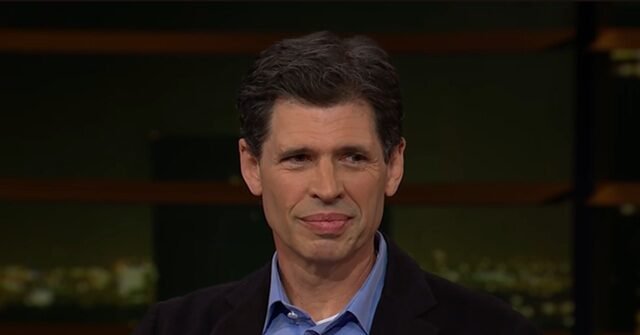
Author Max Brooks used a Friday night appearance on HBO’s “Real Time” to deliver a blunt warning about the Democratic coalition’s long-term health, arguing that a movement defined largely by opposition to President Donald Trump may not survive his departure from the political stage. According to Breitbart’s account of the broadcast, Brooks suggested the party risks trading a short-term win for a much bigger loss down the road.
“I fear if we’re charging towards a short-term win at the expense of long-term political suicide,” Brooks said. “Because, right now, the Democratic coalition is, well, at least we’re not Trump. But what happens when Trump leaves?”
The author, a nonresident senior fellow at the Atlantic Council, didn’t stop at the strategic question of what comes after Trump. He pointed to what he described as a troubling influx of voices into the party’s tent — people he characterized as holding views that could prove damaging once the anti-Trump glue loses its grip.
A Coalition Defined by What It Opposes
Brooks’ core concern is a familiar one in political analysis: coalitions held together primarily by a shared opponent tend to fracture once that opponent is no longer on the ballot. He framed the coming election, absent Trump, as the moment when the Democratic platform would have to stand on its own merits — and he suggested that platform might be a hard sell.
“And we’ve been bringing in some really toxic people with some really bad ideas,” Brooks said, per Breitbart. He then sketched out a hypothetical platform stripped of the anti-Trump framing: “no cops, no borders, no jails, no private property.”
The line drew a quick response from host Bill Maher, who interjected to add one more item to the list. “And Communism,” Maher said. “He — everyone was saying today, oh, he said Communism a million times. I don’t blame him.” Brooks agreed with the addition.
Maher’s Interjection and the Broader Debate
Maher’s comment referenced a separate political moment from earlier in the day, though the Breitbart excerpt does not specify which remarks he was alluding to. His willingness to name Communism as part of the platform Brooks described — and his insistence that he didn’t blame whoever had said it repeatedly — underscores a recurring tension on the show: a host and guests who often criticize the left from a position that is itself critical of Trump.
That dynamic is part of what gives Brooks’ remarks their bite. This wasn’t a conservative commentator lobbing criticism from across the aisle. It was a self-identified figure within the broad Democratic orbit raising alarms about the direction of his own coalition — and doing so on a program whose panel frequently debates exactly these questions.
Brooks’ day job at the Atlantic Council, a think tank focused on international affairs, gives his commentary a policy-adjacent sheen, though his broader public profile comes from his writing. He is best known as the author of “World War Z” and “The Zombie Survival Guide,” works that trade in disaster scenarios and societal collapse. Whether or not that background informed his political metaphor, his language on Friday leaned toward the apocalyptic: “long-term political suicide” is not a phrase that suggests quiet confidence about the road ahead.
The Question Nobody Has Answered
Strip away the specific critique and Brooks is pointing at a question that has circulated quietly through Democratic circles for years: what does the party stand for when Trump is no longer the central organizing fact of American politics? Every coalition has its unifying figure or cause. For Democrats in the Trump era, that figure has been Trump himself — a shared antagonist who papers over internal disagreements on policing, immigration, economic policy and more.
Brooks’ warning is that the disagreements don’t disappear just because the antagonist does. They wait. And when the waiting ends, the party has to articulate something affirmative. His fear, expressed plainly, is that the affirmative version — or at least the version he sees gaining traction — is one that alienates more voters than it attracts.
That’s a debate Democrats have had before, in different forms. The party’s left flank has pushed for ambitious positions on criminal justice, immigration enforcement and economic redistribution, while moderates have warned that those positions cost elections in swing districts. Brooks’ contribution to that argument is to frame it as a matter of timing: the current coalition can afford ideological heterogeneity because it has a common enemy. Remove the enemy, and heterogeneity becomes fracture.
What Comes Next
Brooks didn’t offer a prescription in the segment as described. He posed the problem — what happens when Trump leaves, and what does the party do with the people and ideas it has absorbed — and left it there. Maher’s interjection added a label to one version of the answer, but neither man laid out a path forward.
That absence is itself notable. Political warnings are easy to deliver and hard to resolve, and Brooks’ remarks sit in a long tradition of intra-coalition critiques that diagnose a problem without solving it. Still, the framing he chose — “toxic people” and “really bad ideas” — is unusually direct language for a figure who generally occupies a more measured public register.
Whether his warning lands as prophecy or as premature panic likely depends on what happens in the next election cycle and how the Democratic coalition reconfigures itself in Trump’s absence. For now, Brooks has planted a flag on the side of the argument that says the party’s current strength is borrowed, not built — and that the bill comes due when the thing everyone is against is no longer around to be against.
The segment aired Friday on HBO’s “Real Time.”
Source: www.breitbart.com — https://www.breitbart.com/clips/2026/09/12/max-brooks-weve-been-bringing-in-some-really-toxic-people-with-really-bad-ideas-into-dem-coalition/