
Twenty-five years after the twin towers fell, America has an unmatched infrastructure for remembering September 11 — a memorial that preserves the names, a museum that preserves the wreckage, the recordings, the personal stories. What it never built, according to one Israeli-American veteran writing in American Thinker, is an equally serious apparatus for confronting the ideas that justified the attack in the first place.
Tsahi Shemesh, an IDF veteran and founder of Krav Maga Experts in New York City, makes that case in a September 14 essay titled “We hunted the terrorists but left the ideology alone.” He writes as someone who has lived through terrorist attacks on civilians and spent years in a war zone, and he says he visited the Lower Manhattan museum recently precisely because America now seems confused about political violence and the ideas invoked to excuse it.
What strikes him is not just the horror of the exhibit but the fact that it was entirely foreseeable. Years before the towers came down, Osama bin Laden and Ayman al-Zawahiri issued what they called a fatwa in 1998 declaring the killing of Americans an individual religious duty. The 9/11 Commission, Shemesh notes, documented the religious language explicitly.
A military win, an ideological stalemate
In Shemesh’s telling, America eventually figured out the military half of the problem. It flattened training camps, disrupted networks, hunted commanders, expanded intelligence operations and killed bin Laden. The ideological front, by contrast, got far less attention — a strategic error, he argues, because jihadist organizations don’t require standing armies. They require people willing to accept the beliefs that give terrorism moral permission. Kill a commander and another takes his place, as long as the underlying worldview remains available to whoever is looking for it.
That logic, Shemesh writes, should have made education central to the post-9/11 strategy. Instead, he says, American institutions grew increasingly uncomfortable examining Islamist ideology on its own terms. The conversation drifted toward Western foreign policy, discrimination, poverty, colonial history and grievance — subjects that can explain political conditions, he concedes, but cannot explain away a belief system whose own advocates use religious language to justify violence and supremacy.
Shemesh is careful to avoid painting with too broad a brush. Not every Muslim supports radical Islamist ideology, he writes. But he argues that enough do for its influence to pose a serious challenge to Western values, including inside Western societies. And an ideology, he points out, doesn’t need majority support or an election victory to gain leverage. A committed minority can move institutions when those institutions lose confidence in the principles they exist to defend.
The oppressor-oppressed frame as cover
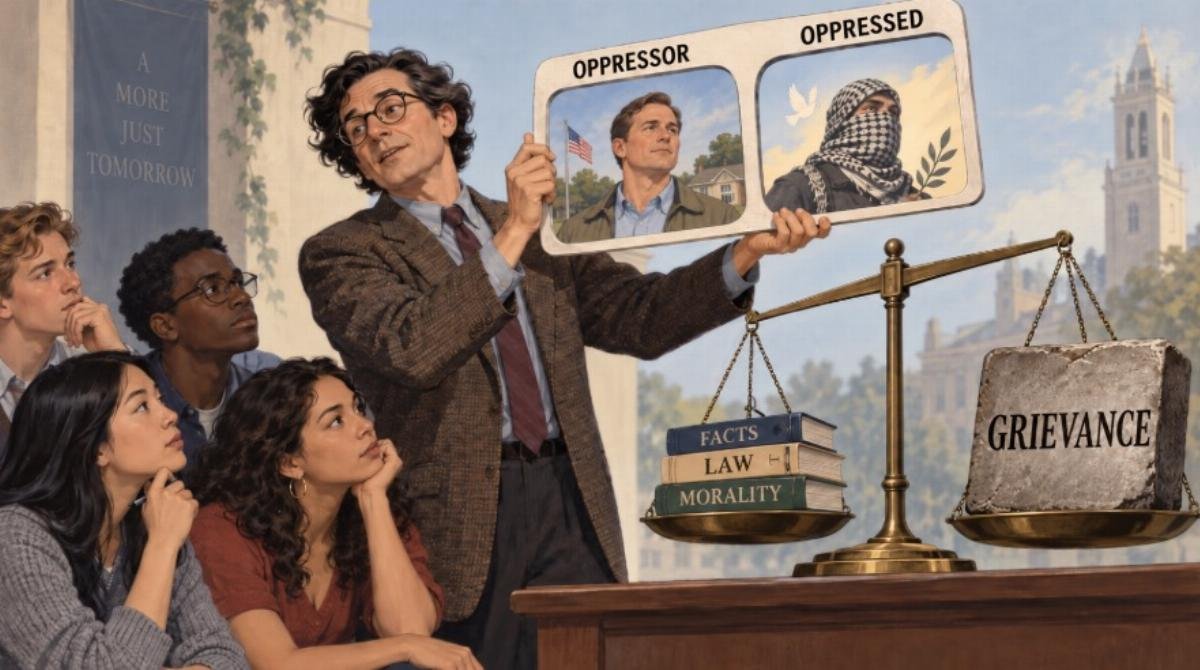
Here Shemesh turns to what he considers the accelerant: a progressive political culture that sorts everyone into oppressor and oppressed. Once a movement is granted the status of the oppressed, he argues, scrutiny shifts to its grievances rather than its doctrine, and acts that would normally be condemned get softer descriptions. Grievances — even illegitimate ones, in his phrasing — end up trumping facts, law and morality.
He points to October 7, 2023, as the moment that exposed how far this mode of thinking had traveled. Within days of Hamas murdering and kidnapping civilians in Israel, dozens of Harvard student organizations signed a statement holding Israel “entirely responsible for all unfolding violence.” Harvard’s president later condemned Hamas’s terrorist atrocities and clarified that the student groups did not speak for the university. Shemesh doesn’t dispute the clarification, but he argues the original response revealed how quickly educated Americans could move from a massacre to an argument assigning blame to the people who were attacked.
The pattern, as he describes it, cuts both ways. Radical Islamist movements have learned that Western language about oppression offers political cover for ideas that clash sharply with Western freedoms. Meanwhile, parts of the radical left have accepted allies whose positions on religious authority, women’s rights, sexual freedom and dissent would be denounced outright if a Western conservative movement held them. Shared enemies, Shemesh suggests, make the cooperation easier — and the convergence around anti-Jewish hatred has become especially visible since October 7.
Free speech as a tool, not a shield
Shemesh is not arguing for censorship. A democracy, he writes, can tolerate hostile ideas and unsupported accusations; free speech allows people to be wrong, and it also gives everyone else the right to examine those ideas clearly and reject them. What troubles him is the reluctance to do the examining.
Western societies, in his view, should be able to state plainly that religious law does not outrank civil law, that terrorism does not become legitimate through grievance, and that murdering civilians does not become resistance because the attacker claims oppression. Those are simple propositions, he writes, and their simplicity is the point.
He closes with a lesson from his own field. In self-defense, he says, preparedness begins before physical contact — once an attacker chooses the timing and conditions, your options have already narrowed. America approached September 11 too late in exactly that sense, then spent two decades becoming exceptionally good at finding armed jihadists while leaving the ideological groundwork largely undisturbed.
Young Americans, he concludes, should understand what jihadist movements actually teach, how extremist ideology converts grievance into permission, and why Western liberty requires confidence in its own principles. The next ideological threat, he warns, won’t wait until America is comfortable naming it.
Shemesh’s essay appeared in American Thinker and reflects his own views as an Israeli-American IDF veteran who writes about Jewish identity, resilience and the ethics of strength amid rising antisemitism.
Source: www.americanthinker.com — https://www.americanthinker.com/blog/2026/09/we-hunted-the-terrorists-but-left-the-ideology-alone/