
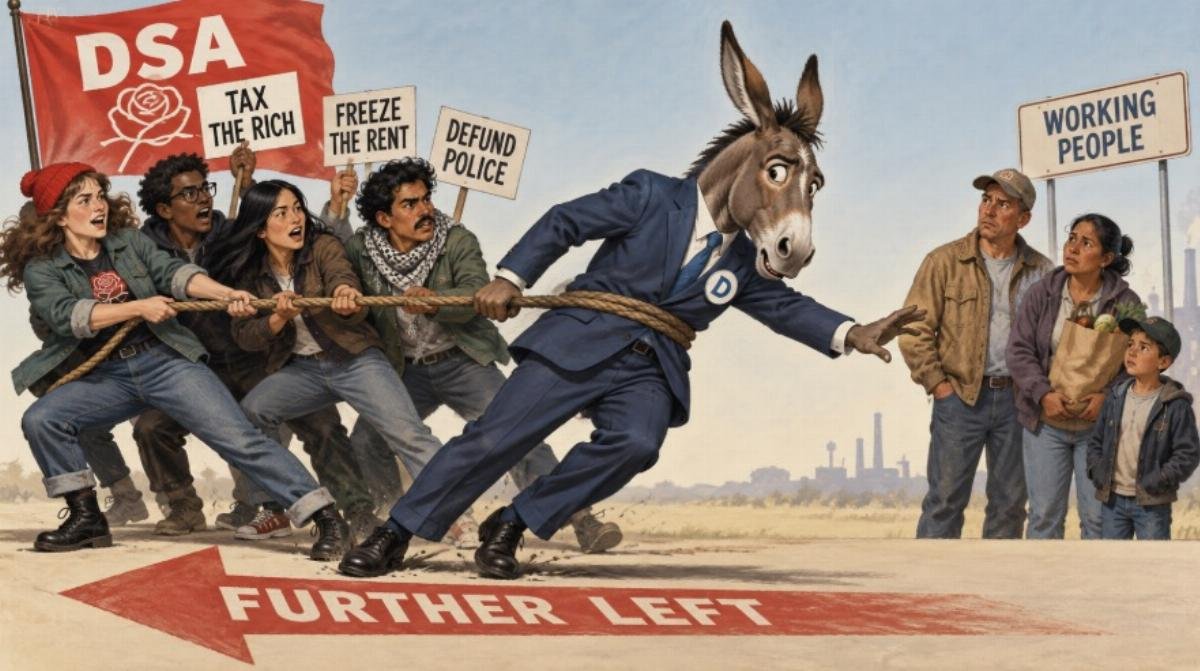
The 2024 election was supposed to force a reckoning. Instead, according to a new American Thinker commentary by Silvio Canto, Jr., the Democratic Party has done the opposite — and the results are already showing up in primary results across the country.
Canto points to Ruy Teixeira’s analysis of the Democrats’ post-2024 trajectory, which argued that the party’s “catastrophic” defeat exposed a widening gap between the cultural and policy priorities of a party dominated by liberal professionals and those of the median working-class voter. The logical response, Teixeira suggested, would have been to close that gap. There was, Canto notes, a brief window after the election when a genuine realignment seemed possible.
That window closed quickly. According to Teixeira’s account as cited by Canto, “#Resistance fever” took hold, party orthodoxy was defended against revision, and momentum shifted decisively toward the progressive left rather than away from it.
The Mamdani Effect
The most visible marker of that shift, per Canto’s piece, was Zohran Mamdani’s 2025 victory in the New York City mayoral race. Canto describes that win as the catalyst for a surge of Democratic Socialists of America primary victories that carried through the 2026 midterm primaries.
The most striking example: Mamdani and the DSA backed three Democratic candidates for New York City House seats — Darializa Avila Chevalier, Brad Lander and Claire Valdez — and all three won. Chevalier’s victory included ousting Adriano Espaillat, the sitting chair of the Congressional Hispanic Caucus. Because these districts are deep blue, Canto writes, all three are all but certain to win in November.

The wave didn’t stop at the city line. According to Canto, Chris Rabb won the Democratic nomination for a Philadelphia House seat, Melat Kiros unseated a 30-year incumbent for a Denver seat, and Donavan McKinney knocked off a sitting Michigan congressman for a Detroit-area seat. All three districts, Canto notes, are safe blue seats — meaning the primary was the real contest.
Further up the ballot, Abdul El-Sayed won Michigan’s Democratic Senate nomination, and Janeese Lewis George won the Democratic nomination for D.C. mayor — a result that all but guarantees she becomes the city’s first democratic socialist mayor.
Canto’s assessment of the pattern is blunt: the most vulnerable Democrat in the country is one facing a primary challenge from the left.
A Winning Slogan Machine
Part of the reason, in Canto’s telling, is that these candidates know how to win primaries — or at least how to turn out just enough of their supporters to vote for whichever slogan is on offer.
On housing, the pitch is straightforward: freeze rents or tax the rich. On food prices, Canto writes, the proposals amount to public groceries — an idea he ties to the failed models of Havana and Caracas. He draws on a personal memory here: his late Cuban mother standing in line at a public “bodega” to collect the family’s weekly ration. Before communism, he notes, bodegas were competing businesses. After, they were perpetually short of everything.
On other issues, Canto says, the left wants to defund the police, eliminate ICE, abolish the U.S. Senate, and more — all laid out, he adds wryly, in manifestos.
The commentary’s closing argument is less a prediction than a warning: Democrats were expected to get the message after 2024. Canto suggests it may take another electoral beating before the party does.
What the Primaries Actually Tell Us
Strip away the partisan framing and there’s a structural story here worth taking seriously. In safely Democratic districts, the November general election is a formality. The primary is the election. That means the ideological center of gravity in the House Democratic caucus is determined not by swing-district voters but by the activists and organized groups who turn out in low-turnout primaries — and the DSA, per Canto’s account, has figured out how to be that group.
Whether that proves to be a strength or a liability depends on which voters you’re counting. Canto’s view is that it’s a recipe for continued national losses, and that the party’s professional class has insulated itself from the voters it needs most. Teixeira’s framing, as quoted, is similar: the party looked at a devastating defeat and concluded the problem was the messenger, not the message.
Supporters of the DSA-aligned candidates would presumably tell a different story — that affordable housing and grocery prices are exactly the kitchen-table issues that working-class voters care about, and that establishment Democrats lost those voters precisely because they stopped offering bold answers.
Either way, the 2026 primary results are hard to argue with as a matter of mechanics. The left identified winnable primaries, concentrated resources, and won them. The question now is what that coalition does with the seats — and whether the broader party decides, once again, to listen to the young lefties or finally to stop.
Source: www.americanthinker.com — https://www.americanthinker.com/blog/2026/09/let-s-listen-to-the-young-lefties-one-more-time/