
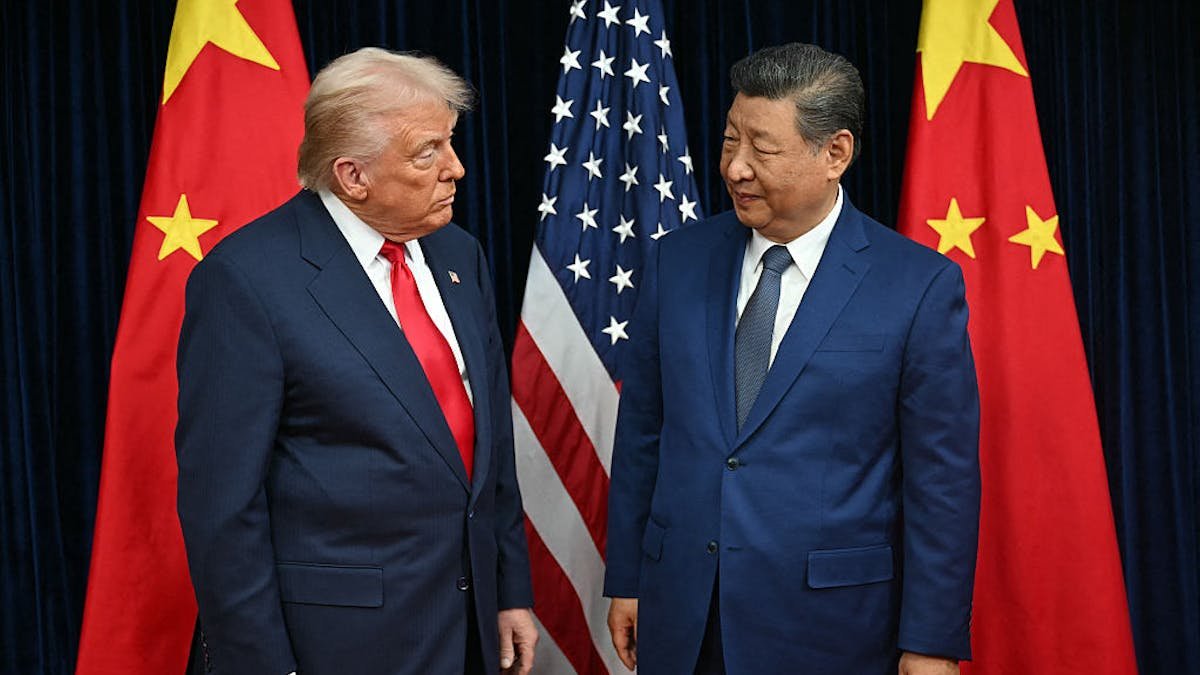
President Donald Trump on Sunday responded to a Wall Street Journal report revealing that Chinese entities played a role in providing Iran with high-resolution satellite imagery used to target a Jordanian air base where three American service members were killed and four others wounded in a July 17 ballistic missile attack, according to The Daily Wire.
Asked about the report, Trump offered a terse reaction: “We spy on them,” he said, adding that China “spies on us.” The comment suggested the president viewed the intelligence-sharing arrangement between Beijing and Tehran through the lens of great-power competition rather than as a distinct escalation.
What The Report Says
According to the Wall Street Journal, Iran obtained high-resolution satellite images of Muwaffaq Salti Air Base in Jordan prior to launching the strike. The ballistic missile attack targeted a housing area where troops were sleeping when it hit on July 17.
The imagery reportedly originated from Chinese sources, though US officials have not formally accused the Chinese government of direct involvement in the attack. When senior American officials raised their concerns about the imagery with Chinese counterparts, the Chinese officials demanded proof, according to the report.
The ambiguity around Beijing’s role stems partly from the structure of Chinese corporate governance. According to the Center for Strategic and International Studies, many large or significant Chinese companies are legally required to have official Chinese Communist Party members on their boards — a requirement that gives the state formal channels to influence corporate decisions. That arrangement makes it difficult to determine whether the satellite imagery transfer to Tehran was directed by the government or occurred through commercial channels with tacit state approval.
Russia Also Providing Intelligence
China is not alone in assisting Iran. According to reports, Russia has also supplied Iran with intelligence, creating a broader picture of great-power support for Tehran’s military operations.

The Trump administration has maintained that no foreign government’s intelligence has significantly improved Tehran’s ability to strike US assets in the region. But recent developments suggest Iran’s targeting capabilities may be improving.
Earlier in the conflict, US and Israeli strikes on Iranian radar and intelligence facilities degraded the regime’s targeting accuracy. In recent months, however, that appears to have changed, with Tehran striking targets with greater precision than before.
The AI Dimension
Artificial intelligence may be a factor in Iran’s emerging capabilities. The International Business Times reported that “Iranian proxies and cyber actors have employed AI for reconnaissance, vulnerability scanning and information operations.” Separately, Anthropic’s September report titled “Detecting and countering misuse of AI” claimed the company thwarted an attempt by the Iranian regime to misuse its technology.

The satellite images may not have directly enabled Tehran to kill American service members, but other aspects of Iran’s relationship with China could have materially improved its capabilities.
Even before Operation Epic Fury, researchers had already suspected Beijing and Tehran were colluding on AI technologies. In recent months, the Trump administration has sanctioned several Chinese satellite-imagery firms over imagery supplied to Iran.
If Beijing has convinced Tehran to use Chinese AI companies for surveillance, target acquisition, or other military means, the Iranian war could serve as a testing ground — allowing the Chinese Communist Party to evaluate how its new systems and technology perform in a conflict against the United States.
Broader Economic Links
China’s assistance to Iran extends beyond intelligence and AI. The nonpartisan US-China Economic and Security Review Commission released a timeline detailing extensive links between the Chinese and Iranian war economies, including rocket fuel precursors and semiconductors — components necessary for advanced weapons systems.
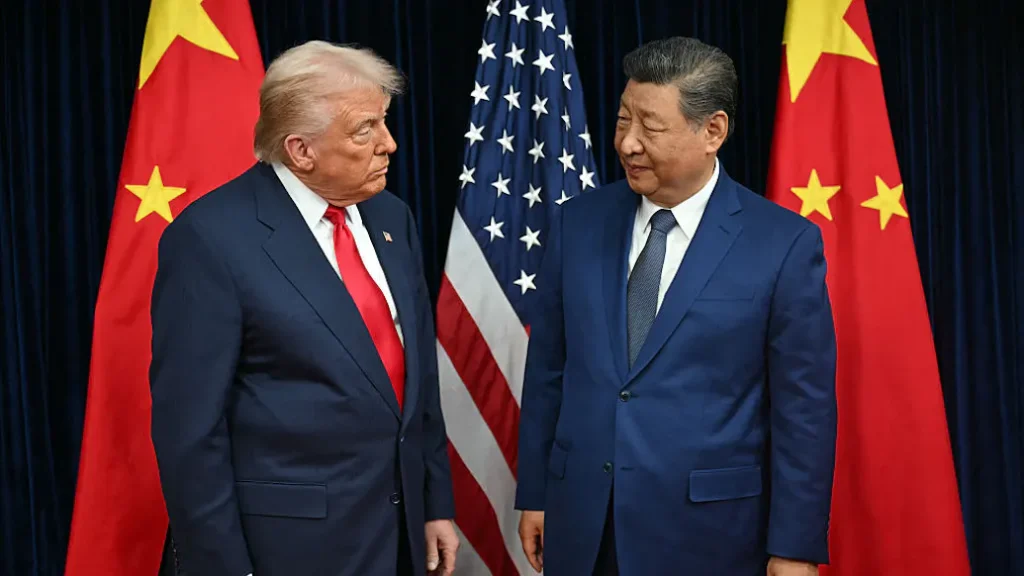
The timing of the report is notable. President Trump is expected to host Chinese President Xi Jinping at the White House on September 24, a meeting that will test how the administration balances its public posture toward Beijing with the mounting evidence of Chinese support for Iran’s military capabilities.
Source: www.dailywire.com — https://www.dailywire.com/news/trump-reacts-to-china-link-in-iran-attack-that-killed-u-s-troops