
A new column published by American Thinker on September 15, 2026, offers a scathing and at-times inflammatory critique of the Lindsay Clancy trial, the women serving on her jury, and the media coverage that followed — while singling out the one Black man on the panel for praise.
Written by Bill Ponton under the headline “My favorite juror,” the piece opens with a provocative thought experiment: imagining an Islamic man watching what Ponton calls the “circus” unfolding in a Boston courtroom and concluding that Western liberalism has failed. Ponton concedes that “at times I must concede that Islamists have a point about Western society,” writing that even as someone “thoroughly ensconced in my culture,” he finds “the spectacle of those women jurors and their fan club repugnant.”
The op-ed, which reads as a personal essay rather than reported journalism, leans heavily on the writer’s own opinions and rhetorical flourishes. Ponton describes Lindsay Clancy as “a woman who has strangled her children” — “beyond the pale of society” — and argues that feminists are treating her actions as “some God-given right.” In his framing, the defense’s discussion of postpartum psychosis is nothing more than “a thinly veiled excuse” for what he calls a broader feminist agenda: “to give free rein to female expression, no matter how perverse.”
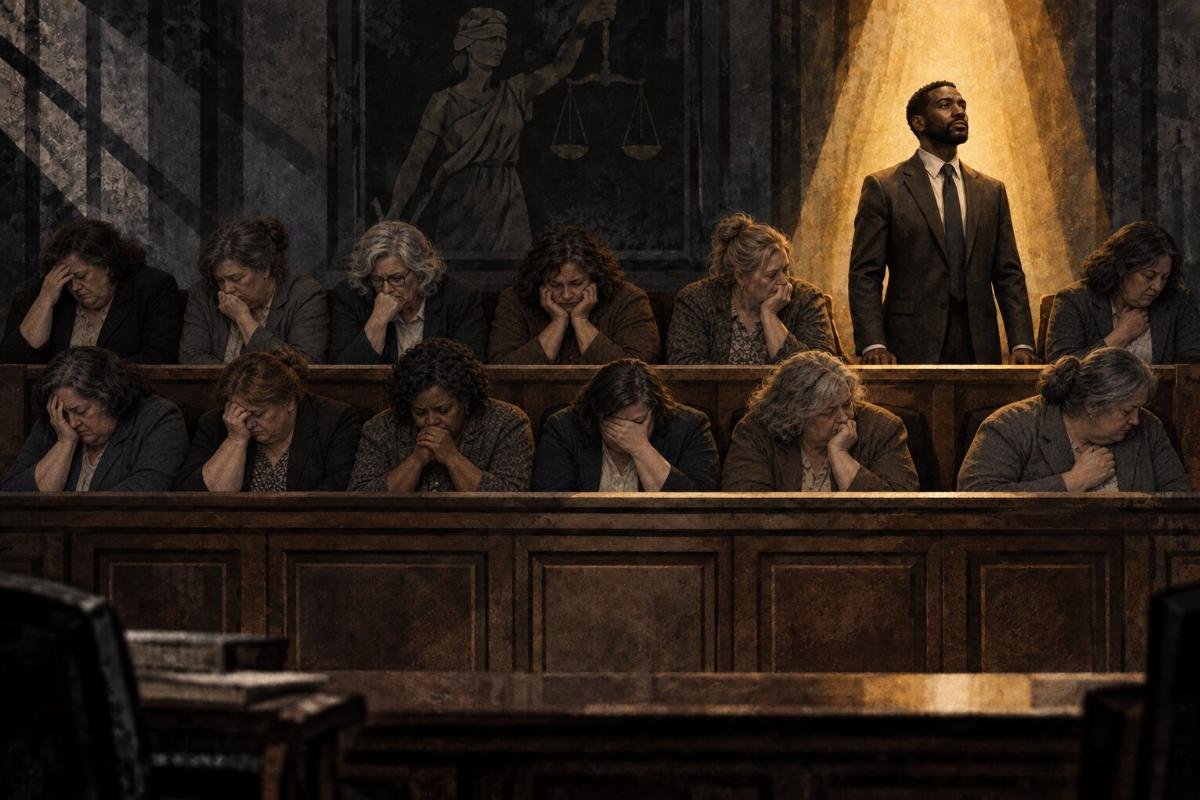
The column then pivots to the jury itself. Ponton describes three men facing what he calls “nine harpies” and asserts that only the sole Black man objected to the prevailing view. He attributes this to a specific and crude theory about race and gender dynamics, writing that “Black men have their hands full dealing with black women” while “white women don’t present the same challenge.” He adds that the Black male juror “didn’t feel cowed by them because he knew none of them would go for the kitchen knives.”
From there, Ponton contends that “now in newsrooms everywhere, the knives have come out” against the holdout juror. He claims that journalists, initially “shocked” at the juror’s race, were “not dissuaded in attacking his character,” and that they “dug up all the dirt that they could find” — an accusation of domestic abuse here, an eviction notice there. He then links to a piece by a writer he describes in a slur, saying her revelations only reinforced his view. His sole response, he writes, is “Right on, brother. You did good.”
The column’s closing lines are strident and self-referential rather than analytical: “Now more than ever, the ability to speak our minds is crucial to the republic we cherish.” The piece ends with a standard American Thinker fundraising appeal.
What the piece actually argues — and what it doesn’t
It is worth being precise about the column’s claims, because much of it is assertion rather than evidence.
Ponton does not detail the specific evidence presented at trial, nor does he engage with the legal standard for postpartum psychosis or any expert testimony. Instead, he dismisses the concept outright as “a thinly veiled excuse,” treating the defense’s theory of the case as self-evidently illegitimate. Nor does he name the newsroom writer he derides, referring to her only with a slur and a link. The column does not identify which outlet she works for in the text, nor does it quote the specific allegations she or others published about the holdout juror.
Similarly, the claims about the Black male juror’s reasoning — that he felt unafraid because “none of them would go for the kitchen knives” — are presented without sourcing. Ponton offers no interviews, no statements from the juror, and no court record to support his characterization of the man’s thinking. That absence is notable given the column’s insistence that the juror’s conduct was honorable and that attacks on him were unfair.
What the piece does do is articulate a specific worldview: that the Clancy case is a cultural battleground rather than a legal proceeding, that gender and race shape jury behavior in predictable and unflattering ways, and that the press is engaged in a coordinated character assassination of anyone who resists the feminist narrative.
The Clancy case as a cultural flashpoint
For readers unfamiliar with the case, Ponton’s column assumes a great deal of background knowledge. He references the “Lindsay Clancy trial” as a well-known event and treats the jury’s composition and the post-verdict media coverage as widely understood. He does not summarize what Clancy was charged with, what the outcome was, or how the jury divided — details that a reader coming to the piece without prior context would need.
That stylistic choice is consistent with the genre. American Thinker’s blog format tends toward commentary aimed at an audience already fluent in the outlet’s preferred framing, and Ponton writes for that audience throughout. The result is a column that functions less as an argument than as a declaration of allegiance — a set of assertions about feminism, race, journalism, and masculinity strung together with polemical energy.
Still, the piece raises a question that transcends its particular grievances: when does a legal proceeding become a cultural proxy war, and what happens to the people inside it — jurors, defendants, witnesses — when that happens? Ponton clearly believes the transformation is already complete, and he believes the responsible parties are feminists, their allies in the press, and a culture that has made it “bad form now to roll one’s eyes when a woman speaks.”
It should be noted that the columnist’s own language is itself notable: referring to women jurors as “harpies,” invoking stereotypes about Black men and “kitchen knives,” and using a homophobic slur to describe a female journalist. Those choices are part of the argument, not incidental to it. Ponton is signaling that he considers restraint in such matters a form of capitulation — that the willingness to say the unsayable is precisely what he believes the republic requires.
What happens next
The op-ed does not purport to break news. It contains no new documents, no interviews, and no reporting of its own. Its value to readers lies in the window it provides into a strain of political commentary that treats the Clancy case as a case study in cultural collapse — and that celebrates the lone dissenter, however he came to his position, as a hero.
Whether the holdout juror welcomes that embrace is unclear. Ponton’s column does not say, and the piece offers no indication that the juror has spoken publicly or authorized anyone to speak for him. What is clear is that Ponton has found, in the Clancy trial, a vehicle for everything he wants to say about feminism, race, journalism, and the supposed cowardice of white men — and that he intends to keep saying it.
For anyone tracking the broader argument over how the Clancy case is being remembered, the column is less a contribution to debate than a marker of how far some commentary has moved from the facts of the courtroom itself. Ponton isn’t asking whether the verdict was correct. He is asking whose side the culture is on — and he has made his choice unmistakable.
Source: www.americanthinker.com — https://www.americanthinker.com/blog/2026/09/my-favorite-juror/