
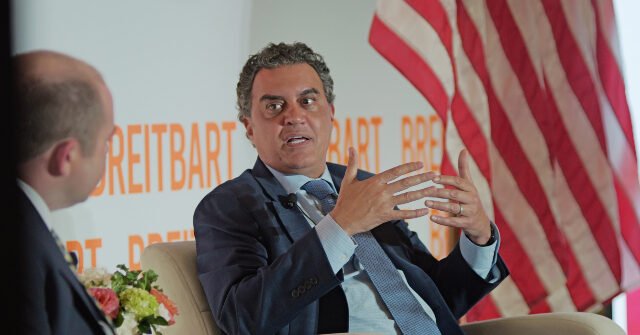
A senior Pentagon technology official poured cold water Monday on the idea that the United States and China could strike a sweeping agreement to slow the development of artificial intelligence, calling the notion “fantasyland” and arguing that any such deal would only hobble the country that is currently ahead.
Emil Michael, the Under Secretary of War for Research and Engineering and the Department of War’s Chief Technology Officer, made the remarks during an appearance on Fox News Channel’s “The Story,” as reported by Breitbart. His comments came just before an expected meeting between the president and Chinese President Xi Jinping, a sit-down that has fueled speculation about a possible bilateral understanding on AI safety and global regulation.
“If You’re Ahead, Why Would You Slow Down?”
Host Martha MacCallum pressed Michael directly on whether Beijing has shown any genuine appetite for sitting down to discuss global brakes on AI development. Michael was blunt in response, describing the idea of a grand, nuclear-style treaty emerging from a single summit as deeply unrealistic.
“This is the extreme naivete of some of these companies, particularly Anthropic, that there’s going to be some grand nuclear-like treaty for AI that happens in a day on a visit, especially when the U.S. is ahead,” Michael said, according to Breitbart’s account of the interview. “If you’re ahead, and the number 2 says sure, we’ll do a treaty that slows you down, great. It’s sort of very — extremely naive, not to mention counterproductive for Americans.”
He added that the expectation of a major breakthrough during the visit amounts to little more than wishful thinking. “I think the notion that there’s going to be some grand action here is crazy,” he said. “Even the Chinese came out today and said we don’t agree with Dario’s proposal, in particular. So, I think this is sort of fantasyland.”
The reference to “Dario’s proposal” points to Dario Amodei, the chief executive of Anthropic, one of the leading American AI developers. Michael singled out the company by name, suggesting that its advocacy for international guardrails reflects a misunderstanding of the strategic dynamics at play.
A Recurring Tension Inside the AI Debate
Michael’s critique captures a long-running divide in Washington and Silicon Valley over how to approach artificial intelligence. On one side are researchers and executives who warn that advanced AI systems could pose catastrophic risks and argue for coordinated international limits, similar to Cold War arms-control frameworks. On the other are officials and industry figures who contend that unilateral or bilateral restrictions would simply cede advantage to competitors — particularly China — without meaningfully reducing risk.
The Pentagon official’s framing leans heavily on the second view: that the United States currently holds a lead in AI, and that any agreement designed to slow things down would disproportionately bind Washington while Beijing continues apace. In that logic, a treaty that constrains the front-runner is not a safety measure but a self-inflicted setback.
That argument has gained traction among critics of proposed AI moratoriums and licensing regimes, who say the technology is too strategically important to be governed by the same logic as nuclear weapons, where mutual assured destruction created shared incentives for restraint. AI development, they argue, is diffuse and commercially driven, making verification and enforcement far harder than counting warheads.
China’s Own Signals
Michael also pointed to China’s public reaction to Amodei’s proposal as evidence that the appetite for a binding slowdown is not mutual. According to his account, Chinese officials have already made clear they do not embrace the specifics of what the Anthropic CEO has floated. That, in Michael’s telling, undercuts the premise that the two countries are on the cusp of a landmark accord.
Whether the president’s meeting with Xi produces anything beyond general statements on AI risk remains to be seen. Past U.S.-China dialogues on emerging technologies have tended to yield broad language about cooperation and responsible development rather than enforceable limits, reflecting both the difficulty of verification and the reluctance of either side to surrender strategic ground.
For now, the message from at least one senior figure in the Department of War is that expectations should be tempered. Michael’s characterization of the moment as “fantasyland” is a direct challenge to the companies and advocates pushing for exactly the kind of agreement that a presidential summit might, in theory, deliver.
What Comes Next
The episode underscores how the AI policy debate is increasingly colliding with great-power politics. As the president prepares to sit down with Xi, the question of whether the two nations can or should attempt to govern AI jointly is no longer an abstract academic discussion — it is a live diplomatic question with competing factions inside the U.S. government itself.
Michael’s remarks suggest that, within parts of the defense establishment, skepticism about such deals runs deep. If his view prevails, the outcome of the meeting is more likely to be a reaffirmation of competition than a handshake on restraint — a result some in the industry will welcome and others will warn against.
Source: www.breitbart.com — https://www.breitbart.com/clips/2026/09/15/pentagon-its-silly-to-make-deal-with-china-to-slow-down-on-ai-we-wont-have-a-big-deal/