
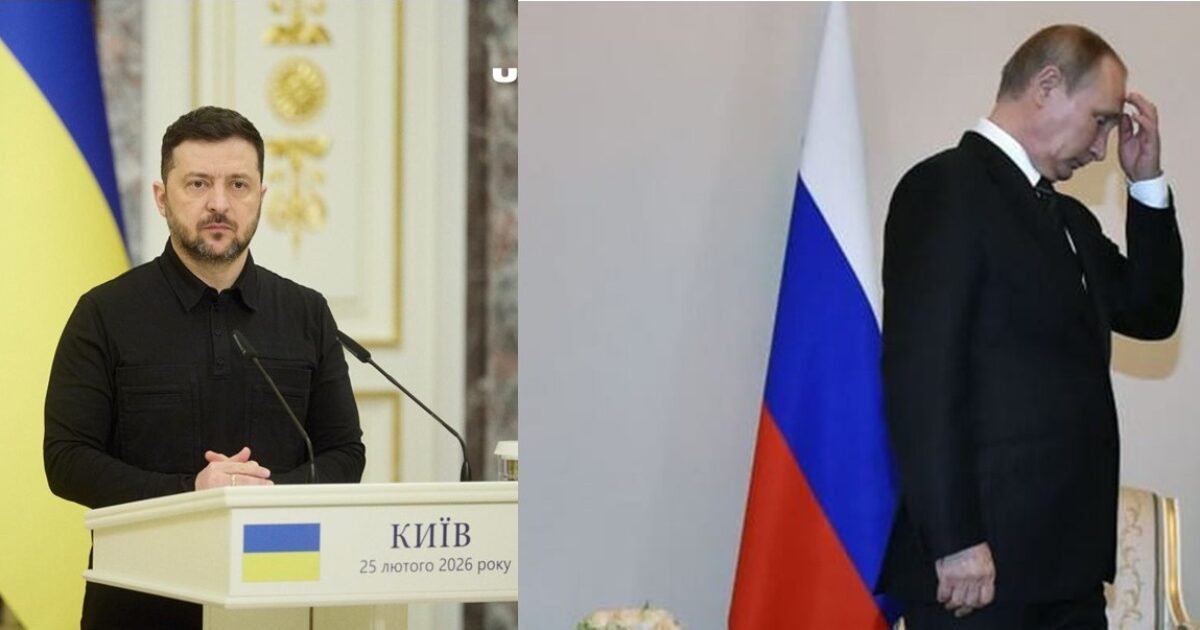
As diplomatic efforts to wind down the war in Ukraine grind on, a familiar argument keeps resurfacing: that Kyiv could trade land for peace. In a piece published by The Gateway Pundit, author Antonio Graceffo rejects that premise outright, arguing that history, Moscow’s negotiating positions, and Vladimir Putin’s own words all point in the opposite direction.
Graceffo’s central claim is that handing Russia Ukrainian territory wouldn’t settle the conflict — it would invite the next phase of it. To make the case, he walks through a set of historical parallels and contemporary data points.
The Munich precedent
The first stop is 1938. Under the Munich Agreement, Britain and France permitted Hitler to annex Czechoslovakia’s Sudetenland in return for his promise to pursue no further territorial expansion. Within five months, Hitler had swallowed the rest of Czechoslovakia. The following September, Germany invaded Poland.
For Graceffo, that sequence is the template for appeasement arguments — a concession made in the name of stability that instead signaled that further aggression would go unanswered.
Crimea as a rehearsal
The second precedent is closer to home. After Russia annexed Crimea in 2014, the Western response consisted of sanctions, without military backing for Ukraine. Analysts at the Atlantic Council, Graceffo notes, have argued that this limited reaction persuaded Putin the West lacked the resolve to confront him — and effectively cleared the path for the full-scale invasion that followed in 2022.
On that reading, the lesson of Crimea isn’t that territorial loss produces peace; it’s that territorial loss without a credible deterrent produces escalation.
Two models of occupation
Graceffo then pivots to the postwar occupation of Europe, drawing a contrast between zones administered by the U.S.-led Western Allies and those controlled by the Soviet Union.
In the Western zones, occupied countries built independent, elected governments within months of the war’s end. The Allies retained authority over certain governmental decisions until full sovereignty was restored — a process that took roughly two years for Italy, seven for Japan, and ten for West Germany and Austria. Aided by the Marshall Plan, those countries grew into some of the world’s wealthiest economies.
Soviet-occupied zones followed a different path entirely: one-party dictatorships that suppressed civil liberties and lagged economically for more than four decades. The implication is hard to miss — where a country ends up after occupation depends heavily on who is doing the occupying.
The economic gap
To underline the disparity between Russia and the West, Graceffo cites per capita income figures. Germany’s 2025 GDP per capita was approximately $60,440, while Russia’s stood at about $17,547. The United States that year was around $89,599. Put another way, Russia’s GDP per capita amounted to roughly 29 percent of Germany’s and 20 percent of the American figure.
Even Russia’s wealthiest cities trail far behind. Moscow’s gross regional domestic product per capita was about $32,000 in 2022 and rose to roughly $42,000 by 2024. St. Petersburg, the country’s second-richest city, posted about $30,000 in 2022. Both figures are several times the Russian national average — yet still well below German and American levels.
Beyond those two metropolitan centers, the picture dims considerably. GRDP per capita in regions such as Belgorod, Vologda, and Samara falls between $8,000 and $15,000. Russia’s poorest areas, including Ingushetia and other North Caucasus republics, sit at roughly $2,000 to $3,000.
For context, the average GDP per capita across Latin America and the Caribbean was about $9,200 in 2024. Most Russian regions outside Moscow and St. Petersburg land in a comparable or slightly higher range, while the country’s poorest regions fall well below it.
What Moscow is actually asking for
The piece also argues that Russia’s demands in the 2025–2026 peace talks extend beyond the territory its forces currently hold. Citing the Observer Research Foundation, Graceffo writes that Russia’s terms require Ukraine to withdraw entirely from Donetsk, Luhansk, Kherson, and Zaporizhzhia oblasts — including roughly one-quarter of Donetsk that remains under Ukrainian control.

That gap between the front line and the negotiating table is central to his argument: if Moscow is asking for more land than it has seized, ceding what it already occupies would not satisfy the demand.
He backs this with statements from Russian officials and Putin himself. In May 2025, Russia’s Foreign Ministry said it would “never allow” Ukraine to be restored within its internationally recognized 1991 borders. In his 2021 essay “On the Historical Unity of Russians and Ukrainians,” Putin wrote that Ukraine has no genuine independent statehood and that Ukrainian sovereignty “is possible only in partnership with Russia.”
Graceffo also reaches back to an April 2005 address to the Russian Federal Assembly, in which Putin described the collapse of the Soviet Union as “the greatest geopolitical catastrophe of the century.”
Putin’s denial, and what it leaves unanswered
Perhaps the most closely parsed passage comes from a February 22, 2022 meeting between Putin and Azerbaijani President Ilham Aliyev. At that encounter — one day after Putin ordered troops into eastern Ukraine and two days before the full-scale invasion — Putin said: “We predicted speculation that Russia plans to restore [its] empire within imperial borders. This absolutely does not correspond with reality.”
Graceffo contends that Putin never explained why the speculation was wrong, describing the remark as a denial rather than an argument. In the same remarks, Putin said Russia had “recognized the new geopolitical realities” following the Soviet collapse and had worked with “all independent countries in the post-Soviet space.” He characterized Ukraine as an exception, saying it “is being used by third countries to create threats towards Russia.”
Neither statement, Graceffo argues, directly addresses the claim that Russia seeks to restore its empire. The first describes Russia’s general posture toward other former Soviet states but offers no evidence regarding Ukraine. The second explains why Russia treated Ukraine differently without explaining why that treatment doesn’t amount to imperial restoration.
He concludes that Putin’s actions do not dispel the speculation that he will push beyond eastern Ukraine — or beyond Ukraine entirely. On that basis, Graceffo writes, the argument that Ukraine can end the war by ceding territory does not hold up.
Source: www.thegatewaypundit.com — https://www.thegatewaypundit.com/2026/09/why-ceding-ukrainian-territory-will-not-bring-peace/