
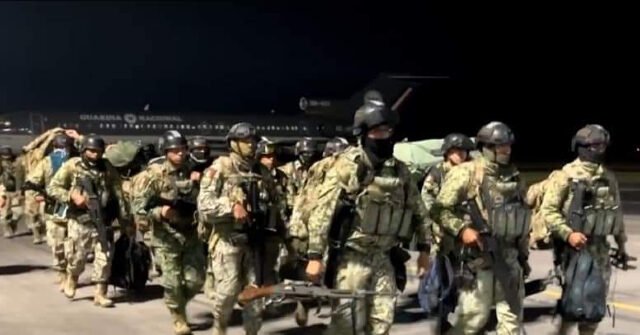
Mexico’s government is sending more than 1,800 federal troops into Sinaloa, a state that has effectively been held hostage by the Sinaloa Cartel’s internal war for the past two years, according to reporting from Breitbart News. The deployment was announced by the country’s top security official, Omar García Harfuch, and includes 1,000 Mexican Navy infantrymen headed to the Pacific port city of Mazatlán, with additional forces directed to the state capital of Culiacán.
The move underscores how far the central government has been willing to go to reclaim territory in a state where previous deployments have failed to break the grip of the cartel factions fighting over it.
A Turf War That Shows No Sign of Slowing
Mazatlán, a beach destination popular with foreign tourists, continues to record a high number of killings nearly every day, according to Breitbart, as two main factions of the Sinaloa Cartel — Los Chapitos and La Mayiza — fight for control of the state’s criminal networks. On Monday alone, the city saw numerous killings, including the murder of a U.S. citizen who was outside a seafood restaurant.
The violence is rooted in a single act of betrayal, according to Breitbart Texas. The fighting began when Los Chapitos kidnapped Ismael “El Mayo” Zambada and flew him to Texas into the waiting hands of U.S. agents. That perceived betrayal created a lasting rift between El Mayo’s family and Los Chapitos, and it has been the engine driving the state’s violence ever since.
The human toll is staggering. In the two years since the fighting started, Sinaloa has seen more than 3,100 murders and at least 5,000 forced disappearances, according to statistics from law enforcement and human rights groups cited by Breitbart. And those figures are likely a fraction of the real number, with the true toll expected to be much higher.
The violence has repeatedly spilled over the border in ways that touch American citizens. The U.S. citizen killed Monday outside a seafood restaurant is the latest example of how the conflict reaches foreigners and locals alike, regardless of the ongoing military presence.
A Pattern of Deployments That Hasn’t Stopped the Killing
The new deployment is not the first attempt to pacify Sinaloa. The article notes that despite prior deployments, the Sinaloa Cartel has continued to wage its fierce turf war — a detail that raises questions about whether an additional 1,800 troops will be enough to restore order in a state where the cartel operates with relative impunity.
García Harfuch’s announcement specifically aims to increase the federal presence in Mazatlán and Culiacán, the two cities where the fight has been concentrated. Mazatlán, in particular, has become a flashpoint, with daily murders occurring despite its importance as a tourist destination.
For the residents of Sinaloa, the new deployment represents both a promise of protection and a reminder of how long the violence has gone on. For U.S. authorities, the killing of an American citizen outside a seafood restaurant is a reminder that the conflict is not a distant problem — it has direct consequences for Americans, whether they are visiting the region or living there.
The deployment also highlights a difficult reality for Mexico’s government: the cartel factions have proven resilient. The two-year war between Los Chapitos and La Mayiza has continued through multiple federal operations, and the latest troop surge is the government’s newest attempt to impose order on a state that has seen thousands killed and thousands more disappear.
Breitbart Texas, which has covered the Sinaloa violence extensively through its Cartel Chronicles project, reports that the fighting began with El Mayo’s capture and has not abated. The statistics cited — 3,100 murders and at least 5,000 forced disappearances — come from law enforcement and human rights groups, and likely understate the true scale of the crisis.
What Comes Next
The deployment of 1,800 troops is a significant escalation, but whether it produces a sustained drop in violence remains to be seen. The Sinaloa Cartel’s internal conflict has defied previous government efforts, and the killing in Mazatlán continued right up to the announcement of the new deployment.
For now, the government is betting that a larger and more visible security presence — including 1,000 Navy infantrymen — can at least stabilize Mazatlán and Culiacán. The coming weeks will show whether that bet pays off, or whether the cycle of violence continues as it has for the past two years.
Source: www.breitbart.com — https://www.breitbart.com/border/2026/09/16/mexico-deploys-1800-troops-to-cartel-controlled-state-amid-raging-violence/