
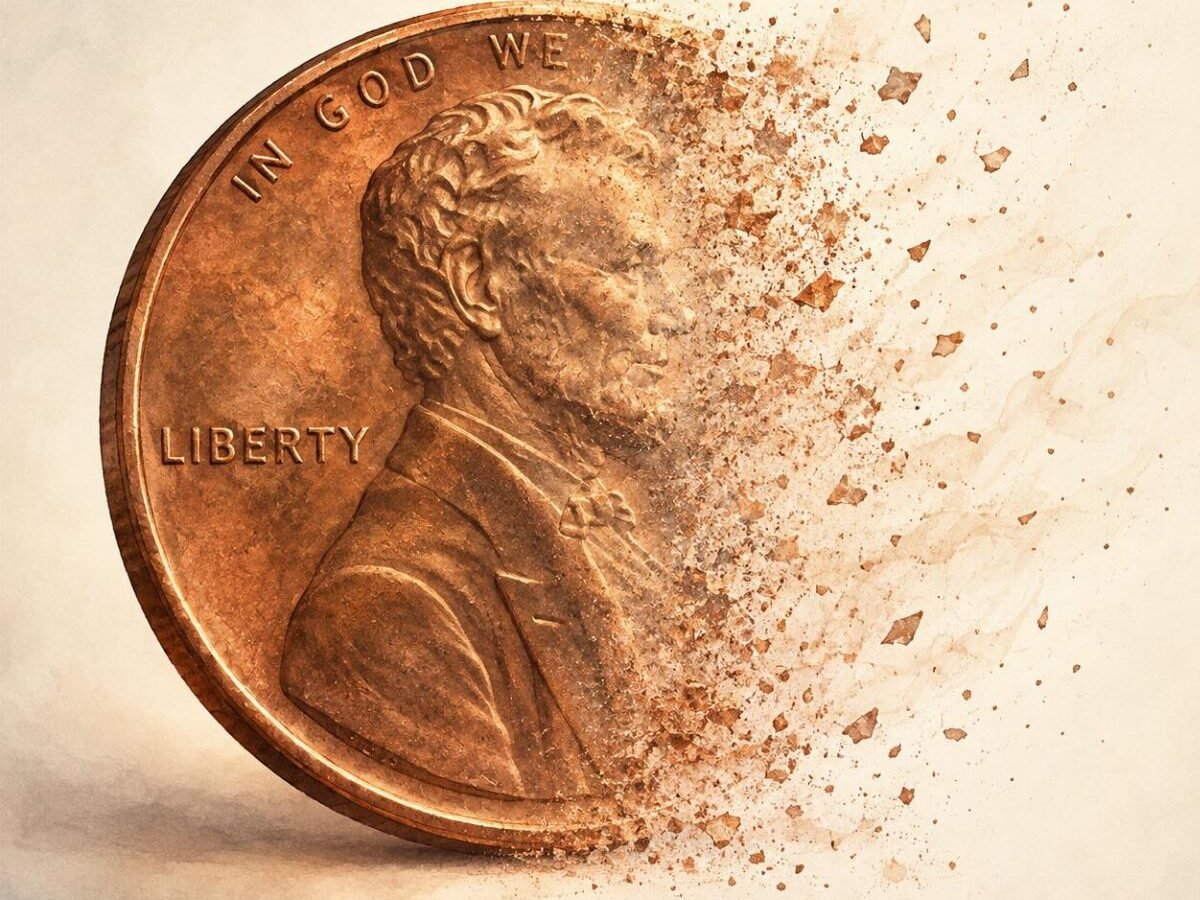
The House of Representatives has passed legislation that would formally end production of the one-cent coin, according to a report at the New York Post, advancing the bill with what American Thinker’s Olivia Murray describes as unanimous support from lawmakers. The vote writes the final chapter on a coin that has circulated in some form for roughly 232 years.
Murray’s commentary, published in American Thinker, frames the penny’s demise less as a numismatic curiosity than as a symptom of something larger: a federal government that can suddenly discover fiscal discipline when the sums involved are trivially small.
The math behind the decision
The supposed justification for retiring the penny is straightforward: it costs more to make than it is worth. Murray cites Treasury figures showing that minting pennies in 2024 produced negative seigniorage of $85.3 million.
She concedes that figure isn’t negligible. But she argues it’s a rounding error against the broader picture of federal finances. The piece points to Government Accountability Office estimates that fraud alone costs the government somewhere between $233 billion and $521 billion annually. Set against that range, she writes, $80 million or so hardly registers.
Beyond fraud, Murray lists the recurring targets of fiscal conservative complaint: trillions in annual spending on new programs, expansions of existing ones, and entitlements serving a growing population — all while the government operates at a deficit and taxes remain, in her assessment, punishingly high.
A taxpayer’s ledger
Murray writes from the perspective of someone earning what she describes as a modest middle-class salary. She says she pays tens of thousands of dollars annually in income and employment taxes, estimating that more than a third of her household income goes to the state of Alabama and the Internal Revenue Service combined.
That personal math is central to her argument. If lawmakers were genuinely interested in eliminating waste, she suggests, the penny’s $85 million problem would rank far down the list of priorities. The fact that it has drawn unanimous bipartisan attention — while fraud and overspending continue — tells her something about where the real institutional appetite for restraint lies.
Inflation and the shrinking cent
Then there’s the question of why a penny is now worth less than it costs to produce. Murray attributes the erosion of the coin’s purchasing power to the spending habits of elected officials in Washington, and she invokes two economic commentators to make the case.
She recalls Milton Friedman’s contention that inflation is “always and everywhere a monetary phenomenon,” made by government and no one else, since only the government holds a monopoly on the printing press. She pairs that with Thomas Sowell’s observation that inflation functions as a means of taking people’s wealth without openly raising taxes — in his phrasing, the most universal tax of all.
The penny’s obsolescence, in Murray’s telling, is not the coin’s fault. It is the logical end point of a financial system carrying more than $40 trillion in debt.
A contrast with Europe
Murray allows herself a comparison that she acknowledges is unusual for her: Europe. She writes that Americans, herself included, enjoy criticizing European politics, and she considers much of that criticism warranted. But she notes that European nations can at least say they have not spent themselves into such a position that they were forced to eliminate their cents and pence.
The remark is pointed, and it lands squarely on her larger theme. The United States, by her account, has reached a level of fiscal deterioration that its transatlantic counterparts have so far avoided.
The cultural casualties
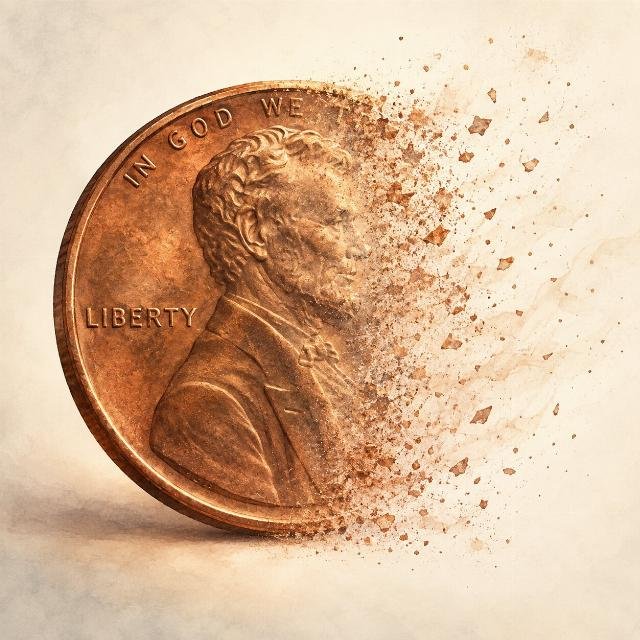
A substantial portion of the piece catalogs what disappears along with the coin. Murray runs through the idioms and traditions tied to the penny: a “penny for your thoughts,” penny candy, the penny arcade, penny loafers once used to hold spare change that could actually buy something.
She notes the loss of smaller rituals, too — finding a lucky penny on the ground, the practice of “pinching pennies,” the expression that every penny counts. She observes that gifting a newborn a penny to symbolize prosperity is a tradition future generations won’t be able to carry on, and that anyone born after 2025 won’t have the option of keeping a penny for good luck. She mentions the old shipbuilding custom of placing a penny under the mast for good fortune, and wonders, wryly, whether nickels will have to do.
Penny loafers, she suggests, will need to make room for dollar bills — until those, too, become a thing of the past.
The political kicker
Murray’s sharpest line is reserved for Congress itself. The only issue, she writes, on which Democrats and Republicans can achieve total agreement is passing legislation that leaves the American public worse off financially.
The piece closes by returning to a familiar theme for the outlet: the importance of free expression to the republic. The publication appends its standard appeal for reader donations to support its staff and keep its commentary in circulation.
What emerges from the column is less a defense of the penny as a unit of currency than an indictment of the priorities it exposes. A coin worth less than its own manufacturing cost is a small thing to retire. The unanimous vote to do so, in Murray’s reading, is evidence of how easy it is for Washington to act when the stakes are measured in millions — and how reluctant it remains when they are measured in trillions.
Source: www.americanthinker.com — https://www.americanthinker.com/blog/2026/09/washington-s-spending-manifests-in-the-true-end-of-the-penny-s-232-year-existence/