
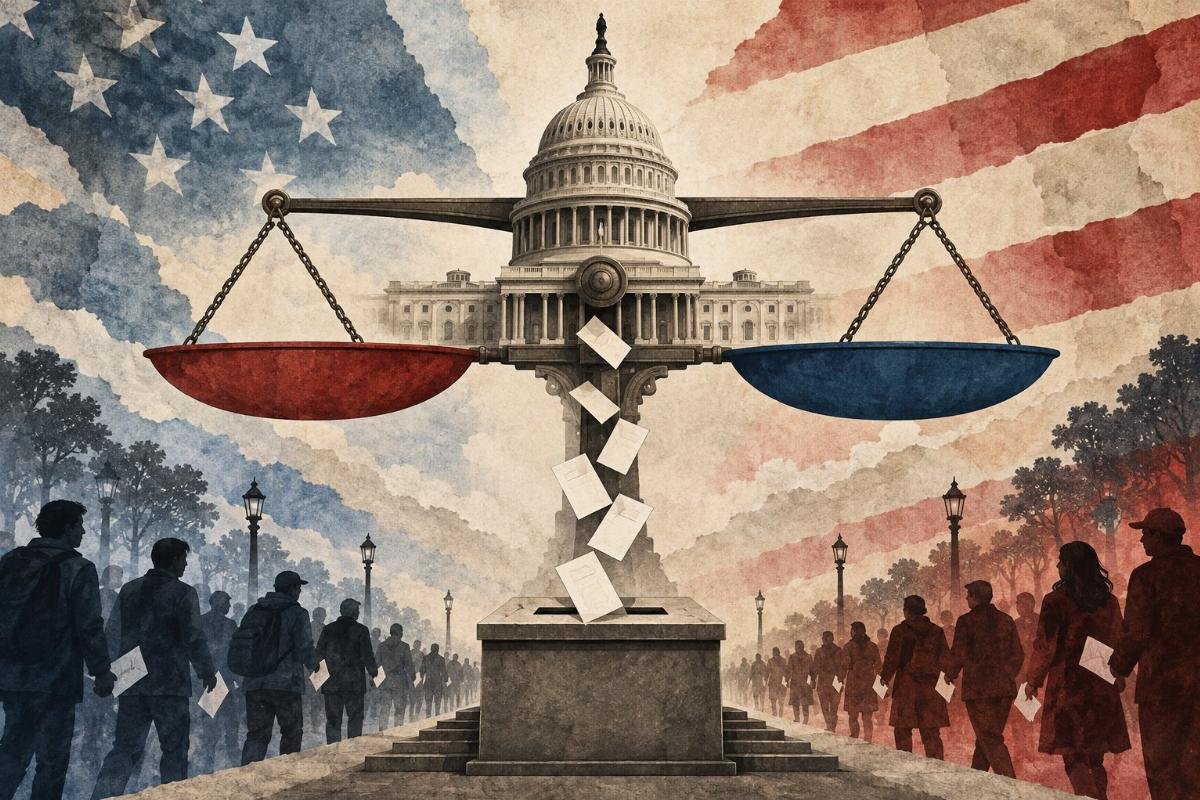
Republicans head into the midterm elections with packed arenas, a dominant social-media presence, and an endless supply of memes, flags, and chants. What they may not have, a conservative writer warns, is a deliverable record that working-class voters can feel in their bank accounts.
In a new op-ed for American Thinker, George P. Brooks — who opens by declaring “I am MAGA. I make no apology for it” — argues that the movement’s enthusiasm is not a substitute for results. If Republicans lose in November, he writes, blaming the media, Democrats, or disloyal voters will not answer “the only question that matters: What did we fail to deliver?”
The piece, published September 16, is framed less as a critique of the movement than as an internal warning from someone who wants it to survive beyond its current leader. Brooks describes himself as a loyalist who believes loyalty “does not require intellectual anesthesia.”
The gap between rallies and receipts
Brooks’ central argument is that Republicans can fill stadiums and dominate a news cycle for an afternoon without convincing the average voter that their lives are improving. “A movement cannot survive indefinitely by telling voters that conditions are wonderful when their checking accounts are telling them otherwise,” he writes.
He ticks through the costs he says define ordinary life: groceries, rent, electricity, insurance, medical expenses, gasoline, and childcare. The average American, in his telling, does not wake up thinking about ideological abstractions — he wonders “what happened to his paycheck between Friday and Monday.”
That framing is notable because it borrows a page from how conservatives talked during the Biden years. Brooks reminds readers that the right mocked the previous administration for explaining away inflation with favorable statistics while families stared at grocery receipts “that resembled mortgage payments.” The argument that “people experience economies rather than spreadsheets” was correct then, he writes, and it does not become false just because a Republican now occupies the White House.
His prescription is blunt: if affordability remains painful, say so. If housing is out of reach for young families, confront it. If healthcare costs remain obscene, address them. And if working-class Americans believe Washington’s definition of prosperity bears little resemblance to their own lives, don’t lecture them about why their experience is statistically incorrect. “Listen to them,” he writes. “That is supposed to be one of the defining differences between populism and establishment politics.”
Beyond tax rates
Brooks situates his argument in a broader view of what conservatism is for. He rejects the idea that it amounts to a set of tax rates and regulatory preferences, describing it instead as “an argument about civilization”: family, work, responsibility, sovereignty, faith, community, property, ordered liberty, and the dignity of providing for oneself.
But those institutions, he insists, do not survive economically on rhetoric alone. You cannot preach family formation to a 27-year-old who believes he will never afford a home without explaining why homeownership has become fantastical. You cannot lecture people about personal responsibility while government builds systems that punish responsible behavior. You cannot celebrate work while millions of working people wonder why employment no longer guarantees stability.
The sharpest warning in the piece is about hypocrisy. Republicans, Brooks writes, “cannot spend years condemning Democrat economic gaslighting only to develop our own version when the political incentives change.” Doing so, he adds, would be “hypocrisy with better PR.”
The succession question
Brooks does not pretend Trump is fading from the scene. He calls the president “the gravitational center of the Republican Party” and says pretending otherwise is “political fantasy.” He credits Trump’s ability to communicate directly with millions of Americans, control the news cycle, and energize voters who once ignored Republican politics with transforming the party.
Still, he argues that a movement built around one personality eventually faces a question every durable movement must answer: can it become an institution? “At some point, MAGA must demonstrate that it is more than the political biography of Donald J. Trump,” he writes. “It must become a governing philosophy capable of surviving him.”
That is not just a matter of ideas, he suggests, but of coalition. He urges cultivation of candidates who can speak to suburban parents, black working-class voters, Hispanics, young men, small-business owners, Christians, independents, and people who “do not spend twelve hours per day fighting strangers online.” Doing that, he adds, requires accepting that criticism from inside the movement is not betrayal — a point he underscores with two rhetorical questions: question a strategy and you are insufficiently loyal? Criticize a Republican politician and someone demands to know whether you secretly support Democrats?
Democrats don’t have to win
Perhaps the most uncomfortable passage is Brooks’ reminder that Republicans can lose without Democrats becoming popular. “Democrats do not have to become popular for Republicans to lose,” he writes. “Republicans merely have to become disappointing.”
Politics, he notes, is often decided not by conversion but by enthusiasm. A voter does not need to become progressive to stay home. “He merely has to conclude that showing up will not materially change his life.”
That reality, Brooks argues, is why “governing matters more than branding.” He closes by reaffirming his optimism about the America First movement, crediting it with shattering assumptions that had “calcified inside both political parties” — challenging globalism, uncontrolled immigration, elite cultural authority, bureaucratic permanence, endless foreign entanglements, and what he calls the strange bipartisan consensus that ordinary Americans should accept national decline politely.
His advice for November is symmetrical. If Republicans win, treat victory as “an instruction, not a coronation.” If they lose, resist the instinct to blame everyone except themselves.
It is a message aimed squarely at a movement Brooks clearly wants to see endure past its current moment — and it amounts to a warning that cheers fade faster than grocery bills.
Source: www.americanthinker.com — https://www.americanthinker.com/blog/2026/09/maga-cannot-live-on-applause/