
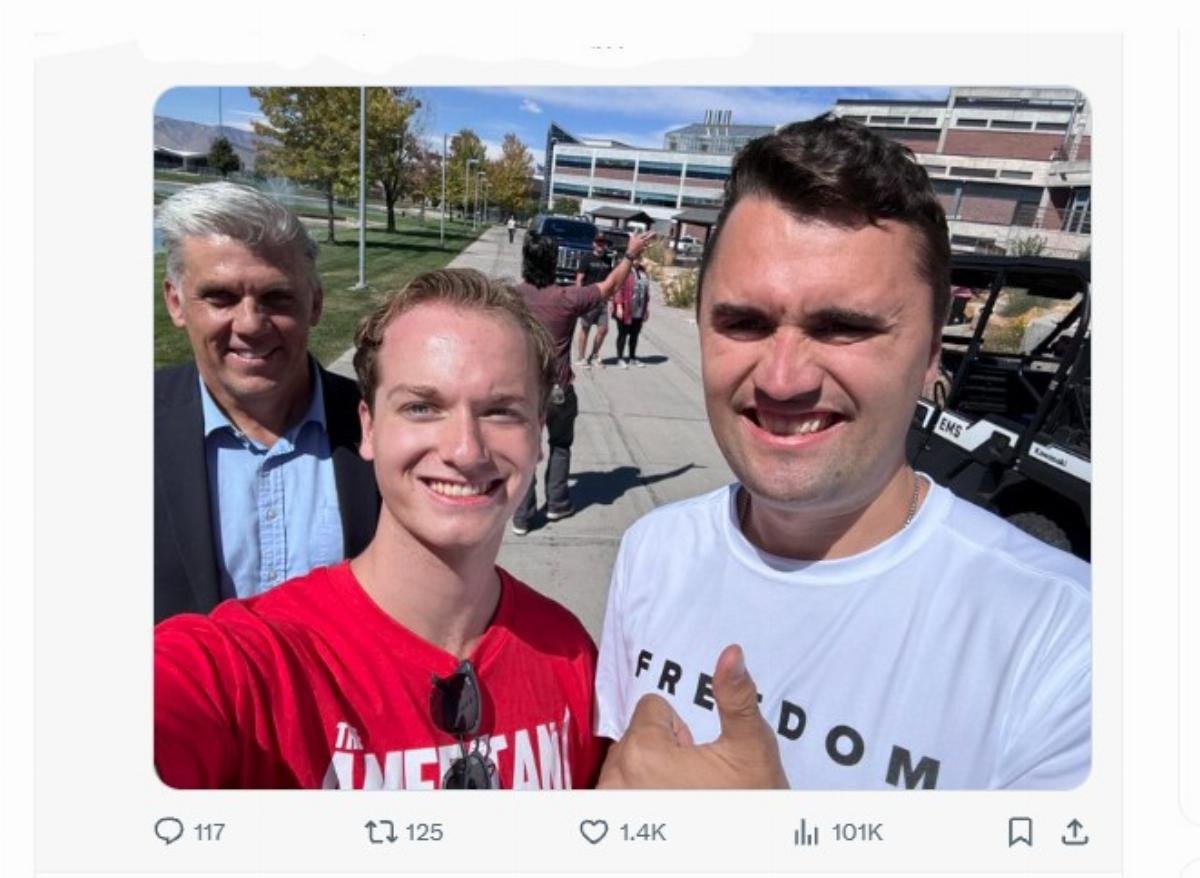
Two University of Utah students say the school is trying to expel them over a photo they posted of a woman who, they say, walked up to their campus booth and posed with a cake celebrating the assassination of Charlie Kirk. The case has become a flashpoint in the long-running fight over campus speech, with the university accused of punishing students for bearing witness to an act they found deeply offensive.
According to American Thinker, which published a detailed account of the episode on September 16, 2026, the students — Riley Beesley and Rylie Barnes — received a letter from the university notifying them that expulsion proceedings were being considered over what the school described as ‘threatening or endangering behavior.’ The outlet reports that the woman, identified elsewhere as Sara Larsen, complained to university authorities after the photo of her holding the cake went viral.
The confrontation, as described by American Thinker, took place when the woman approached the two College Republicans at a campus booth, thrust a cake described as a ‘Kirkiversary’ confection toward them, and posed for pictures. The students took a photo of the act and posted it online. The outlet notes that a photo of Beesley taken four minutes before Kirk was murdered has circulated widely since the 2025 shooting.
What the university is actually alleging
The distinction at the heart of the dispute is whether the students’ actions amount to doxxing. American Thinker argues they plainly do not: the students, according to the outlet, did not publish the woman’s address, did not post her name — which emerged later through other channels — did not reveal where she worked, and did not contact her employer or instructors. They simply posted a picture of what she did in a public setting, the outlet says, which then spread widely on social media.
The university’s rationale, per the source, rested on the woman’s claim that she no longer feels safe. American Thinker pushes back hard on that claim, writing that she appeared comfortable approaching a booth hosted by two Republicans who had recently lost someone they may have known personally, and that the act of presenting the cake was intended to cause distress rather than avoid it.
The outlet’s columnist, Monica Showalter, frames the underlying question as one of basic logic: if thrusting a cake that mocks a murder into someone’s face is permissible, while posting a photograph of that same act is an expellable offense, then the university has its priorities inverted. She characterizes the woman’s complaint as an attempt to weaponize campus authorities against speech she dislikes, and argues the episode is less about safety than about silencing a political viewpoint.
It should be noted that the characterization of the woman’s motives, the description of the cake’s message, and the account of the confrontation all come from American Thinker’s telling and from social media posts the outlet cites. The university has not publicly released the full letter described in the piece, and the outlet’s framing is openly adversarial toward the school’s handling of the matter.
Meeting canceled, questions remain
The story took a turn when, according to the outlet, the University of Utah canceled a scheduled expulsion meeting, citing ‘unforeseen circumstances’ and promising further information. American Thinker reported the cancellation as breaking news and speculated about whether the school had reconsidered its position, while cautioning that the development should not be read as a final resolution.
Showalter’s column argues the university is conflating two very different things: doxxing, which typically involves publishing private information such as a home address or workplace with intent to harass, and what she calls ‘recordkeeping’ — documenting a public act and sharing it. The students, in her telling, engaged in the latter. The woman approached them, in a public place, and made herself part of a public scene.
There is a broader legal context the piece gestures toward but does not fully litigate. Under First Amendment doctrine, publishing a photograph of someone taken in a public space is generally protected speech, and courts have been wary of treating public exposure of publicly performed acts as harassment. At the same time, universities have their own conduct codes, and ‘threatening or endangering behavior’ provisions can be broad enough to encompass student-on-student complaints that would be unlikely to survive a courtroom test. That gap between constitutional protection and campus disciplinary process is precisely where this case sits.
The outlet is careful to note the students’ own account of events, including their claim that the woman voluntarily approached their booth and posed with the cake. That detail matters because it cuts against any suggestion that the students ambushed or secretly photographed her. If she posed for pictures, the argument goes, she cannot reasonably claim the resulting image was an invasion of privacy.
What remains unclear is what happens next. The cancellation of the meeting may signal that the university is backing away from the expulsion threat, or it may simply be a scheduling matter. American Thinker expresses hope that the school will drop the case and, in its view, redirect whatever disciplinary energy it has toward the woman’s conduct instead.
The stakes beyond one campus
The dispute fits a recognizable pattern in recent campus controversies: a politically charged act, a viral image, a complaint to administrators, and a disciplinary process that becomes its own story. Each side in these episodes tends to accuse the other of bad faith — conservatives say universities selectively enforce speech codes against them, while administrators say they are obligated to respond to credible safety concerns raised by any student.
In this instance, the safety concern is abstract and reputational rather than physical. The woman told the university she did not feel safe after the image circulated, according to the outlet’s account. The students, meanwhile, argue they are the ones who were targeted by a deliberate provocation while mourning a public figure killed in their own state.
American Thinker’s closing note is a plea for the university to move quickly and, in its words, teach the woman some manners so she can avoid similar distress in the future. It is a rhetorical flourish rather than a policy proposal, but it captures the outlet’s central complaint: that a school which tolerates a cake celebrating a murder should not then turn around and expel the students who photographed it.
The university has not issued a comprehensive public statement responding to all of the outlet’s claims. Until it does, the episode remains a contested account — one in which the facts of who did what in a public space are largely undisputed, but the meaning of those facts, and the appropriate institutional response, are anything but.
Source: www.americanthinker.com — https://www.americanthinker.com/blog/2026/09/university-of-utah-targets-two-students-who-published-photo-of-leftist-celebrating-charlie-kirk-s-death-with-cake-for-doxxing/