
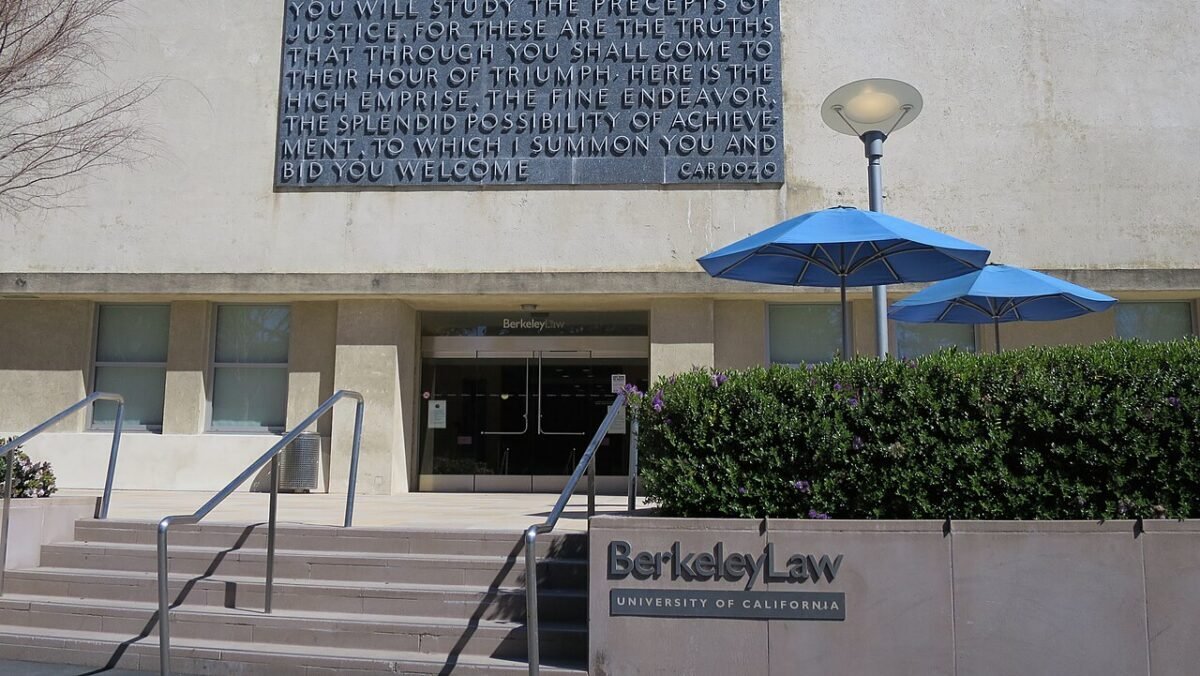
The Justice Department and the Department of Education have concluded that the University of California, Berkeley School of Law violated Title VI of the Civil Rights Act of 1964, finding the school discriminated against Asian and white applicants in its entering classes of 2024 and 2025 — two years after the Supreme Court restricted race-conscious admissions. According to The Federalist, the joint findings letter was dated Sept. 9 and cited the same statute Berkeley’s own faculty teach to first-year students.
The finding rests largely on numbers federal investigators pulled from Berkeley’s own files. After controlling for LSAT scores and undergraduate GPA, black applicants in 2025 had 5.8 times the odds of admission of similarly qualified white applicants, according to the government’s analysis. In 2024, that figure was 6.5 times. Median admitted LSAT scores those years were 172 for both Asian and white applicants, compared to 164 in 2024 and 167 in 2025 for black applicants. Half of the black students admitted scored below the 95th percentile of admitted white students, and more than a third scored below the 99th percentile.
The mechanism federal investigators identified
The findings letter points to an application prompt asking applicants how their perspective, experience, and voice would contribute to diversity. Berkeley allegedly sorted admitted students into sections by what it called a “primary identity.” The Justice Department characterizes that arrangement as a racial proxy. A school can consider how race shaped an applicant’s personal story, the department maintains, but it cannot use race itself — or something functioning as a stand-in for it — as a plus factor.
The backdrop is the Supreme Court’s 2023 decision in Students for Fair Admissions v. Harvard, which held that race-conscious admissions programs at Harvard and the University of North Carolina violated the Equal Protection Clause and, by extension, Title VI. That statute bars any federally funded institution from discriminating on the basis of race, color, or national origin.
The Federalist also cites a 2022 New Yorker interview in which Berkeley Dean Erwin Chemerinsky said colleges would need to “find ways to achieve diversity that can’t be documented as violating the Constitution.” The outlet frames that remark as advice on how to work around a controlling ruling without leaving a paper trail.
Berkeley is not an isolated case
The findings against Berkeley Law follow an almost identical set of conclusions the Justice Department announced regarding Duke Law in August, covering admissions cycles back to 2023. Medical schools have faced similar scrutiny: Yale, UCLA, and UC Davis came first, and in June the department opened 15 additional investigations into medical school admissions at institutions including Harvard, Johns Hopkins, and Stanford. The pattern extends across American legal and medical education, three years after the Supreme Court’s ruling.

Announcing the earlier probes, Assistant Attorney General Harmeet K. Dhillon of the Justice Department’s Civil Rights Division said too many top schools are “more concerned about the demographics of their incoming classes” than producing doctors who can do the job. The Federalist argues the same logic applies to lawyers and judges, noting that the professionals trained in these institutions may one day hold someone’s life or liberty in their hands.
Writing in the outlet, the author acknowledges that an applicant’s full story should not be excluded from consideration. A student who grew up picking crops alongside his parents, or who is the first in his family to attend college, brings something a spreadsheet cannot capture. But the piece draws a distinction between an essay about lived experience and constructing a prompt and rubric around race as a category — a line the author says Berkeley’s dean drew himself in his 2022 remarks.
What comes next for Berkeley
The consequences for Berkeley are expected to be civil rather than criminal. The Justice Department will likely offer a settlement involving new admissions rules, reviewer training, an outside monitor, and years of compliance reporting, and would sue if the school refuses to comply. The Federalist notes that real criminal exposure would require a separate offense — obstruction or false statements to investigators — rather than the discrimination finding itself, though the outlet argues the public paper trail creates genuine risk if records are destroyed.
The article’s author, who describes decades of experience testifying as an expert witness on fiduciary duty, compares the conduct to a breach of trust. A fiduciary, the author writes, owes duties of loyalty and care regardless of good intentions. An officer who knowingly violates a governing rule to pursue a preferred goal, then conceals the reasoning, does not get to call it a judgment call. The author applies the same standard to a law school dean, describing the seat at issue as belonging by law to whichever applicant earned it.
The proposed remedy, as outlined in the piece, is to tie continued federal funding to addressing a specific, proven finding of intentional discrimination, to hold administrators who wrote the admissions playbook personally accountable in any settlement, and to require recurring independent audits at any school caught once — modeled on how a bank that fails an anti-money-laundering exam does not grade its own homework the following year.
The deeper concern raised is institutional credibility. Law schools exist to train the next generation of judges, prosecutors, and general counsels, and the author argues that one of the country’s best-known law schools is currently demonstrating how to work around the rules while hoping no one reads the syllabus.
Source: thefederalist.com — https://thefederalist.com/2026/09/16/doj-goes-after-berkeley-law-for-discrimination-against-white-applicants/