
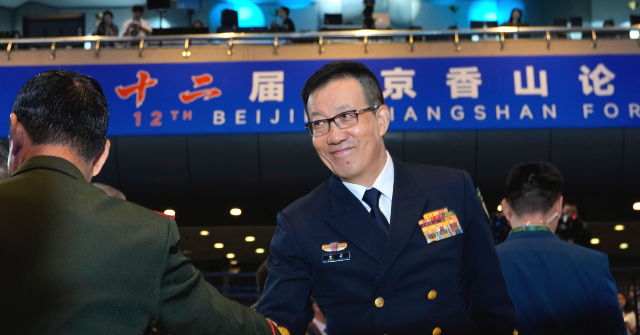
China’s flagship annual defense gathering, the Beijing Xiangshan Forum, wrapped up Thursday after three days in which roughly 2,000 attendees wrestled with the security risks of artificial intelligence and autonomous warfare — even as the host government used the stage to aim barbs at Japan.
Now in its 13th year, the forum is billed by Beijing as a venue where “small and medium-sized countries” can weigh in on defense matters. Launched in 2006 as a counterweight to the International Institute for Strategic Studies’ Shangri-La Dialogue, the two events draw heavily overlapping guest lists, according to Breitbart News.
AI and drones shorten the clock on human decisions
With regional theatrics aside, a recurring theme in the corridors was technological: drone warfare and artificial intelligence. A concern voiced repeatedly was that AI and drone systems are accelerating the pace of conflict, compressing the time available for human deliberation and raising the odds of unintended escalation.
Pakistani Defense Secretary Muhammad Ali warned that AI speeds up decisions while disinformation and misinformation can fracture public trust before governments are able to respond effectively.
International Committee of the Red Cross Vice President Jurg Lauber echoed that anxiety, saying that as weapon systems grow more autonomous, preserving human judgment and control over the use of force becomes more pressing.
Singapore’s defense minister, Chan Chun Sing, described a technology race that is heating up across artificial intelligence, space and robotics — with major advances now arriving in days rather than years. He framed the central question as one of statecraft: how to strengthen one’s own security without weakening others or aggravating their insecurity.
Dong’s warning and a message aimed at Tokyo
Chinese Defense Minister Dong Jun used his address to call on all nations to avoid provocative acts and to curb what he called latent manifestations of hegemony, militarism and historical revisionism. The remarks were not directed at Iran, which drew criticism from Saudi representatives at the forum over its attacks on Middle Eastern neighbors. Instead, Dong’s language was widely read as a thinly veiled shot at Japan.
Tensions between Beijing and Tokyo have run high since Japanese Prime Minister Takaichi Sanae suggested Japan might respond to a Chinese attack on Taiwan. Chinese officials have since engaged in what critics describe as fearmongering about resurgent Japanese militarism.
Dong also urged nations to actively engage in security dialogue on artificial intelligence, outer space and the deep sea. He and other Chinese officials, including Vice President Han Zheng, expressed support for global governance rules covering emerging technology domains.
Washington’s presence and an unresolved accusation
The United States sent a delegation to the forum, led by Brig. Gen. Stacy Kihara, a senior defense official at the U.S. embassy in Beijing. Her attendance came amid heightened friction over technology: Washington recently accused China of stealing AI technology from American companies on a massive scale, a charge Beijing denies.
Attendees were also watching for whether bilateral progress on military technology issues might emerge when Chinese leader Xi Jinping visits the United States for meetings with President Donald Trump on September 24.
Whether the forum’s talk of guardrails for AI and autonomous weapons translates into concrete rules remains an open question. For now, the conversations in Beijing suggested that even as governments seek common ground on emerging tech, the race to field it is outpacing the effort to govern it.
Source: www.breitbart.com — https://www.breitbart.com/tech/2026/09/17/ai-fears-cloud-chinas-premier-annual-defense-conference/